Perry and Almengor, her baking/pastry counterpart, are the heart of LLCC’s Culinary Institute teaching staff. But they have great in-class support from experienced assistants such as Terri Branham, Nina Rossini, and Ryan Lewis, who, along with Perry and Almengor, provide critical handson help and demonstration of proper technique in each class.
There are other critical factors for a chef and restaurant to be successful. Culinary knowledge and the ability to produce delicious dishes – and to do so consistently – are crucial. But equally important is that chefs and owners have at least some business background. At the very least they must be aware of the relationship between costs and expenditures, and what that relationship has to be for a restaurant to succeed.
At LLCC’s Culinary Institute, teaching those restaurant business realities largely falls to Randy Williams. Initially I thought Williams’ class would be boring, one of those nuts-and-bolts courses that college students have to muddle through to get to more interesting topics. That idea seemed to be confirmed the first time I walked through Williams’ class, held in the LLCC Culinary Institute’s dining room. I was heading home from the pastry/baking lab. The dining room was deathly silent; the students’ heads bent low. “They’re taking a test,” whispered Williams as I tiptoed out.
But Williams’ reality reared its head on my next visit. Loud, no, extraordinarily loud music blared from speakers. A giant screen flashed images so rapidly that they seemed less pictures than strobe-light effects in the dark ened room. The students seemed silent this time too although, given the noise level, I might have been too distracted to hear them.
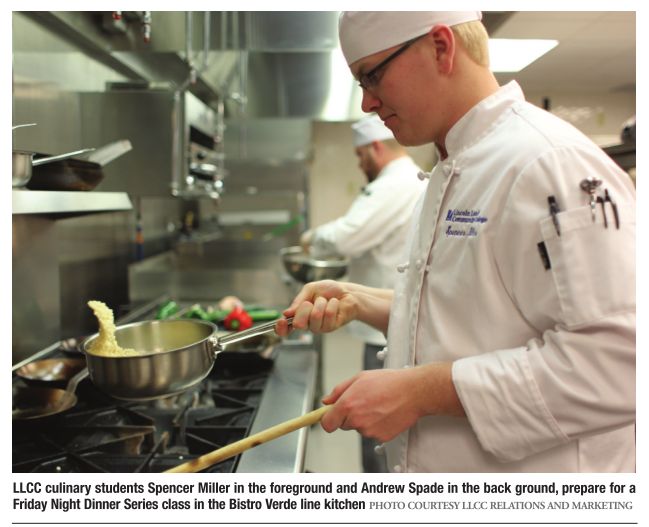
They hadn’t been silent. I also hadn’t seen their hand-held flashlights or candles, or that they’d huddled together in teams, trying to answer Williams’ questions on handouts. Having to come up with responses in spite of the darkness, blaring music, and light show was Williams’ whole point: the importance of keeping focused on those occasions when chaos and confusion threaten to overwhelm even those who are most prepared. Organized chaos is pretty much what it’s like in restaurant kitchens, especially at peak times.
There’s a rush of satisfaction/adrenaline when everybody is working together and pulls it off, but the term for when that doesn’t happen is, in English, being “in the weeds,” in French it’s “dans la merde.” It’s one of the long-standing truisms of the restaurant business. Williams delights in mixing hardcore nuts-and-bolts restaurant operational knowledge with more esoteric how-tos, not least because he knows his students will have to cope with the unexpected situations/mishaps/crises that are part and parcel of the restaurant business. His enthusiasm is demonstrably conveyed to his students who, when called upon, can immediately repeat such “Randyisms” as “Only training half your staff will cost you half your profits,” or “You can’t go broke in too small a shop with too much business.”
For Kitterman, the new LLCC Culinary Institute is the culmination of a long-held dream. But that dream-turned-reality was just the beginning. LLCC’s Culinary Institute will grow and evolve, not just in more classes with professional instructors and expert lecturers, but also with community involvement and support. I can’t wait to see how it develops.
Contact Julianne Glatz at [email protected].