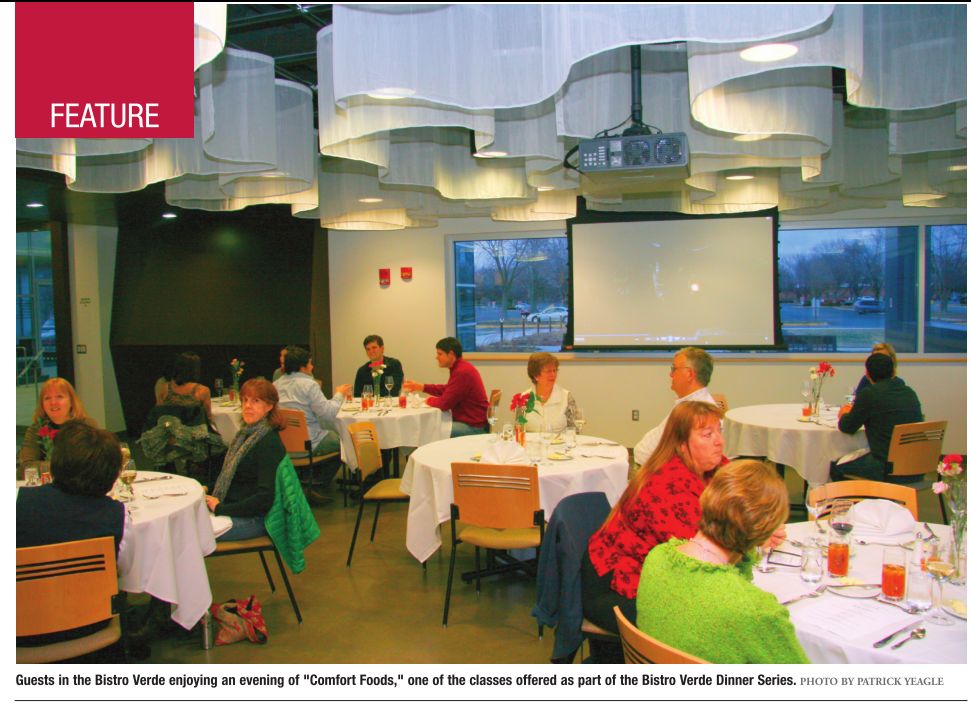
Down a hallway lined with supply pantries, staff office space and refrigerated and freezer walk-ins is the baking and pastry kitchen. It’s as spacious as the food production kitchen and also has student work counters and monitors on three sides of the room.
But here the locus is a long worktable for the instructor to demonstrate the exacting science of sweet and savory pastry and baking. Behind the instructor’s area are convection ovens (convection ovens circulate their heat via a fan, which makes food cook more quickly and evenly at a lower temperature), a stove top, and a large upright freezer-size proofing box that regulates heat and humidity to create an ideal environment for raising yeast doughs. Instead of stoves lining the walls there’s storage for a comprehensive repertoire of baking and pastry utensils, from molds for making chocolates, baking tins of all sizes and shapes, to a mound of heavy wooden rolling pins.
When I first toured LLCC’s Culinary Institute, I was almost dazed, feeling as if I’d stepped into a culinary wonderland. But in a practical portion of my brain, I kept hearing a constant cha-ching, cha-ching, as I mentally added up the cost of the state-of-the-art equipment. I’m not an expert about restaurant equipment and supply pricing, but know enough to realize that serious money had been spent.
In fact, the Culinary Institute’s equipment costs were around a million dollars. And that’s just for the equipment. Specific numbers for the Culinary Institute’s physical space aren’t available, but the entire Workforce Careers Center project, which broke ground April 1, 2010, cost $26.1 million. Kitterman and other LLCC officials are proud that the entire Workforce Careers Center was paid for by a bond issue rather than a tax increase.
The LLCC Culinary Institute’s setup, although smaller, can easily hold its own against big-name culinary colleges, such as The Culinary Institute of America, which has campuses in upstate New York and California’s Napa Valley (where I attended classes), and Chicago’s Kendall College. Those big-name culinary schools do provide their graduates with a certain caché, although not one that automatically guarantees a higher starting salary. And that caché comes at a hefty price: the cost for a CIA associate degree is currently $59,305, which averages out to $14,826 per semester. At Kendall it varies, depending on students attending
either full or part time, but the average cost of an associate degree is $44,190. The cost for an associate degree from LLCC’s Culinary Institute pales by comparison. Students pay $150 per credit hour, which means that fulltime students taking a full 16-hour class load pay just $2,400 per semester and $ 9,600 for their two-year associate degree.
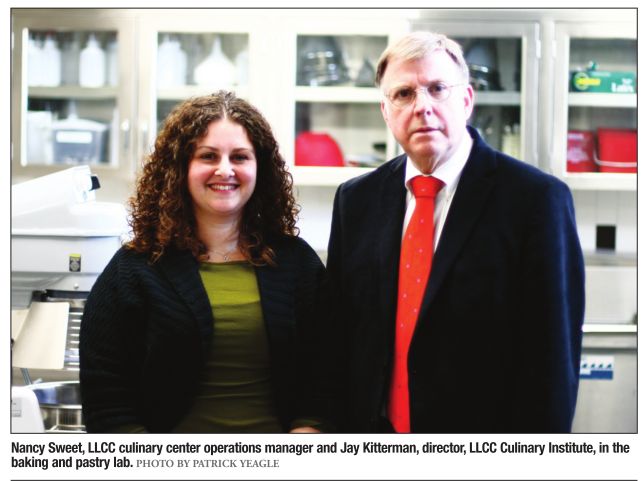
Kitterman remains the titular head of LLCC’s Culinary Institute. But the move to the new state-of-the-art facility and its expanding expectations for both enrollment and course offerings necessitated that his job be split in two. Beginning last month, Kitterman is responsible for non-credit classes open to the general public; Nancy Sweet now oversees the for-credit classes.
Sweet’s background made her uniquely qualified for the position. While working towards a business degree at University of Illinois Urbana-Champaign, she realized that she wanted to work in the food industry. She pursued graduate studies at Johnson and Wales University, whose culinary department maintains a (mostly) friendly rivalry with the CIA for the designation as America’s top culinary college.
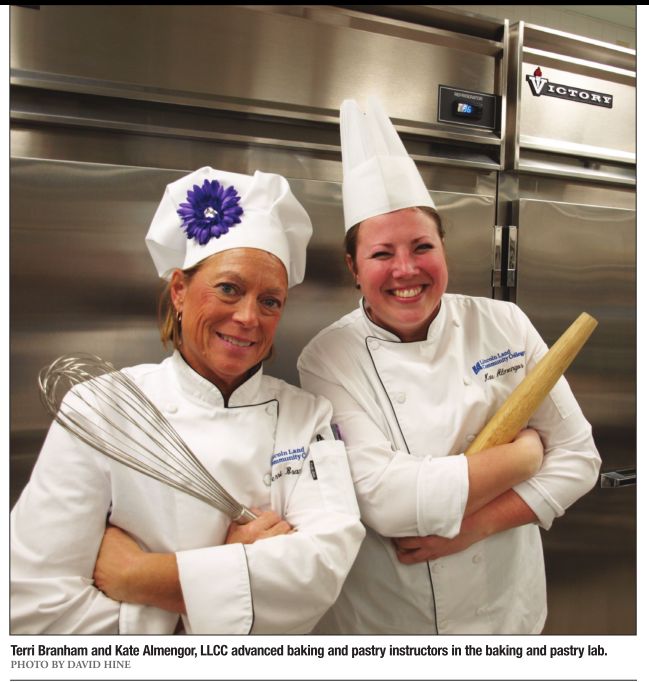
While they’re committed to expanding LLCC culinary class options, for this first semester in the new facility Sweet and Kitterman didn’t add any additional for-credit classes, realizing that not only they themselves, but also the instructors and students needed to get settled in and adjusted to their new quarters, and, not least, all that state-ofthe-art equipment. Their wisdom in so doing was obvious in the first class I observed, an advanced pastry and baking class taught by chef Kate Almengor and her assistant, Terri Branham. The topic of that day’s class was chocolate, and as I entered, the students were busy filling molds with dark, milk, and white chocolate and preparing other bite-sized treats for a reception showcasing the new LLCC facility and its partnership with the Illinois Wine Growers and Vintners Association. The unmolded chocolates were perfect, but for the other desserts the baking time and temperature of the powerful convection ovens needed adjusting.
My perceptions about the students attending for-credit classes needed adjusting as well.
When I initially referred to them as kids, Kitterman winced: “Actually they’re not all kids, not by a long shot.”
He was right. In that first class, young adults well out of high school, and middleaged-to-older folks constituted a significant segment of the roster. Some, such as Liz Sheedy, signed up for LLCC cooking classes because she was “frustrated” with cooking; since she’s retired she figured she might as well take for-credit classes. Others are in training for a second career, such as Diann Haas, who’d been laid off from her long-term job in Litchfield at a factory that made brake parts whose operation was moved to Mexico and China. “I started out at LLCC thinking that I wanted to have my own catering business,” Haas says. “But I discovered that I really love baking and pastry, so that’s become my focus.”
Other for-credit classes I visited also had mixed ages. More than one student had been in the military. John Weck served in the National Guard Reserves, and spent time in Georgia and Florida as well as overseas. The posting that spurred his desire to cook professionally was in Louisiana; his dream is to have a Cajun food truck.
Weck says that attending classes in LLCC’s new Culinary Institute has been a life-changing experience. “Unless you go into a new restaurant [kitchen], you’ll never see anything like this.”
Andrew Spade’s background is in the U.S.
Navy. It gave him not only his first taste of professional cooking, but also a preference to cook for officers and their (relatively) upscale fare, rather than for the general mess. Spade travels to Springfield from Carrollton, 70 miles away, to participate in LLCC’s Culinary program specifically because he’d learned about its new state-of-the-art facility.
Though Spade and every other for-credit student with whom I spoke raved about LLCC’s new culinary home, they were without exception even more enthusiastic about its chef/instructors: baking and pastry chef Kate Almengor and Denise Perry, who teaches other food production classes.
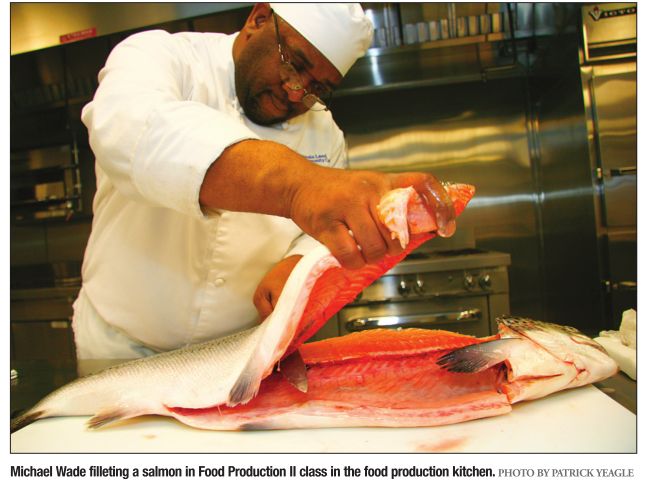
“The best part of Lincoln Land’s program is the knowledge of its instructors,” says Spade. “It’s nice to have that amount of knowledge for beginners.” “She [Perry] is just an amazing, amazing instructor,” says student Ashley Glasscock. “She can answer any question, and she’s very patient.”


