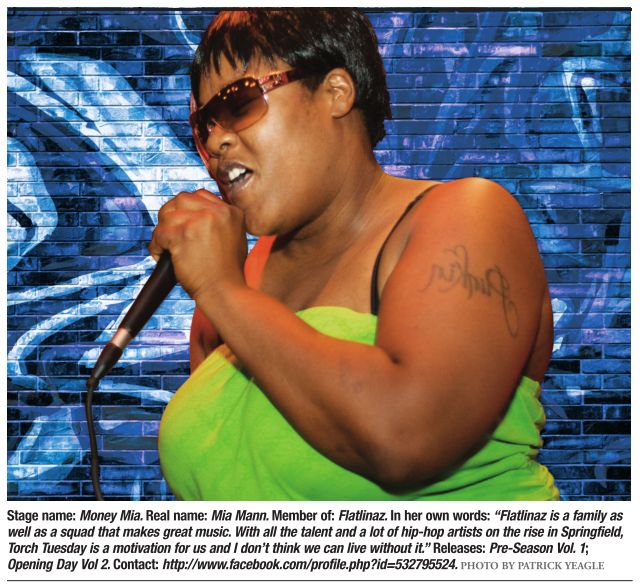
“Even last winter, in the worst of the blizzards, when the streets were shut down and nothing was happening, we still had performers showing up on Tuesday night,” he says, still amazed at the memory. “I almost didn’t make it out myself, but when I got here and saw who all had shown up, I was really glad I did. I mean, that’s dedication.”
Tomas first moved to Springfield from his hometown of Chicago in 1995, after having left Tuskegee University and finding things a little rough back in the Windy City. “A lot of the guys that I grew up with were getting involved in…a lot of different things and I just felt like I needed a change of scenery,” he recalls. His aunt was a member of the Springfield Coalition of Black Attorneys, and after relocating to central Illinois, the young Torch initially stayed with her while picking up classes at Lincoln Land Community College.
Longing for the hip-hop culture that was so much a part of daily life back in Chicago, Tomas did what he could to find what his new environment had to offer. “I started meeting people here in Springfield and I was looking for a hip-hop scene,” says Torch, who was primarily a rapper at the time. “It didn’t seem like too much was going on. But I basically started meeting other guys, doing cyphers and freestylin’ and such. I used to battle against a lot of guys, started getting a little rep.”
During this period, Torch found himself testing his verbal skills alongside a number of respected old school area rappers, including Entourage, Greg the Architect and B-Dog the Gambino. In 1999, though, he landed a job managing a bar in St. Louis, and quickly found himself absorbed in the much larger, metropolitan hip-hop scene there. Still, it wasn’t long before other considerations brought him back to the Land of Lincoln.
“In 2001, my daughter was born and I moved back,” explains Torch. “And what happened was, I brought some of the fuel I had from St. Louis with me to Springfield, and that’s when things started picking up a lot, for myself and for the hip-hop scene here.”
One thing that fanned Torch’s flame was anger at witnessing the blatant way Springfield clubs were then exploiting local hip-hop artists. “A lot of the clubs, like 217, they wouldn’t have any open mics, but they would bring national artists like Eightball & MJG or Scarface or Lil Wayne to Springfield and then would actually charge local performers to open up for these bigger acts. And I had a problem with that. It was like, ‘wow, these guys are coming here and you’re charging us like three-hundred bucks to open for them?’ Which obviously was just helping the club to pay these out-of-town guys. It was highway robbery.”
Determined to find a venue for local hiphop artists to thrive without the threat of extortion, Torch began cultivating relationships in the overall Springfield music community. “I kept building to the point where I got to know guys in some of the different rock bands, like Damwell Betters, Lazer Dudes, Nil8, Bonards. Eventually I pitched the idea to [Bar None manager] Josh Catalano about a hip-hop open mic. He said: ‘You know what? It’s a wild idea, there’s a lot of risk involved on the business side. But it’s so crazy that it just might work.’ And so a year and a half later, here we are. Torch Tuesday is going strong.”
[SOUND EFFECTS: break-beat music shifts from jazzy to a mid-tempo groove, under]
continued on page 14