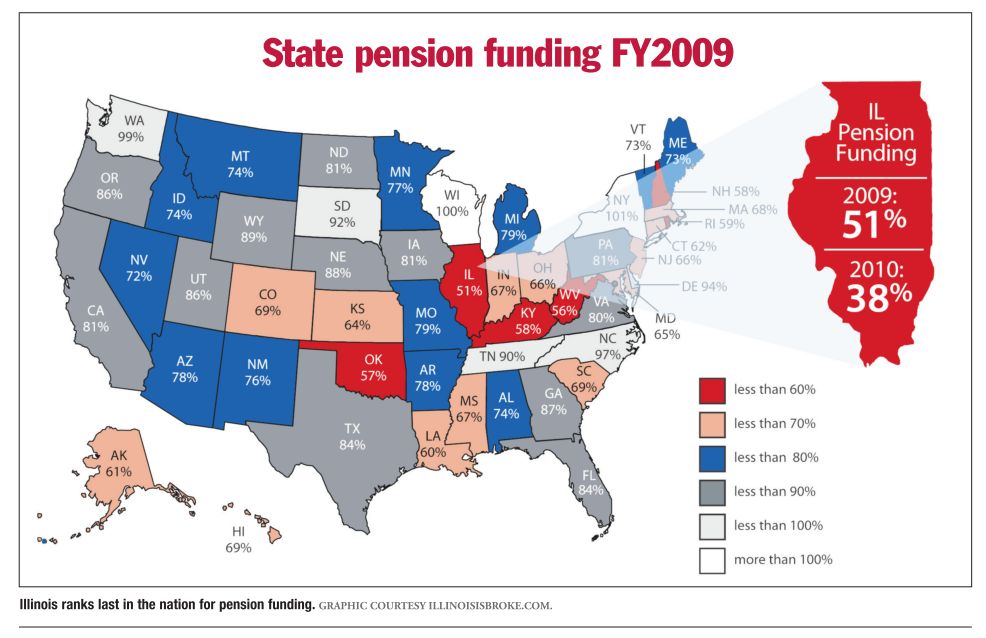
The changes proposed in Senate Bill 512 would offer three choices to tier one employees – pay a larger portion of salary to receive the same benefits, pay less and receive lower benefits after working longer, or enroll in a 401ktype program with no defined benefits, only defined contributions. No current retirees would be affected and new employees would not have tier one benefits as an option.
For tier one TRS members who want to continue with their current benefits, instead of paying 9.4 percent of salary, as they do now, they would pay 13.77 percent in the first three years of the new three-tier system. Their contribution requirement would be reassessed as time went on, but TRS executive director Richard Ingram says it would only eat up more of teachers’ salaries.
Ingram says that after the first three years, teachers’ rates could increase to 15 or 16 percent, with eventual worst-case scenarios reaching nearly 25 or 26 percent – about one-quarter of a teacher’s overall salary. Scheibe, who earns about $48,000 each year and has at least another 10 years before retirement, says those increases are significant. “Of course that’s going to be a scary option. It would be an even more scary option if I were –Will Lovett, Illinois Education Association still single, on my own,
trying to survive on one income,” she says. “When you’re talking about
taking an extra five percent out each year, it’s a lot more difficult to
survive.”
“The three options, they’re all very bad options for our members.”
With the current teachers retiring or switching plans if they’re unable to afford higher rates, eventually tier one benefits would be phased out. The same would be true for the other pension systems, though the rates would vary from system to system.
Will Lovett is a lobbyist for the Illinois Education Association, which opposes SB 512. “The three options, they’re all very bad options for our members,” he says, noting that teachers, who don’t pay into Social Security, rely on the current retirement system for stability. The tier three 401k-type option would leave them with nothing should the economy turn sour, he says.
Besides, Lovett says, teachers have done their part all along. “Our membership feels strongly about protecting their retirement. They feel that they’ve never missed a pension payment and they feel unfairly penalized for something that was never their fault. The state is coming back with this type of legislation and saying, ‘We, the state, didn’t live up to our obligations, but we’re going to stick you with our credit card bill.’” Lovett says public pensions in Illinois are not overly generous as they are now, just decent and about on par with other states. “In this economy, retirement packages and total compensation packages really do play into the kind of people you can bring into the classroom,” he says, suggesting that quality teachers could choose other states with better benefits should Illinois approve SB 512. If SB 512 were implemented, the state could cut its eventual 2045 pension bill by almost half, Fahner says. Instead of taking up nearly 50 percent of the state’s primary revenues in 2045, pensions would only require about 26 percent of those revenues, meaning fewer public services would be crowded out in favor of pension payments.
The entire argument could be moot, though, if the proposed legislation turns out to be unconstitutional, as lawyers for Senate President John Cullerton’s office are predicting. They cite a provision written into the Illinois Constitution
during the 1970 Constitutional Convention: “Membership in any pension
or retirement system … shall be an enforceable contractual relationship,
the benefits of which shall not be diminished or impaired.”
continued on page 14