A grand reawakening for the Illinois River wetland wildlife preserve
CONSERVATION | Jeanne Townsend Handy
In 2000, The Nature Conservancy purchased 7,100 acres of farmland approximately 55 miles northwest of Springfield near Havana and Lewistown, Ill., with the intent of returning it to a semblance of its former state. It would be one of the country’s largest wetland restoration efforts. This land in the Illinois River Valley was given a new name – Emiquon – chosen in tribute to the Native Americans who had inhabited the area in the ancient past. On my first visit in 2004, with the restoration efforts still in the planning stage, I found myself staring out at barren fields and abandoned farm structures, trying my best to imagine the scene described by Stephen Forbes in 1896 – a scene The Nature Conservancy hoped to replicate.
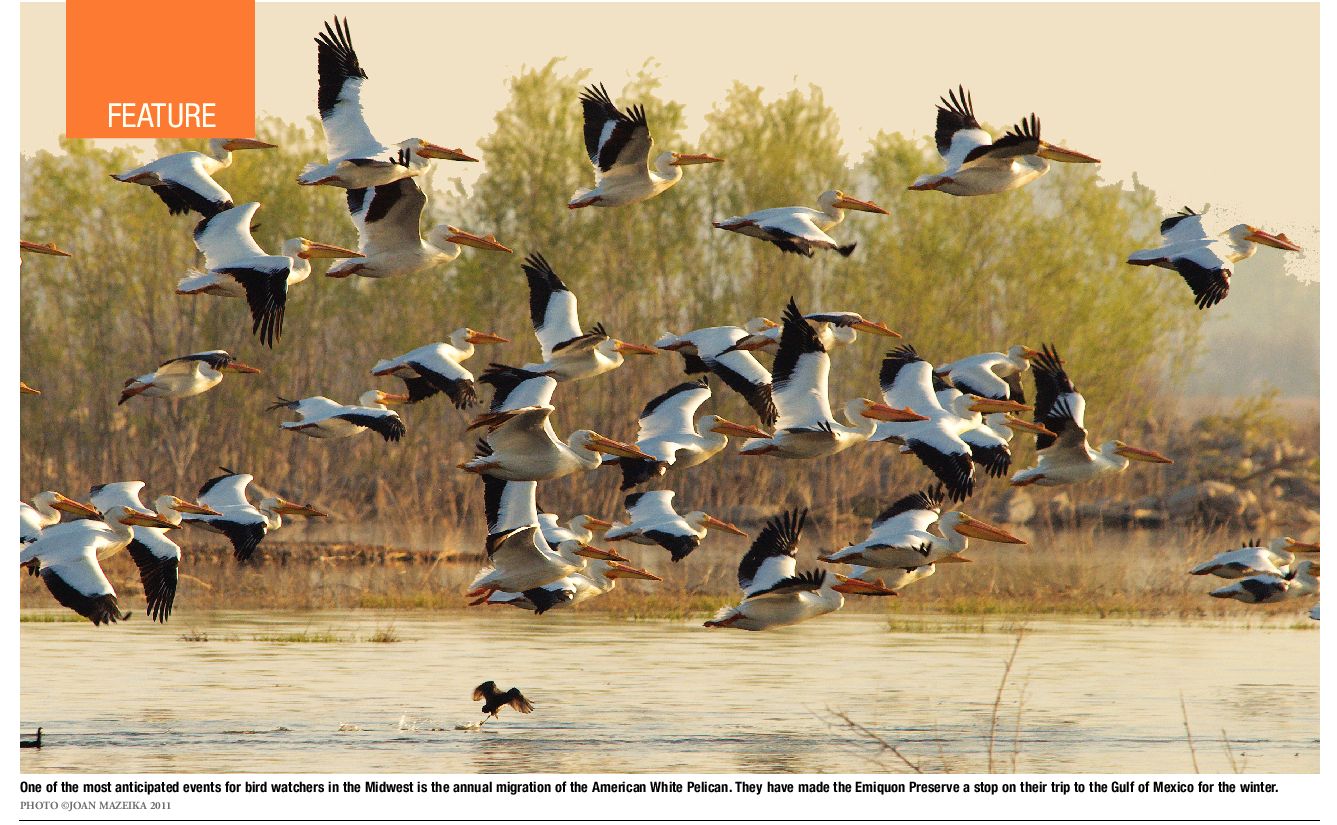
On June 4, 2011, the day marking the grand opening of the Emiquon Preserve, no imagination is needed.
It is a day of blazing sun and blazing temperatures, yet a crowd of people gathers to celebrate the return of water, wildlife and the opportunity to witness a sight once Illinoisans thought would never be seen again. We head across a new boardwalk that juts into the restored Thompson Lake and make our way toward the Wetland Observatory, which is temporarily acting as an elevated podium upon which are seated today’s speakers – a sampling of the people involved in the collaboration
behind the transformation. There are many others who have been involved in the restoration mingling amongst the crowd and manning booths set up to display the opportunities presented by this site. The only thing hard to imagine now is the work that has been involved in returning farmland to wetland.
To understand the magnitude of the project, it is important to recall the area’s history.
The shallow lakes and
swamps are glorious in their season with the American lotus and the
white water lily. Waterfowl abound, and fish lie in the shallows,
basking in the summer sun.
–Stephen Forbes, Illinois Natural History Survey, 1896
It stretches back 12,000 years to the Native Americans who first inhabited the area, drawn here seeking the sustenance provided by the wildlife. Waterfowl gathered here in tremendous flocks, and the floodplain acted as a nursery where plankton and many species of fish reproduced. Their young would move into the river system to create fishing so bountiful that in the early part of the 20th century the Illinois River harvest accounted for 10 percent of all fish harvested commercially in the United States. Some called it the fishing capital of the world.
It was natural that the sportsmen would follow the wildlife to what was then called Thompson Lake, but so too did the scientists. Amazingly, this area acted as the birthplace of both modern archaeology and modern ecology. It was in Havana that Stephen Forbes, “a giant of American ecology,” initiated biological investigations in 1876.
Eventually the fertility of the soil presented a lure too great to resist, and in 1924 the lakes and wetlands were drained, levees were built that separated the river from its floodplain, crops were planted and bottomland hardwood forests were cleared. The lake would be transformed into farmland – and farmland it would remain for more than 80 years.
No one disputes the importance of agriculture to Illinois and its people, yet The Nature Conservancy found an incredible opportunity
continued on page 14