Students with disabilities overcome obstacles to graduate from UIS
EDUCATION | Holly Dillemuth
They told her she shouldn’t even be in college.
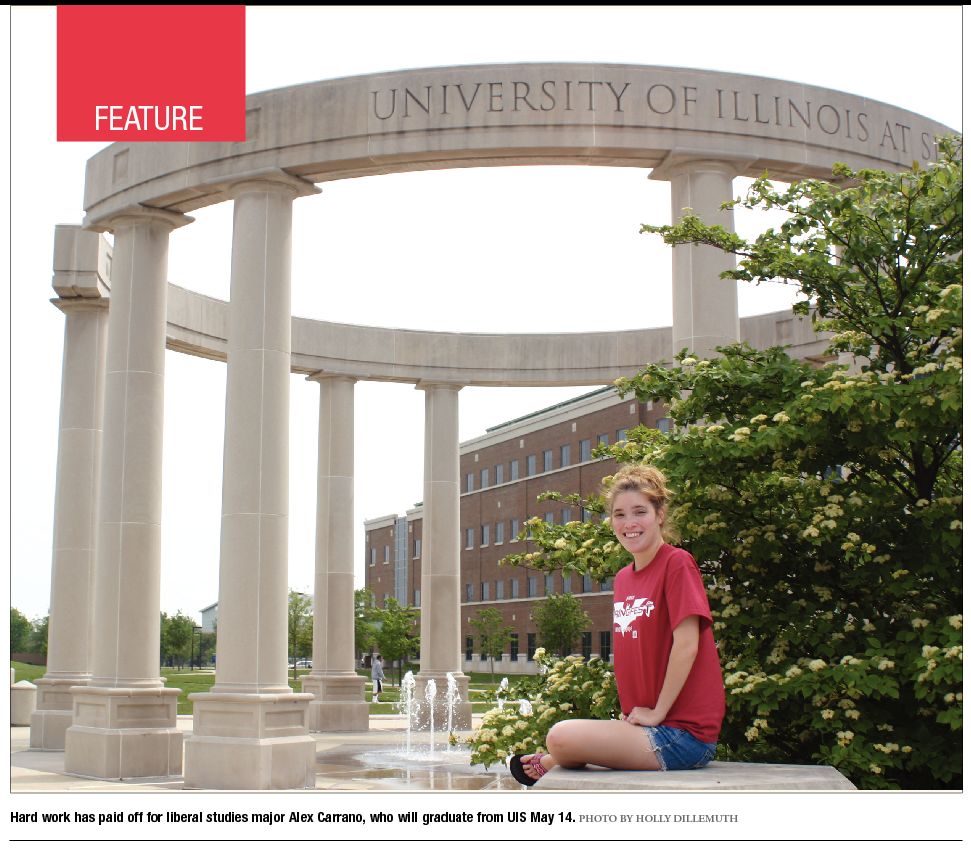
That’s the advice Alex Carrano, 24, received from staff to deal with her learning disability and test anxiety at a former university before she transferred to University of Illinois Springfield. But Carrano, originally from LaGrange, a Chicago suburb, will prove them wrong May 14 when she walks across the stage at the Prairie Capital Convention Center to receive her bachelor’s degree in liberal studies.
“I think about that and it brings me down a little,” says Carrano. “But since UIS, I haven’t had any problems. They’ve definitely been willing to help.”
With help from the Office of Disability Services at UIS, she is one of 40 students with a diagnosed disability who will graduate with a bachelor’s degree or higher.
The number of graduates with disabilities is up at UIS by 33 percent from 2010, when 30 students with disabilities graduated from UIS. Twelve students with disabilities graduated in 2009, according to ODS staff. The numbers show that more students are willing to step forward to get help than in years past.
“What we have to remember is that students who get accepted at UIS get accepted in the way everyone else is accepted,” says Suzanne Woods, visiting director at ODS. “So if they didn’t have the wherewithal to be a student here, they wouldn’t be accepted.”
Several days a week, Carrano comes into the office to work on papers or take exams. It is where she completed her finals the week before graduation. The computer lab is quiet and copies are free to registered ODS students. During the semester, learning specialist Kim Rutherford devised a plan to keep Carrano on track for graduation and she is now earning all B’s.
“You’ve just got to believe in yourself and continue on and not really care what other people think,” Carrano says. She plans to intern for a funeral home after graduation.
Learning disabilities like test anxiety are often hard to diagnose.
“Invisible disabilities are disabilities that are not apparent to the eye, so many times people don’t realize a student has a disability,” says Woods.
Woods says invisible disabilities like test anxiety and dyslexia have become much more common at ODS since 2007 when she came to UIS. There were 54 students registered as having a disability in 2007 and 270 students in the spring of 2011. More than 80 of those have a psychological disability.
The office’s budget of $139,000 includes $117,000 for salaries for three paid staff, which leaves approximately $22,000 for office programs and materials. The Department of Rehabilitation, an arm of the Department of Human Services, used to pay for note-takers and interpreters for ODS, until money ran out.
The staff requests money from student government each school year to supplement costs, but is not funded by student fees like many other student organizations because services must be made available to students by federal law.
“All of our accommodations are based on what the student needs to help them be the most successful in class,” says Woods.
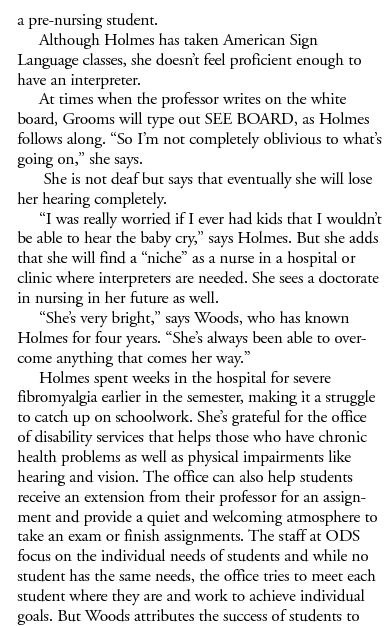
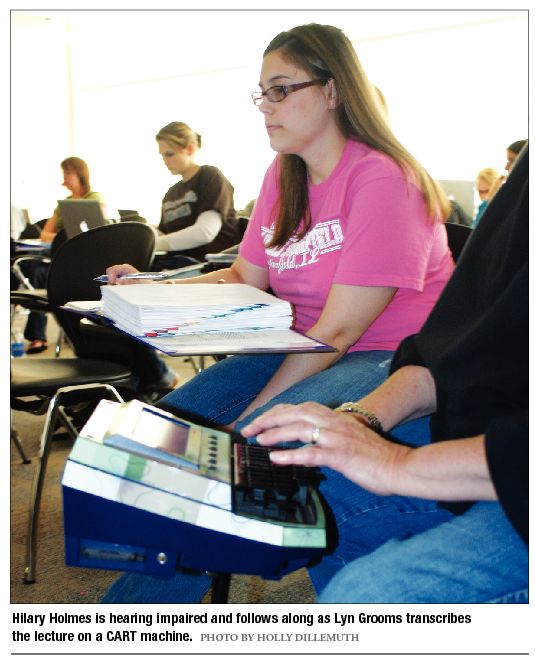
Even when she is wearing bright purple hearing aids, it’s often hard for people to realize that Hilary Holmes, 23, is hearing impaired.

their determination.
continued on page 18


