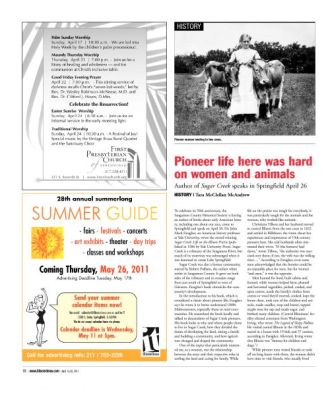
Pioneer life here was hard on women and animals
Author of Sugar Creek speaks in Springfield April 26
HISTORY | Tara McClellan McAndrew
To celebrate its 50th anniversary, the Sangamon County Historical Society is having an author of books about early American history, including one about our area, come to Springfield and speak on April 26. Dr. John Mack Faragher, an American history professor at Yale University, wrote the award-winning Sugar Creek: Life on the Illinois Prairie (published in 1986 by Yale University Press). Sugar Creek is a tributary of the Sangamon River, but much of its waterway was submerged when it was dammed to create Lake Springfield.
Sugar Creek was also a former community, started by Robert Pulliam, the earliest white settler in Sangamon County. It grew on both sides of the tributary and its remains range from just south of Springfield to west of Glenarm. Faragher’s book chronicles the community’s development.
In the introduction to his book, which is considered a classic about pioneer life, Faragher says he wrote it to better understand 1800s Midwesterners, especially those in rural communities. He researched the book locally and talked to descendants of Sugar Creek pioneers. His book looks at why and where people chose to live in Sugar Creek, how they divided the duties of developing the land, raising a family and building a community, and how agriculture changed and shaped the community.
One of the topics that particularly interested me, as a woman, was the relationship between the sexes and their respective roles in settling the land and caring for family. While life on the prairie was tough for everybody, it was particularly tough for the animals and the women, who worked like animals.
Christiana Tillson and her husband moved to central Illinois from the east coast in 1822 and settled in Hillsboro; she wrote about her experiences and impressions of 19th century pioneers here. She said husbands often mistreated their wives. “If (the farmers) had slaves,” wrote Tillson, “the authority was exercised over them; if not, the wife was the willing slave.…” According to Faragher, even some men acknowledged that the frontier could be an enjoyable place for men, but for women “and oxen,” it was the opposite.
Men hunted for food, built cabins and farmed, while women helped farm, planted and harvested vegetables, picked, carded, and spun cotton, made the family’s clothes from cotton or wool they’d weaved, cooked, kept the house clean, took care of the children and animals, made candles, soap and butter, tapped maple trees for sap and made sugar, and birthed many children. (Central Illinoisans’ fertility elicited comment from Washington Irving, who wrote The Legend of Sleepy Hollow. He visited central Illinois in the 1830s and stayed in a house with 19 kids and 37 canines, according to Faragher. Afteward, Irving wrote that Illinois was “famous for children and dogs.”) While pioneer men visited friends or took off on long hunts with them, the women didn’t have time to visit friends, who usually lived several miles away. One
such pioneer wife recorded that she only left her neighborhood three
times in four and a half years. Men were able to play because their
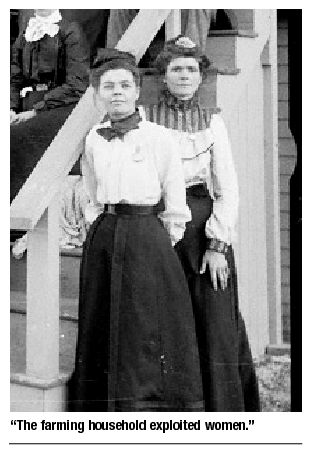
wives were taking care of things at home. “The farming household
exploited women as wives, and this constituted a central dynamic of the
social system,” Faragher writes.
In
contrast to their Kickapoo Indian counterparts, the pioneer women had
it much worse. (Sugar Creek was a seasonal home to the Kickapoo before
the whites moved there.) Faragher outlines how the Kickapoo women had
more rights and less responsibility. The family goods and everything the
men brought home from the hunt, outside of his hunting tools, belonged
to the women. Unlike the white women, Kickapoo women controlled their
reproduction through a variety of means and averaged only four children
each. In addition, Kickapoo wives could, and often did, divorce husbands
they felt were lazy or cruel. By comparison, they seemed downright
liberated compared to their downtrodden white sisters, who aged
prematurely as a result, according to contemporary accounts.
Faragher will speak
about “Small Places, Wider Worlds: Sugar Creek and Settler Colonialism
in North America” on April 26 at 7 p.m. at the University of Illinois
Springfield’s Brookens Auditorium. His lecture is free and open the
public.
The Sangamon County
Historical Society is holding a reception with Faragher for SCHS members
and their guests before his talk, from 5:30 to 6:30 p.m. in UIS’ Public
Affairs Center restaurant. Tickets, which include hors d’oeuvres, are
available for the reception for $18 before April 18 and $23 after that
date. If you are not an SCHS member, you can attend the reception if you
join the Society and buy a ticket. To order a ticket, send your check
to: Sangamon County Historical Society, 123 South 7th St., Suite 402,
Springfield, IL 62701.
Contact Tara McClellan McAndrew at [email protected].