The longest war
continued from page 15
Higher-ups in the battalion command structure had to check maps to see whether the insurgents’ position was too close to any buildings. If it had been, permission to fire would have been denied. Abu Company knew that, in this case, there were no buildings around.
In the meantime Griechen had heard the medic call. He was about 100 yards from the command post, and as soon as he started moving, it felt like every insurgent in the hills started shooting at him. He was pinned down, along with two others.
Finally there was a lull, and all three broke cover and ran for the command post. Griechen fell down several times – but the last, at least, was a lucky move. One of his buddies said later that the last time the medic fell, machinegun fire whistled right through where his head would have been.
Luck on the battlefield is a good thing.
Had Griechen and the two others not moved when they did, they likely would have been killed. The enemy mortar team had indeed adjusted their fire to target the medic’s original position. Less than a minute after the three ran for the command post, their position took a direct hit from a mortar.
The command post, shielded from direct fire by a boulder, was a hive of activity. Every rifle and machine gun in the platoon was fir ing.
The mortar carrier had fired all 13 of his 60mm rounds in about two minutes and had switched to his rifle. As soon as Griechen had bandaged Sommers’ head, the decision was made to move 60 yards up the hill to where the Air Force controllers and intelligence crew were posted.
Griechen and three others put Sommers on a litter and set off up the hill, under fire. When they reached the new position, Roberson started an IV, but the incoherent soldier, flailing about, dislodged it, and it had to be done again.
Suddenly a gigantic explosion sent a couple of soldiers flying through the air – unharmed, as it turned out. Peacock’s crews back in Boris had gotten the OK to fire, but their first round, though accurate, had hit too close for comfort. Butler called in a correction, and the long guns shifted their pounding fire to the opposite slope, closer to the insurgents.
Back at Boris, Peacock worked feverishly to keep the wall of steel between the Americans and the enemy. His crew’s guns have fired more counter-fire missions than any other guns in eastern Afghanistan. With the size of the American patrols being so small, artillery and air power often make the difference between life and death. Peacock’s job was twice as difficult as it should have been that night: An accident had put one of his two guns, along with its crew, out of action. A bad fuse apparently had allowed a round to explode as it left the barrel of the gun, and six crew members were wounded. Had the explosive gone another 30 feet, it would have killed everyone in the other gun crew.
On the mountain Jarmuz was calling for a
medevac and air strikes. The medevac would take at least another 20 minutes to arrive. The air strike would get there first. A French Mirage jet made contact with the air controllers, and Butler directed the pilot where to drop the 500-lb. laser-guided bomb.
Unfortunately, the pilot pulled up on his first approach and went around, giving the insurgents time to take cover. On his second run, he released, and the bomb hit close to the target Butler had aimed him at. Only about seven minutes had passed since the fight started, but it seemed like a lifetime to those men on the mountain.
In the ensuing lull, it was the insurgents’ turn to regroup. They knew that they were in danger: Peacock’s guns were already finding their mark, and aircraft were on station, making escape much more difficult. They knew that if they were caught on the mountain after dark, they would almost certainly be killed by the Apaches that stalk them in the night.
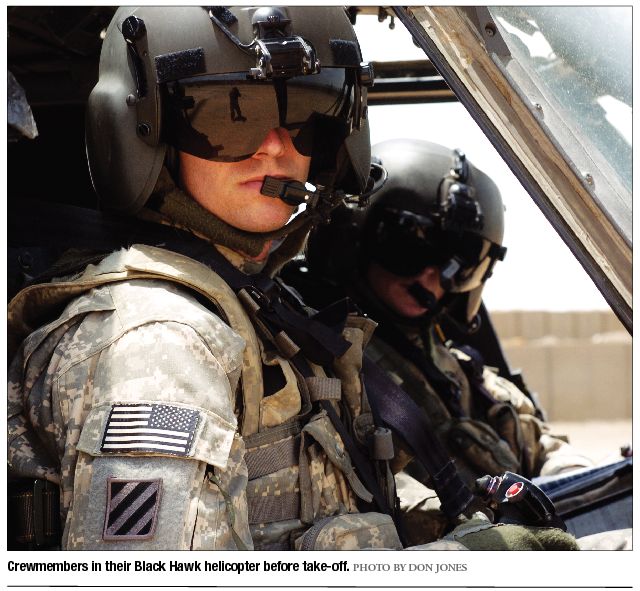
By this time, Roberson had laid down the smoke canister to mark the landing zone for the Blackhawk, and the Apache pilots gave the go-ahead. Less than a minute later, Sommers was on his way to OE.
Griechen had won the battle on the mountain to keep Sommers alive, and Peacock had kept the enemy at bay with withering fire. The exclamation point came when an American F-15 delivered its 2,000pound bomb on the enemy fighting positions. Later assessments would show that Butler’s targeting for the bombs and artillery had killed almost 40 fighters.
Still to come was the terrifying 10-hour march off the mountain for 2nd Platoon.
Jarmuz figured that
getting his men off the mountain was the better part of valor: Even
though they had not been able to set up their ambush on the insurgents
who’d been shelling Margah, they had engaged a large enemy force and
inflicted significant casualties.
As
they neared the base of the mountain, Jarmuz judged that it was safe
for his troops to put aside their night-vision goggles, as their poor
depth-perception qualities had contributed to many falls during the
trek, and to turn on lights to help them find their way down.
Thirty
minutes later, when they hit the road, two trucks, commandeered by
their compadres back at Margah, arrived to pick them up and drive them
back. As bad as Margah was, there’s no place like home.
The
battle by Jarmuz’ platoon on the mountain did nothing to change the
overall strategic picture in Afghanistan. But those kinds of actions
continue to take their toll on the enemy. It is obvious that more and
more “green” insurgents are in the battle. The veterans are taking more
of a leadership and training role and putting the “new guys” out to do
battle with the Americans. Combine that with a dramatic increase in
missile strikes in the tribal region just east of Margah and Boris, and
the generals in Kabul will tell you that we’re making “significant
progress” but that it will be a long, slow fight.
When
the platoon flew back to Boris, they were haggard, exhausted and
emotionally drained. What was to be a routine mission had turned into a
life-and-death struggle, with one of their friends gravely wounded. For
days no one in the platoon wanted to talk about it. They just wanted to
get clean and eat and sleep. And Jarmuz and Watson let them do just
that.
Seven months
later, Abu Company was leaving Afghanistan in bits and pieces. Most of
the unit were home by the end of January. These last few weeks can’t go
by fast enough.
Since
I left Afghanistan in August, several significant things have happened.
First and foremost was the death of Specialist Jimmy “Big Rob” Robinson
– a machine gun team leader; graduate of Monroe, Ohio’s Lemon-Monroe
High School; husband to Kate; and loving father of two – during a mortar
attack on FOB Boris. I still have gear that Jimmy hooked me up with at
Margah.
Sommers is
in Florida. His prognosis is good, but his head injury was so severe
that his doctors’ predictions for his long- term recovery change from
day to day.
After
Abu Company left Margah for FOB Salerno and points north, a force of 120
insurgents foolishly decided to try and overrun the 20-plus Americans
at Margah on Halloween. At the end of the fight, 92 insurgents had been
killed and two captured. Five Americans were lightly wounded.
Don
Jones, of Ft. Worth, Texas, has been a photojournalist since 1978. He
specializes in covering combat around the world including the Middle
East and Central America. He currently teaches photojournalism and
electronic news gathering as an adjunct professor in North Texas.
Bill
Putnam is a military-trained photojournalist living in the Washington,
D.C., area. Lately, his work has concentrated on the mental, physical
and political cost of war through documentary photography, portraiture
and video. Afghanistan was his first trip back to war since leaving Iraq
in June 2006 after nearly two years there. His work can be seen at www.billputnam.net and www.vimeo.com/billputnam.
This article first appeared in Fort Worth Weekly.