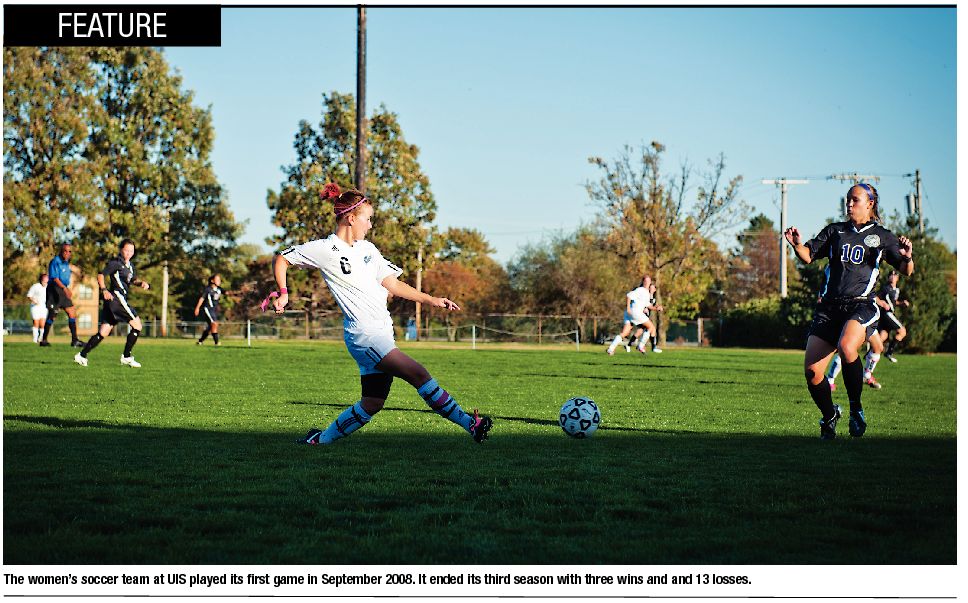
Not ready for the big time
Both Hayler and Williams say the coach shouldn’t necessarily be the focus of the discussion – Fauser’s February 2010 decision was supported by both the athletic director and the chancellor.
The administration did, however, offer nonathletic scholarships to Thompson and her fellow former teammates. “I think it [the alternative scholarships] says that they know they made a mistake,” says Thompson, who accepted the offer. “It looks like an act of kindness to where it’s like, ‘Well, you know, our athletics program screwed you over, so we’re going to help you out’ – which shouldn’t happen.”
Though the administration says the scholarship revocations were justified, vice chancellor for student affairs Tim Barnett says the conversation isn’t necessarily over. “In the future, if we have an issue that comes up similar to this last time, when more than one athlete may not have the scholarship renewed, we’ll probably have a broader discussion about that,” he says, adding that if a similar situation occurs again the university would likely “look at rationale and the reasons why that decision was important to be made.”
Goals v. reality
Former Chancellor Ringeisen, who oversaw the initiation of UIS’ move to NCAA, saw building a thriving athletics program as a way to attract more students to UIS. The name NCAA itself and the stepped-up competition would provide a more enriching experience for students on campus.
Interim Chancellor Berman has a similar vision. “We have a challenge here at UIS. We have 1,100 students living here on campus, we’re away from downtown, and we see athletics as a big part of what we can do to build a sense of community right here on campus.”
That goal for a campus community rallied around athletics has yet to be achieved, though students both on and off campus continue to provide the majority of funding for the program. In FY09, the student athletic fee alone accounted for 58 percent of the final budget for athletics. From FY07 to FY10, fulltime student athletics fees, with the blessing of the student body, rose by 38 percent from $96 to $132. The athletics programs are also supported by parts of other fees, including a special fee for the Recreation and Athletics Center (TRAC), the home-away-from-home for student athletes.
Even with student fees, UIS athletics isn’t breaking even. In FY09, athletics ended the fiscal year with a $267,000 deficit, spending a total of $1.46 million, a few hundred thousand dollars more than the $1.16 million expected to be spent that year when administrators developed a five-year plan in 2007.
Though the move to NCAA has come at a financial cost – and a greater one than originally expected, Berman says it’s worth it. “It’s an investment and whenever you get into building something, starting something new, you have to put money in up front, before the thing straightens itself out financially.”
To help stabilize the athletics budget and reduce its reliance on student fees, UIS is working toward a reinforced fundraising strategy, says Scott Reed, assistant director for athletics communications. To help integrate the athletics department with the rest of campus, student-athletes and faculty are working on several initiatives, says Dr. Marcel Yoder, faculty athletics representative and professor of psychology. “The participation in any co-curricular activity … is an important part of these students’ lives and that importance needs to be recognized,” he says. To meet that end, he’s working to partner faculty members with athletic teams in a sort of mentor program, in which faculty members attend practices and games to see what it’s like to be a student athlete. “Faculty will get an idea of what student-athletes’ lives are like, of the pressure on coaches. … It also will give student-athletes and coaches a broader perspective of how faculty thinks about academic performance and athletics.”
Yoder hopes the general student and student-athlete populations can be brought together through initiatives including gamenight recognition of academically high-achieving students and the practice of professors, before beginning instruction, allowing students in any activity to announce upcoming events.
“There are a lot of great things that our student-athletes do,” Yoder says. “We have tended to get tied up into what staff and administrators have done and we’ve kind of lost track of the good things students are doing.” He lists student-athletes’ collective GPA (higher than that of the overall student population) and volunteer activities, as parts of UIS athletics that many don’t realize. Of UIS’ recent troubles, most of it has not been about the student-athletes themselves doing wrong, Yoder adds.
Working it out
Kubal says tension between faculty and the administration seems to have eased some since Ringeisen’s October retirement. Formerly UIS’ provost, interim chancellor Harry Berman took over for Ringeisen this past fall, but the new chancellorship is just the latest in a string of shifting positions related to athletics occurring over the past few years. The department now deals with a new administrative liaison and a new IAC chair, among other recently shuffled positions.


