Grabbing art with both hands
The hallways echo with chatter and laughter from someplace in the building.
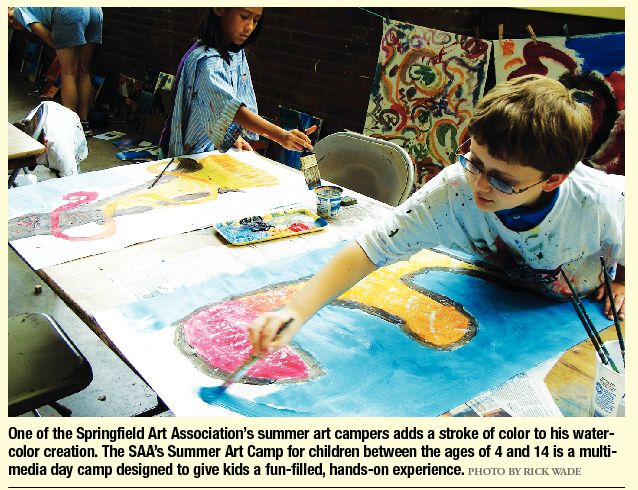
We track the sounds to a classroom where kids wearing blousy paint-splattered shirts are gleefully brush-stroking watercolors on poster boards, in groups clustered here and there on the floor, or in studied solitude at a table. Older girls, teenagers probably, bustle purposefully about, helping kids, cleaning up spills, giving instructions.
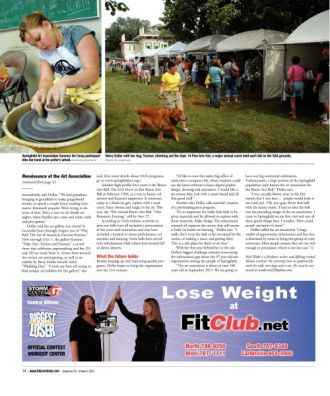
Meanwhile, in yet another building, a bevy of uncharacteristically quiet teenage girls sits at electric potter’s wheels. Their eyes are riveted to the spots between the wet, spinning clay and their muddy hands where, miraculously, vases begin to form.
In another house on the property is Dollar’s not-quite secret hideaway where she works at one of her favorite passions: making paper.
Dollar uses the paper she makes to create art, some of which is on display in October as part of a new exhibition in the art gallery, “Pulp: Fact, Fiction and Fantasy,” a juried show that celebrates papermaking and the 2D and 3D art made from it.
Dollar came to Springfield about a year ago with an impressive resume; she holds a master’s degree in fine arts from University of
Colorado, taught art at all education levels and in workshops, managed galleries, was cofounder and president of Optical Illusions, Inc., an audio-visual production company, served as administrative director of a private preschoolthrough-fifth-grade school and exhibits her own work in juried art shows.
Dollar said she teaches a hands-on approach to art. “I have a strong background in alternative education, and I am pretty serious about giving people stuff to learn with their hands. People learn in a variety of ways, and sitting and being talked at is not always the best way to take in information and process it,” she explains.
“To do art, I always start kids moving around, even if it’s just learning the amazing proportion of their own bodies and how those observations carry over into the world. (For instance) your hand is basically the size of your face. I have them stand up and test: What is a hand length? How many hands tall am I? If they can physically feel it, they are more likely to draw in accurate proportion. If they can’t find those experiences in the traditional school setting, I love offering them here, where sort of anything, within reason, goes.”
When asked how she is able to handle a job with such diverse duties, she laughs heartily.
“Strangely enough, with the SAA being a sort of little five-ring circus, with the historic property, the gallery and the school, the various fundraisers and events that flow through here, it all seems to utilize my rather strange list of abilities. So here I am.
“It’s this sort of wild mix of one week I am coordinating for the art fair, then I am doing the schedule for the gallery and looking at artists’ work, then maybe I am judging work for another art fair, then we’re trying to design new classes to attract new people into the school, then maybe we’re brainstorming what will be the next art outreach portfolio we want to develop.”
As she walks back to the main building, Dollar pauses and nods toward the large garden where vegetables are growing. The field is neatly tended. “I would like to see people in the neighborhood use this area for growing food, so they will feel ownership in this place,” Dollar says.
All the bright colors of summer – green, yellow, red – and the pink mansion with the green shutters stand in stark contrast to the gritty, black and gray streets that seem to constrain the five-acre oasis.
Clearly, Betsy Dollar has a vision for these aging buildings along the busy streets where cars zip by. Dollar said she just wants the people inside the cars to stop, and look at what is available here for their benefit.
During a time when public schools are balancing budgets by slashing extracurriculars such as the arts, places like the SAA will be needed more than ever.
Dollar said she believes critical learning skills get lost among educational methods that encourage students to parrot back information without processing it. That’s where SAA programs come in, providing hands-on exercises for increasingly complex minds.
“Every form of art, no matter how simple, requires a consecutive series of decisions … of where that line goes, what will lie next to it, what comes after that. Those skills are absolutely critical to lifelong learning and processing information and being in touch with your environment.
“The arts are important,” she added, “whether a child grows up to be a rocket scientist, a house painter or a philosopher.”
Contact Rick Wade at [email protected].