“We realized the only way to make money at this was to take away from the artist, so we didn’t make much,” said Sean. “With all the expenses of phone, food, promotion, lodging, sound — that’s when I knew this would be a fan hobby.”
After mulling over the music hosting idea for awhile, then receiving encouragement and abetment from many acquaintances, especially Ron Sakolsky, Sean’s former professor at Sangamon State University, fellow DJ at WQNA and confirmed anarchist and actionminded individual, and David Landis, a longtime Burns cohort, graphic designer, music fan and believer in DYI philosophy, they decided to move ahead with the plan.
Sean’s previous booking experience came in 1984 while a student at Sangamon State University. He approached the student affairs director and discovered the reason no one brought in bands was simply because no one wanted to do it. Thus emboldened, he booked Chicago hard-core punk band Naked Raygun, paid them $600 of SSU money and accomplished his first booking/promotion mission.
“It demystified the process for me when I found out you just call someone, offer them money and they say yes or no and that’s that,” Sean recalled. “And I learned two lessons. One, that it can be done and, two, no matter what band you book someone isn’t going to like it.”
With the concept in place and progressing, the notion now needed a name. Music performance choices were based on Jamie’s and Sean’s affection for an array of music loosely defined as an amalgam of country, folk and blues singly represented by styles such as rockabilly, rock-nroll and bluegrass. By the mid-90s music industry types developed the encompassing umbrella terms alt-country, Americana and American roots music to basically cover the wide variety of popular contemporary styles essentially based in folk music traditions. Adding the central Illinois location designation to the idea of rejuvenating this music gave birth to the moniker Sangamon Valley Roots Revival. The next step involved finding a music group to fit the bill.
“In the late 1990s Hightone record label was putting out a lot of great roots music. One act that I liked very much was called Johnny Dilks and the Visitacion Valley Boys. I found their booking agent’s contact information online. He told me that if I could come up with $250 and a couple of hotel rooms that we could get Dilks and his boys on a Wednesday night in March. This was very cool,” said Burns. “I reasoned with Jamie that we couldn’t lose more than about $400 and surely a few people would show up.”
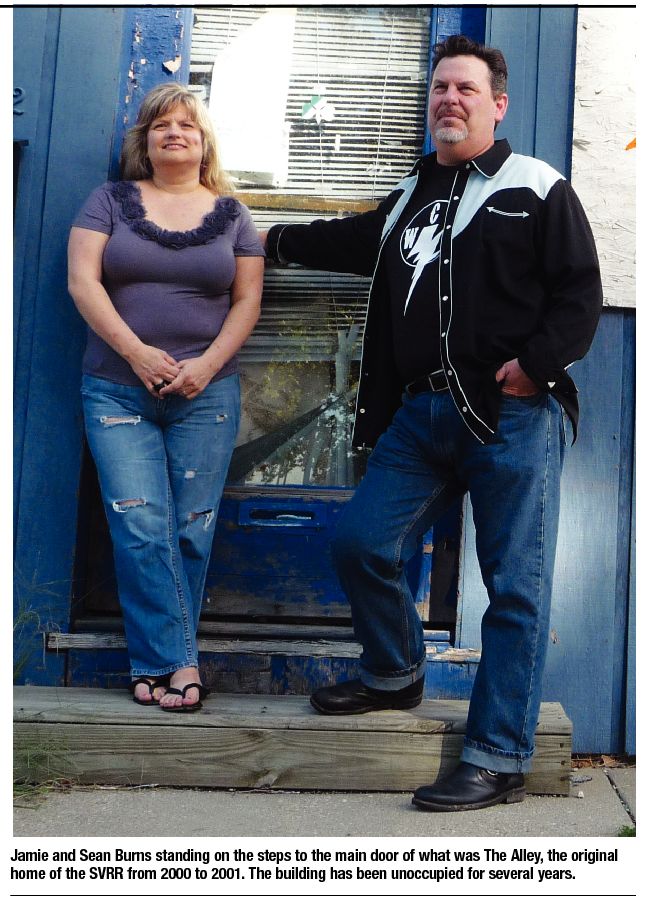
The first show in March of 2000 immediately proved the possibility of combining music enjoyment with hosting bands to be a real and viable project. Rodney Patterson, manager of the Alley, a now defunct, then funky tavern at Second and Carpenter, hosted the show, while Matt Dietrich, the arts and entertainment editor at the State Journal-Register at the time, wrote a feature article on Dilks, and the Burns promoted like well-seasoned hucksters. An amazing number of people showed up and the show was a resounding success. They not only made enough to pay for expenses, they also made friends for a lifetime with Marc Mencher the agent, Dilks the entertainer, Rich Harrison the sound person and others involved in the show. Jamie made homemade lasagna for the band, signed up audience members for an upcoming newsletter and drove the musicians around, while Sean introduced the band, kept all on schedule and watched the door money. They both danced quite a bit to the delightful cowboy swing music, realizing their good fortune, hardly believing what just happened and reveling in a job well done.
Over the next several years they continued to build upon the success of the first night, but every show always contained the seed of the original notion. They booked artists because they were fans of the music and never lost sight of that vision. Even now, 10 years later with more than 100 acts hired of varying forms of Americana music, the same formula applies.
“When we started doing this I always went by two rules,” said Jamie. “Number one, we wouldn’t book an act we couldn’t afford to pay if no one showed up — and I used to not enjoy myself until I counted enough people so we would break even. And second, we wouldn’t book just to be nice. All the acts had to be stellar, since for the most
part early on, most people had never heard of the artists we brought
and they relied on believing if we booked them they’d be good. Our
reputation is and was everything.”


