SIU School of Medicine’s first dean relects on the early years Forty years ago, the success of the Southern Illinois University School of Medicine was anything but certain. Six years of planning had brought the school to the point of leasing a building for its headquarters and hiring a dean. The person chosen for the job was Dr. Richard Moy.
Moy, then 38 years old and wholly discontent with the course of medical education in the United States, almost didn’t take the position. It was his wife, Dr. Caryl Moy, and an idea about risk that pushed him out of the Chicago area toward Springfield. “You cannot keep your mind hermetically sealed,” Moy says. “You have to be prepared to risk yourself to see if you can do more.” It’s the philosophy that pushed him to implement his ideas for medical education reform and accept the offer to become dean of the thennonexistent medical school.
For 23 years, Moy helped guide the school, and last week he helped celebrate its 40th anniversary by giving a lecture to current students, as well as a handful of oldtimers returning to relive the school’s early trials and jubilations. The SIU School of Medicine was one of about 20 community based medical schools – a school that would use existing resources such as St. John’s Hospital and Memorial Medical Center to teach its students instead of creating an entirely self dependent institution – that popped up across the nation in the 1960s in response to an expected shortage of practicing doctors. Moy was determined to make SIU’s medical school one that would focus, not on research, but on teaching the student what he or she needed to practice medicine.
“You tell people that and they go ‘What’s so earth-shattering about that? Isn’t that what you do?’” says Dr. J. Kevin Dorsey, the current dean and a 1978 graduate of SIU’s School of Medicine. “But that’s not what medical schools did.”
When the SIU School of Medicine was being proposed, the course of most medical education programs left students passionless, Moy says. A research-centric culture permeated the so-called teachers’ styles. They taught what they were immersed in – what they could most easily turn into a lecture, not necessarily what students needed to know in order to succeed in their chosen profession.
“Medical schools at that time were victims of the atomic bomb,” Moy says, explaining that the Manhattan Project had brought great minds together to develop new technology, creating a template that the country then followed in establishing the National Institutes of Health, which poured grant money into medical schools’ research programs. “If the dean
didn’t push his faculty to get those research grants, the president
would fire the dean and get one who would. The result was that we
entered the ‘publish or perish’ era and, unfortunately, medical students
began to drift to the bottom of the food chain.”
But SIU sought to change that, and in Moy’s and Dorsey’s eyes, the school succeeded.
Moy
points, in part, to one of his recruits, Dr. Howard Barrows, who
brought problem-based learning to the school. “It changed the face of
medical education in the United States,” Moy says, adding that a Harvard
University dean met with Barrows before sending a team to Springfield
to study the school’s medical education curriculum and take it back to
Boston. “I came down here to start a medical school that would put its
educational mission up on the flagpole where it belonged,” Moy says.
“This faculty reformed medical education in the United States.”
“We
wanted to innovate, and we were not fettered by being old,” Dorsey
says, explaining why SIU met so much success. “So we could just create.
We had no ties to the past. And disruptive innovations are made by
newcomers; they are not made by the old guard. The old guard is into
sustaining innovations, things that maintain the status quo.”
Moy
originally feared that no one would leave their posts at research-heavy
schools to help bring the new school and its new ideas to life. “I had
this fantasy that I was like Charlie Brown out on the mound with a brand
new mitt and ball and bat and nobody wanted to play,” Moy says.
“Fortunately, I was wrong. There were a lot of wonderful people … who
had been wearing protective coloring, who did believe with me that a
medical school was primarily an educational institution. … And they
came.”
In 1975, the
school celebrated its first graduating class, a group of 24 men and
women. The event was a feat, considering that the school’s one-time
“Paul Revere,” the late Dr. Homer Kimmich, encouraged the governor’s
medical education advisory committee, which he was on, and later the
governor himself, to limit funding to the school.
Kimmich alleged that the Springfield community didn’t support the school, Moy says.
The
outlook was grim, but the school was saved, according to Moy, by
community leaders, including Dr. James Graham, thenpresident of the
Sangamon County Medical Society, who spoke on the school’s behalf during
budget hearings. He also credits a church congregation, the chamber of
commerce and the Springfield city council for bringing positive media
attention to the school by holding special meetings and making countless
phone calls to the newspaper.
“Talk about a community-based medical school – the community rallied.”
The
school’s budget was reinstated. Had it not been, Moy reflects, “We
would have been dead in the water. … Our chairmen might have
reconsidered their decision to come. Recruitment would have been dead. …
I probably would have had to resign.”
Instead,
Moy remained until he retired in 1993, and the medical school continues
to grow – it’s now alma mater to more than 2,300 medical school
graduates.
SIU
School of Medicine also continues to make Moy proud. During its last
accreditation site visit, the school received zero notes for
improvement, a rare thing for any institution, Moy says. “That’s
approaching perfection.”
Contact Rachel Wells at [email protected].
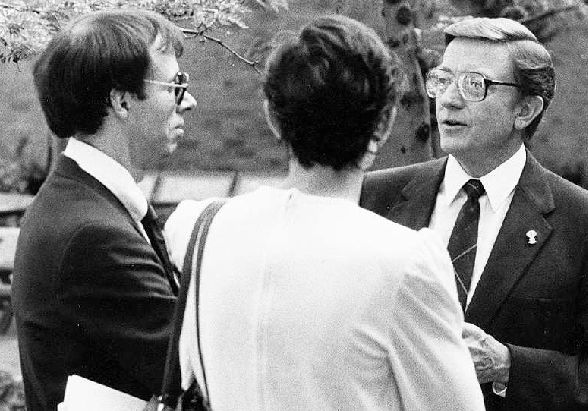
Dr. Richard H. Moy, SIU School of Medicine's dean for its first 23
years, greets alumni during a 1988 reunion. PHOTO COURTESY SIU SCHOOL OF
MEDICINE
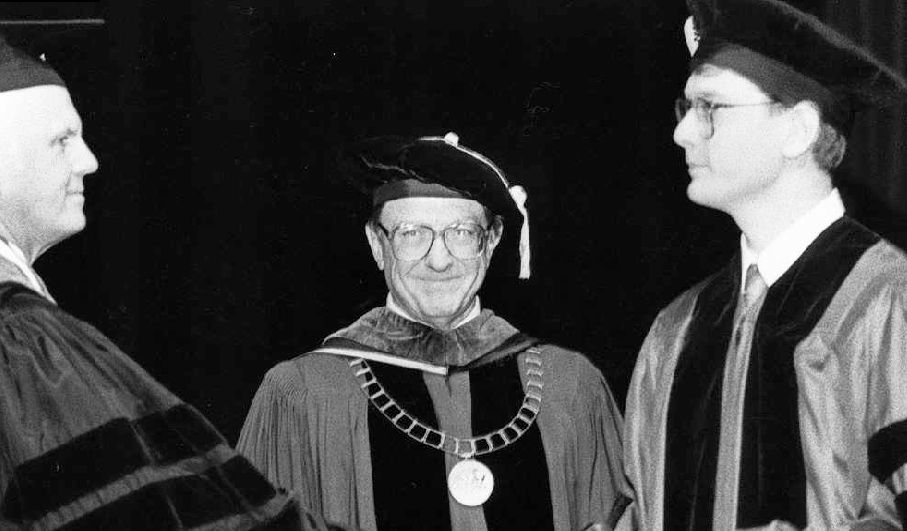
SIU School of Medicine's first dean and provost, Dr. Richard H. Moy
(center), and the late John C. Guyon (left), then-president of the
university, awards diplomas to the school's 1987 graduates. PHOTO
COURTESY SIU SCHOOL OF MEDICINE


