This is the village it takes
continued from page 15
of children in foster care are African American. People who choose to come here know that it’s intergenerational, interracial, inter-whatever, and I think the differences aren’t something to be overcome, but really to be celebrated.”
Hope Meadows was started in 1994 with a $1 million grant from the State of Illinois. Now the community is funded by grants, private donations, rental income and contracts with the Illinois Department of Children and Family Services. The success of the Hope Meadows program led Eheart to establish Generations of Hope Development Corporation, a nonprofit company aimed at spreading the intergenerational community model nationwide. Generations of Hope receives support from the donors like the W.K. Kellogg Foundation, the nonprofit organization started in 1930 by the famous breakfast cereal inventor of the same name.
Though the State of Illinois’ financial crisis has delayed some payments to Hope Meadows, the state recently promised more than $1 million to Hope for an expansion. The administrators of Hope plan to build a multi-apartment complex called Hope House to accommodate more senior volunteers. Gehrmann says the community actually has five empty homes that have been converted from duplexes to full-size homes, but those are meant to house adoptive families. Seniors stay in the unconverted duplexes.
Eheart and Gehrmann say monetary donations are always welcome to Hope Meadows and Generations of Hope, though the two organizations have different needs beyond money. Eheart says Generations of Hope needs construction contractors who are willing to help build new intergenerational communities in other cities nationwide, while Gehrmann says Hope Meadows actually needs more adoptive families to apply and fill the five empty houses.
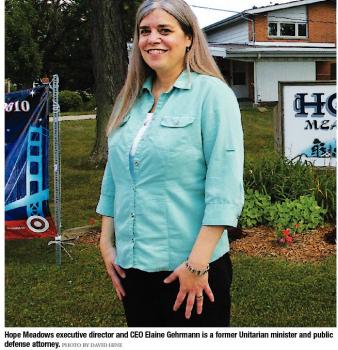
A former Unitarian minister and public defense attorney, Gehrmann says she wanted to be a part of Hope because it “deals with the whole person and their whole situation.”
“Being a lawyer, clearly I helped some people, but I could only help them with their legal problems,” Gehrmann says. “A legal problem may be the least of your problems, and may be a manifestation of a larger problem. This place provides a lot of the things that communities used to provide that they don’t anymore.”
Contact Patrick Yeagle at [email protected].
To read some of the extensive research about Hope Meadows and the "Intergenerational Community as Intervention" model, visit http://tinyurl.com/23hyemf.


