This is the village it takes
continued from page 13
iors grow older, they can rely on community members to look after them.
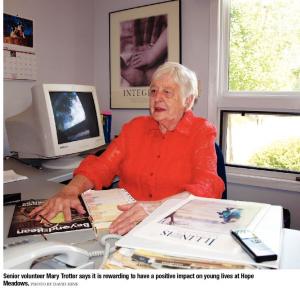
Senior volunteer Mary Trotter works in the administrative office at Hope and enjoys doing activities with young children in the community. She tells about winning over a troubled young boy, who now refers to her as his best friend.
“It’s very rewarding to see them grow up,” Trotter says. “He used to be my little man, but he’s not so little anymore. He’s on the honor roll now, and he has come a long way.”
David and Carol Netterfield moved to Hope Meadows from Nebraska in 2008 to retire, and they joke that they’re busier now than ever.
“I always thought as a younger person, when I retired I would prop my feet up and sit in front of a TV for the rest of my life,” David Netterfield says. “But our schedule is so busy … it’s just amazing how busy you can be when you care more about somebody else than you care about yourself.”
Dr. Eheart says the seniors are an integral part of Hope’s success because they provide wisdom and support for other community members.
“I’m really convinced the program would have folded in the first two years if it hadn’t been for the seniors,” Eheart says. “I think they, as a whole, just absolutely love the program and love their life. It really becomes a way of life for them.”
Dr. Eheart says the ICI model isn’t going to replace the state’s adoption system, but it can provide an alternative. In many states across the nation, the number of young single mothers being locked up for nonviolent crimes is growing rapidly, Eheart says, and the ICI model could be adapted to reroute them away from incarceration toward a brighter future. She points to a drug-abuse treatment project already underway in Portland, Ore., that was based on the Hope model.
“I really see it as an option to keeping some of these vulnerable populations out of the current system, and it can certainly be more cost effective,” Eheart says. “They can get the support they’ve never had, and it provides them the opportunity to give back.”
Despite the fact that many of the adopted children are African-American and most other residents are white, Gehrmann says racial and cultural differences don’t matter at Hope.
“I think it helps that everybody gets to know everybody else as an individual, and when you know someone as an individual, it’s harder to put them into a category,” she says. “And the nice thing about this is it’s intentional. You come here knowing the setup of the community, and the reality is that the majority
continued on page 14


