Illuminati Motor Works hits the track with 500 mpg electric car
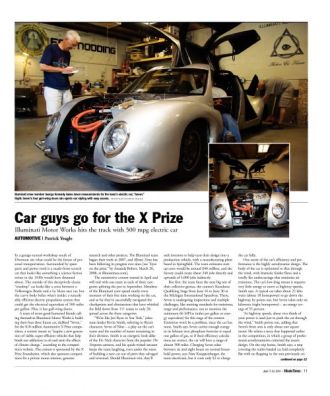
 In a garage-turned-workshop south of Divernon sits what could be the future of personal transportation. Surrounded by spare parts and power tools is a made-from-scratch car that looks like something a science fiction writer in the 1930s would have dreamed about. The outside of this deceptively-classic “teardrop” car looks like a cross between a Volkswagen Beetle and a Le Mans race car, but the curvy body belies what’s inside: a remarkably efficient electric propulsion system that could get the electrical equivalent of 500 miles per gallon. Plus, it has gull-wing doors.
A team of seven good-humored friends calling themselves Illuminati Motor Works is building their four-door future car, dubbed “Seven,” for the $10 million Automotive X Prize competition, a contest meant to “inspire a new generation of viable, super-efficient vehicles that help break our addiction to oil and stem the effects of climate change,” according to the competition’s website. The contest is sponsored by the X Prize Foundation, which also sponsors competitions for a private moon mission, genome research and other projects. The Illuminati team began their work in 2007, and Illinois Times has been following its progress ever since [see “Eyes on the prize,” by Amanda Robert, March 26, 2008, at illinoistimes.com].
The automotive contest started in April and will end with one team in each of three categories splitting the pot in September. Members of the Illuminati crew spend nearly every moment of their free time working on the car, and so far they’ve successfully navigated the checkpoints and eliminations that have whittled the field down from 111 teams to only 28, spread across the three categories.
“We’re like Jeri Ryan in Star Trek,” jokes team leader Kevin Smith, referring to Ryan’s character, Seven of Nine – a play on the car’s name and the number of teams remaining in their division. Smith is an energetic look-alike of the Dr. Nick character from the popular The Simpsons cartoon, and his quick-witted sarcasm keeps the team laughing, even under the stress of building a new car out of parts they salvaged and invented. Should Illuminati win, they’ll seek investors to help turn their design into a production vehicle, with a manufacturing plant based in Springfield. The team estimates startup costs would be around $40 million, and the factory could create about 240 jobs directly and upwards of 5,000 jobs indirectly.
But first, the team faces the next big test of their collective genius, the contest’s Knockout Qualifying Stage from June 16 to June 30 at the Michigan International Speedway. There, Seven is undergoing inspections and multiple challenges, like meeting standards for emissions, range and performance, not to mention the minimum 66 MPGe (miles per gallon or energy equivalent) for this stage of the contest.
Emissions won’t be a problem, since the car has none. Smith says Seven carries enough energy in its lithium iron phosphate batteries to equal one gallon of gas, so if their efficiency calculations are correct, the car will have a range of almost 500 miles. Charging Seven takes between six and eight hours on normal household power, says Nate Knappenburger, the team electrician, but it costs only $3 to charge the car fully.
One secret of the car’s efficiency and performance is the highly aerodynamic design. The body of the car is optimized to slice through the wind, with dramatic fender flares and a totally flat undercarriage that minimize air resistance. The car’s low drag means it requires very little energy to move at highway speeds, Smith says. A typical car takes about 25 kilowatts (about 18 horsepower) to go down the highway, he points out, but Seven takes only six kilowatts (eight horsepower) – an energy savings of 55 percent.
“At highway speeds, about two-thirds of your power is used just to push the car through the wind,” Smith points out, adding that Seven’s front area is only about one square meter. He relates a story that happened earlier in the competition, in which a group of professional aerodynamicists criticized the team’s design. On the trip home, Smith says, a tarp covering the trailer-hauled car laid completely flat with no flapping in the area previously cri-
continued on page 12