City Older Neighborhood (ICON) Coalition, which plans to push for changes in Springfield city ordinances that would make it easier for the city to act on problem properties.
Combs points to the city of St. Louis, which has created a dedicated team of lawyers, code enforcement officers and even a judge to handle blight. The city also charges an upkeep fee for problem properties, and failure to pay can result in foreclosure by the city. Combs says the city of Wilmington, Del., has even begun to charge a vacant property registration fee that increases with the number of years a property sits vacant, with a one-year waiver for owners who sell, rehabilitate or demolish a vacant property.
Though Springfield already requires registration of boarded-up properties, Combs says there is too much “wiggle room” for property owners who do the bare minimum to avoid city fines, and there is no limit to the length of time a property can be boarded up before enforcement efforts are intensified.
“I think when people look at Enos Park, they see an image not only of this neighborhood, but of the city in general,” Combs says.
“Let’s solve this problem. Let’s get these properties into the hands of someone who is going to do something with them.”
Bike-friendliness in Davis
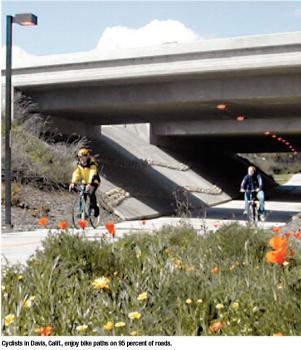
In sunny Davis, Calif., bikes actually outnumber cars. Home of the University of California Davis, the city of 65,000 is the king of bikefriendly cities. Starting more than 40 years ago, Davis began making bicycle transportation a priority for city planners, and the city now has bike lanes on 95 percent of its roads. Fourteen percent of the town commutes to work on bikes, which is 35 times the national average. Instead of riding buses to school, children ride bikes. Davis even has traffic signals specifically for bikes. The town is so bike-centric that the California Department of Transportation used it as a model for bike laws statewide, and federal bike guidelines are loosely based on the Davis bike standards.
Bikes are a boon because they have the potential to improve the quality of life a city offers. They increase physical fitness, which improves overall health. They reduce pollution and traffic congestion by replacing cars, and thereby reduce the incidental costs of car ownership. They can even mitigate economic inequality by increasing mobility for those who can’t afford cars. And although bikes slow the pace of transport slightly, that slowed pace allows better observation and appreciation of the environment and the community.
In contrast to Davis, Springfield has a ways to go toward bike-friendliness. Bike lanes and bike paths are a rarity here, and awareness of bike safety and etiquette is low, both among
continued on page 12


