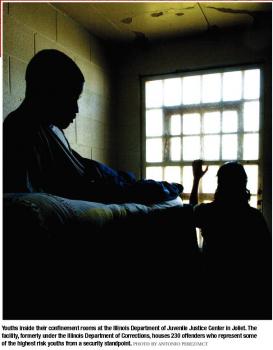
Kids in prison
continued from page 11 youth offenders, but by already overburdened officers from the adult correctional system. They are more accustomed to dealing with hardened criminals than with kids who might have made some bad choices.
Understaffing and lack of training
The John Howard Association of Illinois released a study of the juvenile justice system in January 2010 saying staffing levels in IDJJ are too low; counselors, administrators, teachers, clerics and even maintenance staff have dwindled due to retirements and transfers, hindering the effectiveness of youth prisons. Staff-to-youth ratios are 1/24 in some facilities and can reach 1/60 at night, the study says.
“It is difficult to imagine effecting change in a youth’s thinking and behavior with such high ratios,” the study says. “In order to impact youth behavior, one must be aware of the youth’s ongoing behaviors and respond appropriately. … This requires staff-to-resident ratios that are much smaller than in current practice.”
How much smaller? The study says a ratio of one adult to eight youth is most effective, “although 1 to 10 is do-able with well-trained staff.”
But training for IDJJ staff is sparse. Many of the staff in the juvenile justice department are transplants from the Department of Corrections, lacking training in youth rehabilitation and bringing with them the attitudes prevalent in the adult system.
“While the agency has recently utilized outside resources to train a few staff, the majority of staff members remain untrained in juvenile treatment policies and practices,” Betsy Clarke says. “The failure to train all staff in treatment-oriented approaches to youth corrections renders it impossible to fulfill the treatment mission of the new department.”
Education and programming
While youth are incarcerated in Illinois, they are supposed to receive education so they don’t reenter the outside world lagging behind their peers in learning. Sometimes they receive that education, but often they don’t.
Clarke says at least one youth prison offers only half-day education, and the John Howard study says the department’s schools – District 428 – are funded at only one-third the minimum level of normal public schools. IDJJ is working on educational improvements to better train teachers, keep in contact with parents and create a uniform calendar for the


