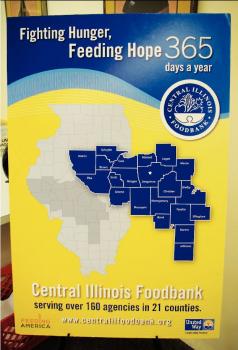
Since Central Illinois Food Bank covers so many counties, it may wind up asking another food bank to deliver to a closer agency, even if it’s not under their official jurisdiction. This would get produce to people sooner, reducing its chances of spoiling, she says.
“When you’re looking at truly perishable product, everything changes,” she says.
The organizations served by the food bank face a number of challenges besides refrigeration, Molitoris says. Because the area her organization serves is so large (at 12,300 square miles), the food bank can’t reach all its agencies as often as it would like. Currently, the organization delivers to 40 percent of its agencies, in places more than 100 miles away like Quincy, Mt. Vernon and as close as Christian County, 26 miles away.
“Springfield is a pretty easy community to serve if you have the food,” Molitoris explains. “Local pantries come in, they pick up the food, they drive to the agencies and get the food out. But many of our other pantries are much farther away. We have pantries that are 150 miles away. We deliver to them, but it’s only once or twice a month. It’s a challenge.”
A larger challenge, Molitoris says, is for the people accessing food.
“We have counties in our area where people are driving 25-30 miles to get to a pantry,” she says. “Imagine, if you’re having a hard time putting food on the table, you’re having trouble making ends meet, and you have to face the choice of ‘how am I going to pay for the gas to get rid of the pantry?’” As the number of hungry people in Illinois continues to rise, this problem will become even worse. Molitoris and Gilmore say they’ve been working with rural agencies, in places like Adams County, trying to start new programs, but they’re still in the early planning stages.
Though the storage issues aren’t likely to be resolved anytime soon, Gilmore says she’s happy that food banks are receiving the new products, even if it does mean semitrailer freezer systems.
“It’s really nutritious product, and we want to distribute it, but it’s definitely changing our storage needs,” she says. “With regards to nutrition, we’re definitely in a better spot than we were five years ago.”
Contact Diane Ivey at [email protected].


