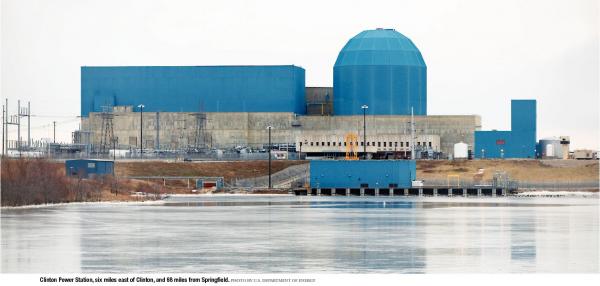
Clinton attempts a comeback
Clinton Power Station is a silent sentry at the edge of a 5,000-acre man-made lake, six miles east of Clinton, and about 68 miles from Springfield. Its powder blue dome rises above silos, cornfields and endless country roads with names like “500 North” and “County Road 14.”
Stepping inside the Clinton Power Station is like going underwater. Safety regulations provide for a fair amount of sensory deprivation, between hard hats stamped with Exelon Nuclear’s circular green logo, malleable bright orange earplugs and thick safety goggles. It’s a world of yellowish fluorescent lighting, layers of colored tape along the cement floor (marking where employees can or can’t walk) and the ever-present whir of powerful machinery.
For Bill Harris, the station’s communications manager, walking into the control room of Clinton Power Station is like entering a sacred place.
“It’s like going into the sanctuary of a church,” Harris says. “There’s no fooling around, no loud music, no eating, no reading books. Just silence.”
Situated on approximately 14,300 acres, the station sprawls out in a sun-baked field. When navigating the winding road, it’s easy to feel alone – chirping birds, grassy riverbank, rows of empty parking spaces. Despite numerous signs warning visitors, employees and trespassers alike, it’s easy to think no one is watching. Surrounded by a seemingly pastoral scene, it’s easy to underestimate what lies inside.
But armed security guards watch from concrete towers, razor wire and video cameras guard the perimeter and computerized surveillance systems track the exact locations of all who enter the plant. The extensive acreage is necessary, since all stations must be built away from population centers in case of an emergency. Isolation is essential, because employees deal with some of the most dangerously radioactive material on earth.
Built in 1976 by Illinois Power Co., now owned by Exelon Nuclear, the Clinton Power Station is one of six nuclear plants in Illinois. Exelon Nuclear, headquartered in Warrenville, near Chicago, operates the largest nuclear fleet in the United States and the third largest in the world. Exelon’s 10 stations, with 17 reactors, represent approximately 20 percent of the U.S. nuclear industry’s power capacity.
The waters of Clinton Lake provide the steam that turns the station’s turbines, generating 1,065 total net megawatts of electricity, Harris says. For comparison, Springfield’s Dallman 4 Power Plant generates about 200 megawatts. Energy from the plant travels all over the nation, but the single reactor at Clinton Power Station could power a city the size of Boston or Seattle. With an additional reactor built, the station could generate enough power for a million homes.
As the U.S. seeks new energy options, some are touting nuclear energy as the crown jewel in a green and renewable energy future. Supporters say Illinois is part of a “nuclear renaissance,” which is reinforced by President Barack Obama’s administration.
This week, the Illinois Senate voted 40-1 to pass a bill that would lift the current moratorium on building new nuclear reactors in the state. The bill will now move to the House for consideration.
In February, Obama announced more than $8 billion in federal loan guarantees to build two nuclear reactors in Georgia. Building a nuclear power station usually costs between $6- 8 billion, Harris says, and companies rely on investors to help them with the cost. The loan guarantees provide monetary insurance for investors.
“To meet our growing energy needs and prevent the worst consequences of climate change, we need to increase our supply of nuclear power and today’s announcement helps to move us down that path,” Obama said when announcing the loan guarantees, which will build the first nuclear power plants in nearly 30 years.
Mark Kanavos, the plant manager for Clinton Power Station, says he’s optimistic about the industry’s future in the state.
“There’s certainly a nuclear renaissance,” Kanavos says. “A lot of reactors are being proposed all over the country.”
Opponents of nuclear energy say the industry fails to address its biggest liability: nuclear waste that will remain highly radioactive for


