My first was at the U of I campus town in Champaign back in the ’70s. The place was Zorba’s, a dark and dingy dive that smelled of stale beer and broiling meat. It was my first gyro. Waiting in line, I saw a cylinder of ground meat rotating slowly in front of a vertical broiler. For each order, the cook would plop what looked like a small round of pizza dough onto the flat-top to warm through and become slightly toasted – pita was as unfamiliar as that revolving cylinder of meat. Then, with a long carving knife, he’d slice strip after strip of the meat, heap it into the middle of the bread, fold it, then top it with tomatoes, onions and a sour cream and cucumber sauce. The whole was wrapped tightly in paper, which I quickly learned was useful for keeping shirts clean.
The gyro seemed exotic – part and parcel of the new things I was experiencing in my first college year. The flavors, though, were as familiar as they were delicious: ground meat – mostly beef with a bit of lamb, oregano, garlic, onions, tomatoes, cucumbers in sour cream. It was the combination that was new and foreign.
These days, gyros are almost as common as hamburgers: an estimated 50,000 vertical gyros broilers are in operation throughout America; more than 100 million gyros are eaten here annually. They’re ethnic, sure, but much as pizza is. And like pizza’s popularity in the U.S., gyros’ nationwide growth in consumption since the 1970s owes as much to the New World as to its Old World heritage. In fact, that popularity originated right here in Illinois, a couple hundred miles up I-55 in the Windy City.
Gyros (pronounced YEE-rohs, not with a hard “g” sound; it’s Greek for “spin”) may have originated in Greece, but they’re also similar to Turkish döner kebabs and Middle Eastern shwarma. Food anthropologists debate about which came first. Greeks sometimes used ground meat, but more common was (and is) thinly sliced meat stacked into a cone beside a vertical grill, as are döner kebabs and schwarma. Most were made with beef or lamb, or a combination. Other meats predominated in other areas, though – pork in Cyprus, chicken elsewhere. But Chicago’s gyros titans agree that none were ever mass-produced in Europe or the Middle East. Before the 1970s, the cylinders were made in family restaurants with their own recipes, one at a time.
That’s about all those titans do agree on.
All are Greek. All became wealthy in the 1970s marketing ready-made cylinders of gyros and their vertical rotisseries. The disagreement centers over who was first? Who was, essentially, the “Henry Ford” of gyros? Finger-pointing and accusations of outright lying abound from these by now mostlyretired men; twists and turns of the story, and even a now-deceased Jewish claimant by the almost-too-good-to-be-true name of John Garlic.
Regardless of who was first, all are success stories. These days, though, there’s no question who’s at the top of the heap. Kronos Gyros, founded by Chris Tomaras, is the world’s largest gyros manufacturer, capable of producing enough cylinders each day to make 600,000 sandwiches. But it’s still a familyowned operation (as are the rest of Chicago’s gyros operations), one that keeps a close eye on their products’ quality.
I go back to Zorba’s occasionally. It’s still the same dark and dingy dive as it was almost 40 years ago – a rarity now, because UIUC’s campus town has become a warren of ubiquitous fast-food chains; few locally owned restaurants or businesses survive.
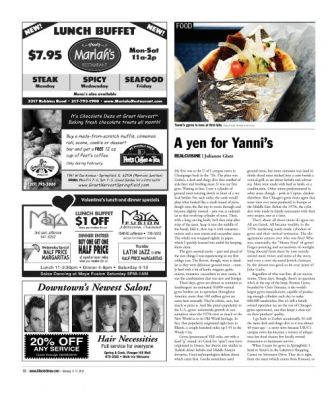
When I yearn for gyros in Springfield, I head to Yanni’s in the Laketown Shopping Center on Stevenson Drive. They do it right, from the meat (which comes from Kronos), to