High price for high schools
continued from page 11
Man with a plan
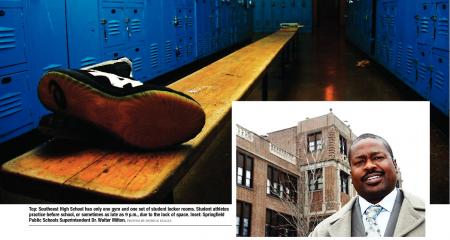
Since becoming superintendent, Milton has pushed District 186 to produce students who can compete with the best from around the world. To achieve this goal, Milton says, the district needs to design modern schools to meet the needs of its techno-savvy learners.
“I know a lot of people say, ‘Schools were good enough for me, why can’t they be good enough for the kids?’” Milton says. “But our young people deserve it. They are depending on adults in this community to deliver on our promise and our ability to do what’s right for them.”
Milton says that if school board members “stay the course” and show the community “strong, consistent decision-making,” they will convince the community that Option B is in their children’s best interest.
“We have a plan,” he says. “We’re not vacillating with that anymore. It’s out here. This is the year that we’re going to do it. And we’re going to need your support.
“No one is confused about it. Everyone knows where we’re going. We’re going right, and everyone knows that we’re going right.”
City taxpayers shouldn’t be fazed by the project’s price tag, either, Milton adds, since the $200 million-plus will stimulate Springfield’s economy and attract more residents to the capital city.
The sales tax, if raised from nearly 8 to 9 percent in Sangamon County, would direct an estimated $9 to $10 million annually toward Springfield’s school construction plan. The General Assembly created the funding source in 2007, mandating that school boards representing at least 51 percent of each county’s students agree to place it on the ballot. Springfield Public Schools represents nearly 49 percent of county students, and so would require support from surrounding school districts.
The sales tax option is viewed as attractive to voters, because its revenues are funded by county consumers, including tourists and other visitors, and are split proportionately between all county public high schools. Also, if approved, the sales tax could be used to abate property taxes.
However, Milton says, the district still might need to rely on a future property tax increase, in addition to a sales tax increase, to fund Option B. According to district estimates, a 55-cent property tax increase would be needed to equal revenues from a 1-percent sales tax increase, requiring homeowners to pay an additional $272.50 per year on a $150,000 home.
Milton sees it as an investment — increases in property taxes directly correlate to increases in property values.
“People want to come to good schools,” Milton says. “They want to come to schools that are physically pleasing, and they want to come to schools that deliver a great academic program. That increases your property values, so it’s an investment all around the table.”
Across the board
School Board President Art Moore told board members at a meeting on Jan. 20 that a property tax increase was the better option.
“In order to achieve Option B, you need to be able to fund Option B,” Moore said. “The sales tax, as we’ve been told, does not fully fund Option B.”
When the rest of the school board instead spoke in favor of pursuing a sales tax increase, Moore conceded, saying that he was open to any route that would improve high school facilities.
On Feb. 1, the school board approved 6-0, with Judith Ann Johnson abstaining, to seek support for the sales tax increase. It’s unknown when the county board will place the referendum on the ballot; Moore had previously proposed posing either a sales or property tax increase to voters in April 2011 or February 2012.
Susan White, elected to the school board in 2009, voted against Option B last November, arguing that it wasn’t the right time to ask the community to fund the plan with a property tax increase.
She explains: “If we wait until 2012 and put a property tax on the ballot, and it fails, we’ve waited two years, we have nothing, and we have to start over.”
The sales tax option has similar risks, she says, but it’s something new for the school district. It would be less demanding on homeowners and would improve educational facilities throughout Sangamon County.
Bill Looby, the other board member who voted against Option B to avoid raising property taxes, agrees that the sales tax increase is “the best of a bunch of lousy options.” He recently polled his sub-district on the south side of Springfield and found that, out of more than 200 responses, the sales tax increase was strongly favored over a property tax increase.
“It’s not a slam dunk by any stretch of the imagination, and it’ll take a lot of work to get anything through,” Looby says. “But in my view, it’s the realistic alternative.”
North-end board member Nick Stoutamyer supports seeking a sales tax increase, but suggests that the board continue researching other options. He asked Milton to put together a team of district professionals,
continued on page 14


