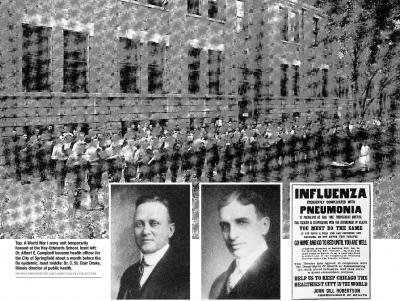
flu, Campbell had doctors give short talks about the danger of influenza before shows at Springfield’s movie and vaudeville theaters. He also told schools to send home any kids who had a cold. However, that request was “shamefully abused,” according to the Oct. 10
Illinois State Journal, and Campbell threatened to quarantine the homes of the sick.
Four days later he got tougher and said anyone with colds or flu symptoms had to stay away from the public. “Police officials have been asked to see that persons showing symptoms of influenza are isolated at once from public places,” said the Oct. 14 Journal. The same edition advised readers not to panic if they felt sick, but “go to bed, stay quiet and take a laxative.”
Poor former Springfieldian Mildred Shull got a double dose when she had the flu as a child in 1918. Her memories, recorded in 1976, are part of the University of Illinois at Springfield’s (UIS) Oral Histories (available online at www.uis.edu/archives/contents.htm). She said she was given “10 little white pills (of) calomel, two every half hour, and then a dose of castor oil.” (Laxatives like calomel and castor oil were used commonly in the 1800s to rid the body of impurities, which were thought to cause disease.)
Other Spanish flu remedies included aspirin or quinine, a potent drug which the Food and Drug Administration now says has “serious or life-threatening effects.” Home remedies abounded. The Journal newspaper recommended Vick’s VapoRub one day and lemons the next. It reported a lemon shortage because flu victims elsewhere had been so successful getting relief from “hot lemonade.” Eating raw or cooked onions worked for the Spanish, it added.
Then there were stinky spices. Shull recalled being forced to wear necklaces made with bags of the spice asafetida (or “Devil’s Dung”) during the pandemic. “Oh, how they did smell!
They stunk to high heaven!” she said in her oral history. Parents thought the stench would ward off flu germs. It certainly warded off anyone with a sense of smell.
Meanwhile, towns surrounding Springfield “were starting to shut down their theaters and schools,” says Mann. “In Springfield, though, they kind of prided themselves on the fact that they were able to keep things open because they’d started these preventive measures so soon.”
City schools called in nurses, health officials and volunteer mothers to check students daily for signs of sickness and send them home if any appeared. “It was the same at the theaters, somebody would be turned away if they had signs of the flu,” Mann adds.
But those measures weren’t enough. On Oct. 15, as local flu cases rose, the state Department of Health ordered Springfield’s theaters, pool halls and other entertainment venues closed to stem the flu’s spread. The paper said the vaudeville performers in town would take a “needed rest” or perform elsewhere.
The real threat of the virus was that it could lead to pneumonia, which often proved fatal. The situation was so bad that in mid-October the state health department made an autocratic ruling: all Springfieldians had to report anyone they knew who might have pneumonia. Visits to pneumonia patients were prohibited and even their funerals were greatly restricted. The Oct. 15 the Illinois State Journal said their funerals could only be held when the body had been properly embalmed or was enclosed in a tight casket. Violators were subject to heavy fines or jail.
But getting undertakers’ assistance wasn’t easy, according to Shull. “People were so afraid of this flu and when somebody died, the undertaker wouldn’t go in (the house) to take the body out,” she said in her UIS oral history. “They raised the window and shoved a board in. I can remember this because it made such a horrible impression on my mind as a child. They shoved this board in and the people inside would wrap the body in a sheet and lay it on that board and they would slide it out.”
On Oct. 15, the city’s health director quarantined Springfield. In addition to the already closed theaters, he shut its schools and churches and prohibited “social gatherings of all kinds.” Campbell declared that funeral services must be
continued on page 14


