We welcome letters. Please include your full name, address and telephone number. We edit all letters. Send them to [email protected].
RAIL BUSES
Springfield’s rail situation is anomalous in that it flows from an antique set of circumstances [see “Stopped by a train,” by James Krohe Jr., Sept. 17]. The reason you have these problems is because of the antique situation where the operator of the (freight) trains is also the owner of the railbed. There is no logical reason for this. If the ownership of the rails is severed from the train operators, then you get the situation you have with air carriers and truck operations: the operators pay a fee and all operators get an equal chance to run trains. That would encourage private train operators to bid for passenger rail service.
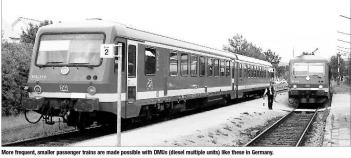
Nor does that service have to be run at a loss. The use of “DMU” equipment, that are self-propelled diesel railcars, basically allows the rails to be used with a “bus on steroids.” Modern DMUs get 2.2 mpg and can contain up to 194 passengers, so they can be quite cost-effective at lower passenger fares. The big advantage of single-car DMUs is that you can have a major increase in frequency of service; imagine cars running every hour between Chicago, Springfield and St. Louis (this is common in Europe). The DMU movement has not progressed in the USA because of the problem of access to rail trackage. Once some outside entity, either the state or a separate private operator, owns the trackage, then you will see DMU operations start.
You can only open up the marketplace to competition where access to the rails is not run as a monopoly. So a good place to start is to take over the trackage by eminent domain, and then have the state in turn rent access to the trains under the state’s terms. And yes, I have a personal interest — I am putting together a DMU manufacturing plant.
Jan van Eck ([email protected])
Ivoryton, Conn.
SIDEWALK NIGHTMARE
I was impressed by your article on hiring the disabled [see “More than able,” by Amanda Robert, Sept. 17]. My son is a disabled adult who works for the state. His job is located at First and Jefferson. He rides the bus to and from work and in recent months he has had a difficult time getting around all the barricades on sidewalks. The city is doing street work and for the past few weeks they have had four corners closed at three intersections starting at Pasfield and Washington and extending to First and Washington. The sidewalk from College and Washington to First and Washington was closed for months last winter and spring due to the Ameren cleanup at First and Washington and now both sides of the street from First to College are closed again. There is no good way for him to walk to work safely after he gets off the bus.
Closing both sides of a street for many months and then all four corners at consecutive intersections is unthinkable for the walking public and impossible for the handicapped. It is horrid the way the city ignores the needs of pedestrians, let alone the disregard they have for the handicapped.
Who speaks for them?
Margaret Wood
Springfield
SANGAMON CLEANUP
Sept. 19 was “It’s Our River Day.” Our local cleanup was from Irwin Bridge to the New Salem boat ramp. There were about 30 people on ground cleanup and 25 people in 14 canoes. We gathered 49 tires, a bike, a washing machine, a pet carrier, a 55-gallon drum that once held farm chemicals — enough trash to fill a six-ton dumpster plus a smaller one.
We would like to thank the Sangamon Paddlers, Illinois River Sweep, It’s Our River Day, New Salem Canoe Rentals for supplying boats, Friends of the Sangamon Valley for getting a dumpster, Lincoln’s New Sale State Historic Site for supplying a dumpster at the boat ramp, AT&T Pioneers, and all the volunteers.
It was really a back-breaking effort for all involved. Who would wade through poison ivy to pick up a beer bottle or pry a tire out of river mud and wrestle it up the bank? Someone who cares and is outraged.
If this 10-mile stretch yields this much trash, how much is on the entire 200 miles of the Sangamon? It’s a small dent for sure, but even a little awareness is the key to get into people’s heads not to pollute.
Mike Riley
Springfield


