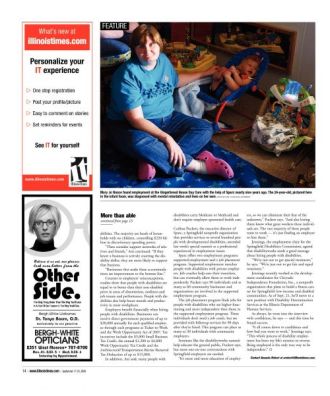
More than able
continued from page 13
abilities. The majority are heads of households with no children, controlling $220 billion in discretionary spending power.
“Then consider support networks of relatives and friends,” Ani continued. “If they know a business is actively courting the disability dollar, they are more likely to support that business.
“Businesses that make these accommodations see improvement to the bottom line.”
Counter to employers’ misconceptions, studies show that people with disabilities are equal to or better than their non-disabled peers in areas of absenteeism, tardiness and job tenure and performance. People with disabilities also help boost morale and productivity in most workplaces.
Employers benefit financially when hiring people with disabilities. Businesses can receive direct government payments of up to $20,000 annually for each qualified employee through such programs as Ticket-to-Work and the Work Opportunity Act of 2007. Tax incentives include the $5,000 Small Business Tax Credit, the annual $1,200 to $4,800 Work Opportunity Tax Credit and the Architectural/Transportation Barrier Removal Tax Deduction of up to $15,000.
In addition, Ani said, many people with disabilities carry Medicare or Medicaid and don’t require employer-sponsored health care.
Carlissa Puckett, the executive director of Sparc, a Springfield nonprofit organization that provides services to several hundred people with developmental disabilities, attended last week’s special summit as a professional experienced in employment issues.
Sparc offers two employment programs: supported employment and a job placement program. Supported employment matches people with disabilities with private employers. Job coaches help ease their transition, but can eventually allow them to work independently. Puckett says 90 individuals and as many as 60 community businesses and organizations are involved in the supported employment program.
The job placement program finds jobs for people with disabilities who are higher-functioning and more independent than those in the supported employment program. These individuals don’t need a job coach, but are provided with followup services for 90 days after they’re hired. This program can place as many as 30 individuals with community employers.
Seminars like the disabilityworks summit help educate the general public, Puckett says, but more one-on-one conversations with Springfield employers are needed.
“It’s more and more education of employers, so we can eliminate their fear of the unknown,” Puckett says. “And also letting them know what great workers these individuals are. The vast majority of these people want to work — it’s just finding an employer to hire them.”
Jennings, the employment chair for the Springfield Disabilities Commission, agreed that disabilityworks sends a good message about hiring people with disabilities.
“We’re not out to get special treatment,” he says. “We’re just out to get fair and equal treatment.”
Jennings recently worked as the development coordinator for Chrysalis Independence Foundation, Inc., a nonprofit organization that plans to build a fitness center for Springfield’s low-income and disabled communities. As of Sept. 21, he’ll move to a new position with Disability Determination Services at the Illinois Department of Human Services.
As always, he went into the interview with confidence, he says — and this time he found success.
“It all comes down to confidence and how bad you want to work,” Jennings says. “This whole process of disability employment has been my life’s mission to reverse.
Being employed is the only true way to be independent.”
Contact Amanda Robert at [email protected].