Page 15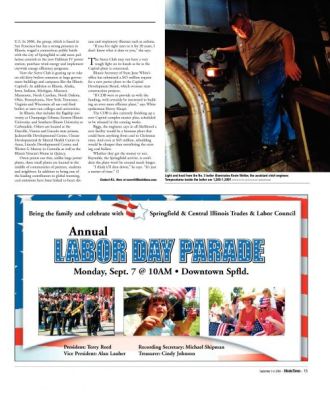 Loading... Tips: Click on articles from page |
  U.S. In 2006, the group, which is based in San Francisco but has a strong presence in Illinois, waged a contentious public battle with the city of Springfield to add more pollution controls to the new Dallman IV power station, purchase wind energy and implement citywide energy efficiency programs.
Now the Sierra Club is gearing up to take on old dirty boilers common at large government buildings and campuses like the Illinois Capitol’s. In addition to Illinois, Alaska, Iowa, Indiana, Michigan, Missouri, Minnesota, North Carolina, North Dakota, Ohio, Pennsylvania, New York, Tennessee, Virginia and Wisconsin all use coal-fired boilers at state-run colleges and universities.
In Illinois, that includes the flagship university at Champaign-Urbana, Eastern Illinois University, and Southern Illinois University at Carbondale. Others are located at the Danville, Vienna and Lincoln state prisons, Jacksonville Developmental Center, Choate Developmental & Mental Health Center in Anna, Lincoln Developmental Center, and Warren G Murray in Centralia as well as the Illinois Veteran’s Home in Quincy.
Owen points out that, unlike large power plants, these small plants are located in the middle of communities of patients, students and neighbors. In addition to being one of the leading contributors to global warming, coal emissions have been linked to heart dis ease and respiratory illnesses such as asthma.
“If you live right next to it for 20 years, I don’t know what it does to you,” she says. The Sierra Club may not have a very tough fight on its hands as far as the Capitol plant is concerned.
Illinois Secretary of State Jesse White’s office has submitted a $45 million request for a new power plant to the Capital Development Board, which oversees state construction projects.
“If CDB were to provide us with the funding, we’d certainly be interested in building an even more efficient plant,” says White spokesman Henry Haupt.
The CDB is also currently finishing up a new Capitol complex master plan, scheduled to be released in the coming weeks. Biggs, the engineer, says in all likelihood a new facility would be a biomass plant that could burn anything from coal to Christmas trees. And even at $45 million, rebuilding would be cheaper than retrofitting the existing coal boilers.
Whether they get the money or not, Reynolds, the Springfield activist, is confident the plant won’t be around much longer.
“I think it’ll shut down,” he says. “It’s just a matter of time.” Contact R.L. Nave at [email protected]. |


