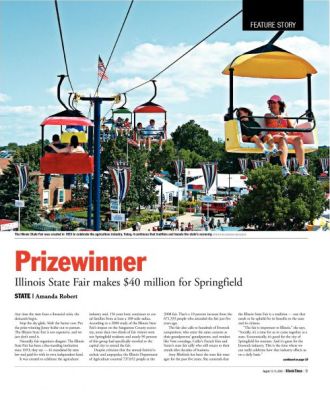
Illinois State Fair makes $40 million for Springfield Any time the state faces a financial crisis, the demands begin.
Stop the sky glide. Melt the butter cow. Put the prize-winning Jersey heifer out to pasture. The Illinois State Fair is too expensive, and we just don’t need it. Naturally, fair organizers disagree. The Illinois State Fair has been a free-standing institution since 1853, they say — it’s mandated by state law and paid for with its own independent fund. It was created to celebrate the agriculture industry and, 156 years later, continues to corral families from at least a 100-mile radius.
According to a 2000 study of the Illinois State Fair’s impact on the Sangamon County economy, more than two-thirds of fair visitors were not Springfield residents and nearly 90 percent of this group had specifically traveled to the capital city to attend the fair. Despite criticism that the annual festival is archaic and unpopular, the Illinois Department of Agriculture counted 737,052 people at the 2008 fair. That’s a 10 percent increase from the 671,333 people who attended the fair just five years ago. The fair also calls to hundreds of livestock competitors, who enter the same contests as their grandparents’ grandparents, and vendors like Vose corndogs, Culler’s French fries and Sutter’s state fair taffy who still return to their stands after decades of business.
Amy Bliefnick has been the state fair manager for the past five years. She contends that the Illinois State Fair is a tradition — one that needs to be upheld for its benefits to the state and its citizens.
“The fair is important to Illinois,” she says. “Socially, it’s a time for us to come together as a state. Economically, it’s good for the city of Springfield for tourism. And it’s great for the livestock industry. This is the time where we can really celebrate how that industry affects us on a daily basis.” continued on page 10 See also
|