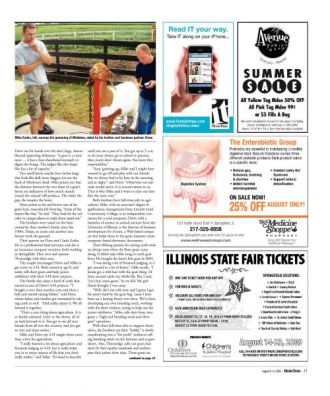
Drew ran his hands over the doe’s large, almost bloated-appearing abdomen. “A goat is a ruminant … it has a four-chambered stomach to digest the forage. The judges like this shape.
She has a lot of capacity.” Two small horns maybe four inches long that look like dull stone daggers jut out the back of Mistletoe’s skull. Mike points out that the distance between the two bases of a goat’s horns are indicators of how much muscle (meat) the animal will produce. The wider the gap, the meatier the beast.
Drew points to the red-brown coat of the goat’s lean, muscular left front leg. “Some of the buyers like that,” he said. “They look for the red color in unique places to make them stand out.” The brothers were raised on the farm owned by their mother’s family since the 1960s. Today, an uncle and another area farmer work the ground.
Their parents are Dave and Cinda Earles. He is a professional land surveyor, and she is an insurance company recruiter, both working in Springfield. They own and operate Thornridge with their sons. The couple encouraged Drew and Mike to get active in 4-H. Both started at age 8, and today still show goats and help junior exhibitors with their 4-H show projects.
The family also raises a herd of cattle that started as one of Drew’s 4-H projects. “I bought a cow, then another cow, and then a bull and started raising babies,” said Drew, whose father and mother got interested in raising cattle as well. “Dad really enjoys it. We all learned it together.
“That’s a nice thing about agriculture. It is so family-oriented. Goin’ to the shows, all of us look forward to it. You get to see all your friends from all over the country, and you get to visit and share stories.”
Mike and Drew say 4-H taught them more than a love for agriculture. “I really learned a lot about agriculture and livestock judging in 4-H, but it really helps you in so many aspects of life that you don’t really realize,” said Mike. “It’s hard to describe until you are a part of it. You get up at 5 a.m. to do your chores, go to school or practice, then you’re doin’ chores again. You learn that responsibility.”
“Sure, growing up, Mike and I might have wanted to go off and play with our friends. But we always had to be here in the morning and at night,” said Drew. “Otherwise our animals would starve. It is second nature to us. That is why Mike and I want to raise our families the same way.” Both brothers have full-time jobs in agriculture: Mike, with an associate’s degree in agribusiness management from Lincoln Land Community College, is an independent contractor for a seed company; Drew, with a bachelor of science in animal sciences from the University of Illinois, is the director of business development for eGrain, a Web-based company that helps those in the grain industry create computer-based electronic documents.
Their lifelong passion for raising cattle took an abrupt turn when the Boer goats came along. It didn’t take Mike long to catch goat fever. He bought the farm’s first goat in 2005. “I was doing a lot of livestock judging, so I got around to a lot of farms,” Mike recalls. “I kinda got a wild hair with the goat thing. I’d been around cattle my whole life. But I said, ‘Let’s buy some goats.’ So we did. My girlfriend thought I was crazy.
“Well, she’s my wife now and I guess I got bit pretty hard by the goat bug ’cause I have been on a buying frenzy ever since. We’ve been developing our own breeding stock, working with the show wethers, trying to help out the junior exhibitors.” Mike calls their foray into goats a “high-end breeding stock and show goat” operation.
With their full-time jobs to support themselves, the brothers say their “hobby” is slowly transforming into a “for profit” endeavor selling breeding stock via the Internet and at goat shows. Also, Thornridge culls out goats that don’t fit their quality standards and wethers past their prime show days. Those goats are continued on page 12 |