aren’t going to want to live in,” Sims says.
Nevertheless, he adds, “I’m convinced that if we can get one built, people will like it. We tend to be bullish about these things, but of course, it’s not my money.”
Yet new urbanists see hope. The tastes of baby boomers and empty nesters, who are increasingly giving up their larger homes for smaller digs that offer more amenities, are converging with those of their children and grandchildren, who prefer the kind of lifestyle that new urbanist communities make possible.
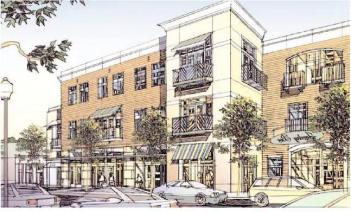
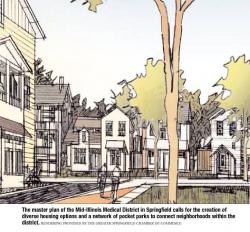
Springfield planners point to the Mid- Illinois Medical District as the perfect illustration of this. According to the district’s master plan, completed in 2005, students and medical professionals can not only rent an apartment in the same building that houses the coffee shop where they cram for exams, but also be footsteps away from their instructors, who are also living in one of the district’s neighborhoods, like historic Enos Park. Besides, people just like neighborhoods designed around new urbanist principles better than living in the burbs and having to drive everywhere, says Douglas Farr, an architect and urban planner in Chicago.
“If you show people a picture of, or take them to see a traditional walkable neighborhood with a cute little main street — oh, people just love that,” he says. Perhaps too much. John Peter Barie, the CNU-Illinois chairman, explains: “What we’ve found is that when you offer these kinds of developments, they’re instantly popular. As developers build these communities, they sell very well, quickly. People want that alternative so one of the problems is that all the new urbanist communities are very expensive. Well that’s the law of supply and demand.”
Gentrification has yet to visit Springfield’s older neighborhoods. Yet critics charge that new urbanist dwellings in major cities are out of reach for many low- and middle-income folks, further perpetuating the very race and class divisions the Congress for New Urbanism purports to oppose.
Barie offers that “people of lesser means,” who now suffer due to disproportionately high transportation costs of owning a car or being subjected to long bus and train commutes, would benefit by taking advantage of a live-work arrangement in which a person could operate a storefront business such as a barber shop or nail salon and live in an upstairs apartment.
Architect Jim Johnston, founder and president of Sustainable Springfield, says despite the grumbling of “doomsdayers and naysayers,” new urbanism has gone mainstream.
“Till Al Gore came out with An Inconvenient Truth, we didn’t take these issues seriously. Now going green is the thing to do,” he says. One of the mantras of the new urbanist movement, Johnston says, is that, “No kid should have to ride their bike more than 10 blocks to buy a popsicle.”
As the economy improves, as real estate development resumes, as the price of oil creeps upward, Johnston believes sprawl will be a passing phenomenon.
“Economics will be the driver. But sooner or later, we’re going to have to get back to basics.”
Contact R.L. Nave at [email protected]


