 NEW URBANISM THE SPRINGFIELD WAY
continued from page 12 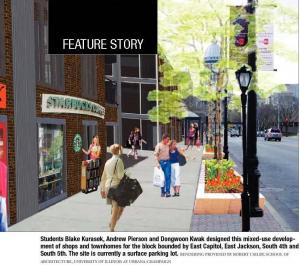 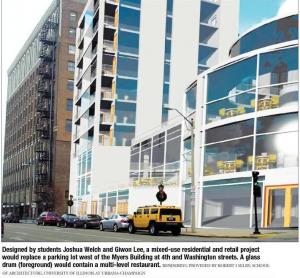
all hallmarks of new urbanism. Still, downtown still seems to be a long way from having the cineplex and swanky nightclubs the students sketched out. Paul O’Shea, the city’s planning and design coordinator, also chairs the R/UDAT follow-up committee and worked closely with Selby’s students on the AIA 150 project.
“The younger generation does not want a great job in a crummy city. We need to be a destination city for this younger generation,” says O’Shea, who maintains that progress has been made along those lines.
Efforts by such groups as Downtown Springfield, Inc. and Springfield in Bloom have helped land the city on a number of prestigious “tops” lists of greenest, smartest and coolest cities in the U.S. Those honors help boost tourism.
“That’s no small item,” O’Shea says. When the natives complain about things being done for tourists, O’Shea says it should be noted that visitors provide valuable wordof-mouth.
They go home and tell people how cool downtown Springfield is. “When they consider moving, they remember us.” With that foundation in place, the next step is to entice firms to develop more residential units in favor of more lucrative downtown office space. O’Shea insists that there is fervent demand for downtown living, and that would “ignite” more services geared toward downtown neighbors.
Norm Sims, executive director of the Springfield-Sangamon County Regional Planning Commission, sees it as a classic chicken-and-egg dilemma.
“In order to attract amenities to downtown Springfield, more people will have to move downtown, but nobody’s going to move there unless more amenities are offered,” he says. Obstacles to new urban development — downtown or elsewhere in Springfield — are manifold.
Despite new urbanism having existed as an urban design movement for more than two decades, the types of
pedestrian-friendly neighborhoods new urbanists envision — with
businesses and residential dwellings compacted in a small area — are
still considered experiments in most places. “The younger generation does not want a great job in a crummy city. We need to be a destination city for this younger generation.”
Banks, therefore, which are set up for either home loans or business loans, haven’t figured out how to structure mixed-use loans. In addition, zoning regulations, which over time have come to favor sprawling suburbs over development of the inner-city, make it less of a headache to convert a cornfield into a big-box chain retailer than to tackle urban infill projects.
“Developers don’t want to build something people don’t want to buy. And lenders don’t want to loan money for something people |


