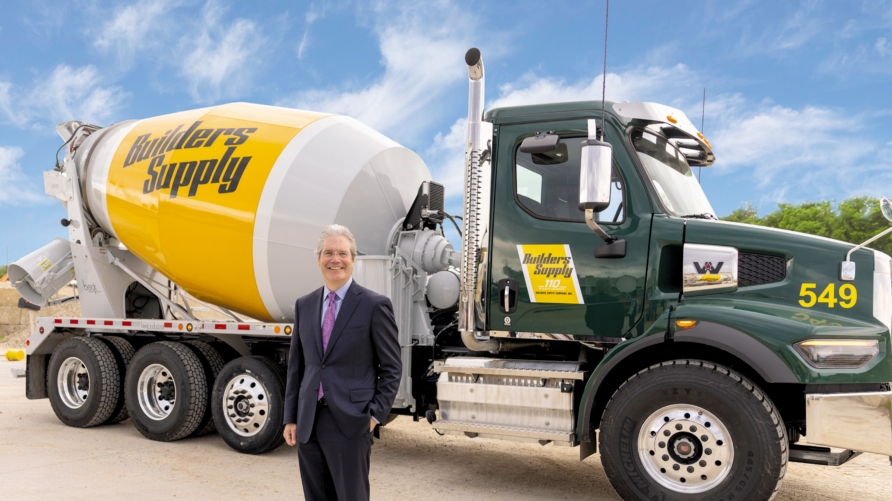
G. Carlton Golden Jr. is working with the NRMCA to reduce our carbon footprint to net-zero by 2050. Company’s president has some solid ideas about the future
G. Carlton Golden Jr. is president of Builders Supply Company, a leading regional concrete supplier to the construction industry. He was recently elected to serve as secretary/treasurer of the National Ready Mixed Concrete Association (NRMCA) board of directors.
Golden has served on the NRMCA for 14 years and served four terms on its executive board.
He said his selection would be a good thing for the local area. “I believe it’s going to help the local region with some things we can do in research and development. Not only that, but I’ll have a say in the national and global part of our industry.
“Concrete is the most used material on the planet,” Golden explained. “[NRMCA has] worked since 2014 to reduce our carbon footprint by 20%, with a net-zero carbon footprint by 2050. We actually started this back in the 1990s to reduce our carbon footprint as an industry. We reduced it 40% by the early ’90s.”
He said that effort is necessary in the modern industrialized global economy. “I am of the opinion that anything we can do to be a good steward and a good corporate citizen, we need to be doing. I’m eager to learn new ways, smart ways, that we can cut our carbon footprint and be able to meet that goal with reasonable solutions.”
The task will not be easy, he said.
Currently, the United States only delivers about 3% of cement production for the world. Europe accounts for about 6%, while India totals about 12%. The elephant in the room is China, which is responsible for 76% of global concrete. “If you look at the whole world, and the [U.S.] cement industry eliminated all the carbon, it would
only have a 3% effect on the globe. So, it’s critical for this to be a
global initiative, is to have these global companies sit down with us
and have discussions with us,” Golden said. He is anxious to use his new
position to move that initiative faster. He said some common sense
steps can be taken to help.
“Buying
raw materials closer to your location so you don’t have to have
expensive transportation. Using trains instead of trucks to deliver your
raw materials and using barges if the mileage is shorter and it’s
feasible.
“Another
thing is optimizing mix designs. Using less cement per yard to get the
same specified strength. By reducing the cement content, that’s reducing
your carbon footprint, and it’s also saving you some dollars and your
customers dollars.”
Having spent his working life in the industry, Golden is interested in the technologies that are setting the future of cement.
New
technology has reduced the energy needed to produce a ton of cement by
15%. By using artificial intelligence, manufacturers can find more
efficient routes to deliver materials and products. Golden said the
industry is sophisticated enough to make the adjustments necessary to
meet new standards without compromising quality and safety.
“We’re looking at bridges that have lasted
for 50 years,” like, he noted, “the Jimmie Davis Bridge. Look at I-20,
It’s lasted for 60 years. Both of those were designed for 50-year life
cycles. Today, we have the technology to last a 150-year life cycle at
only a 3% or 4% higher total cost of the project.”
Golden
has a number of things on his “bucket list” he’d like to achieve from
his new position in the industry. “There’s something called eco-friendly
concrete. This concrete uses a form of magnesium sulfate which
eliminates a lot of the carbon produced in making cement. It also
absorbs carbon dioxide as it hardens. It pulls it out of the atmosphere.
We’re working with M.I.T. and our research lab in trying to develop
that.”
They
also look into concrete’s role in colonizing places like the moon and
Mars. Some of the research being done uses sulfur instead of water and
utilizes materials available on their surfaces to make concrete. “It’s
two and a half times the strength of concrete that we traditionally use,
and it reduces cement in the concrete tremendously. It not only has a
chance on Mars or the moon, but it will also help us find some other
ways to decarbonize [on Earth], too.”
Builders
Supply has come a long way from hauling concrete with mules and wagons
in the early 1900s to the first ready-mixed concrete trucks in Louisiana
in 1932 and an almost ubiquitous fleet of cement mixers building
Louisiana’s infrastructure.
“The
federal government is not allowing any cement mills to be built,”
Golden said, “so cement is in short supply. With those challenges, if
you’re a small operation, it’s very difficult to compete in a market
that you have global competition. We’ve competed with Martin Marietta,
with Texas Industries, with Holcim Cement. We’ve had global competition
even in this market here.”
Still,
the company retains its smalltown roots. “Nothing beats being able to
go to Home Depot or Walmart and rub shoulders with people you know. You
have generational friendship there,” Golden said.
And
he looks to the future with optimism. “I think there are going to be a
lot of interesting things that are going to happen in our lifetimes.”


