For more than 40 years, the esteemed North Louisiana artist Clyde Connell made sculptures, paintings and mixed media objects that offered deep reflections on her surroundings. From detailing the bayou landscapes of Lake Bistineau to chronicling the pervasive inequalities in life for people of color and women, Connell created artworks that were at once educational, intriguing and beautiful. In crafting each piece, she aimed to capture what she referred to as the “human condition” in its complexities. As I walked around artspace, taking in the works in the Critical Mass 10 exhibition, a question continued to surface: Should all art have a purpose of educating viewers today? When we consider visual works such as Andy Warhol’s 1962 Campbell’s Soup Cans and Gordon Park’s photographs commissioned by the Farm Security Administration in the 1940s, we begin to
realize visual art has been a vehicle for igniting change for many
decades. It also becomes apparent that an artwork’s educational purpose
can vary widely, whether the subject matter prompts a literal or figural
theoretical interpretation.
In
fact, when a beautiful still-life painting of a plant, a place or a
friend creates a sense of wonder to the extent that it stops a viewer in
their tracks, it becomes a powerful form of meditation. In a world that
is overwhelmingly demanding, the encouragement to slow down and really
see our surroundings is tremendous — a fact surely reinforced throughout
the past two years. By offering a unique viewpoint, artists can teach
their audiences with each work they create. Through an array of media,
subjects and techniques, the more than 100 artists from across North
Louisiana displaying their work together in Critical Mass 10 reminded me
of this.
Observing
the many works on view, it was clear that a number of artists in the
area are using a vibrant color palette as a primary tool to interpret
this moment in time. Kathryn Usher’s repetitive stitching in a panoply
of colors on her tattered linen duster begs questions of labor in
life and work. In Ellen Soffer’s painting “Summer Light, Blue Lake,”
the artist’s bright, beautifully mixed pigments create a dynamic tension
between abstract shapes and natural, undulating edges. And John
Wagoner’s work, “Paint Pathology,” is an energizing hallmark for the
exhibition. The process he employs of building up color and material to
peel away and uncover is a refreshing approach to painting. Each of
these works calls for pause and for the viewer to consider how the artist’s intentions might transfer beyond the work’s surface.
The
most captivating works in the Critical Mass 10 exhibition, however,
transport the viewer to a different time and place. From its alluring
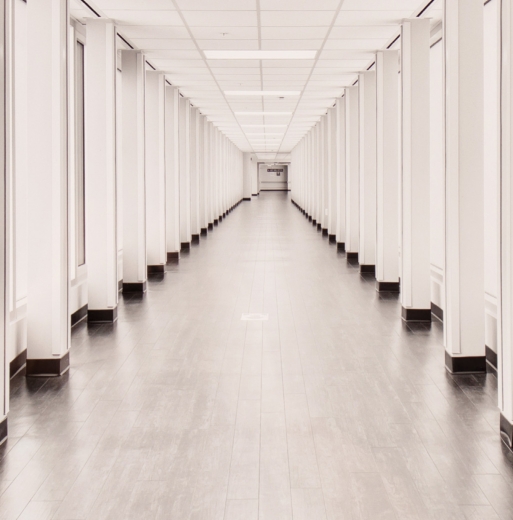
composition to the sobering subject matter, Debra Roberson’s photograph,
“A Votré Santé” — Highland hospital hallway to the cancer wing —
beckoned me back numerous times, bringing to mind Connell’s approach to
capturing the “human condition” and garnering the artist the Critic’s
Choice award. Whether you approach this black-and-white photograph with
curiosity or caution, the rhythm of the columns flanking the hallway
captured in this photographic work is likely to ignite deep emotion, be
they feelings of joy, suffering or wonder. When looking at this work,
each viewer brings their experiences and memories from a hospital or
clinical setting to the table, experiences often defined by one’s
gender, race, age or geographic location. And it is not lost on most
that Louisiana has the fifth-highest rate of cancer mortalities in the
United States. While you may or may not have experienced a long walk
down the hallway
Roberson illustrates, she invites you in, encouraging acknowledgment of
what is and of empathy. In both her photograph on view and her ongoing
body of work, Roberson’s powerful photographs continue the important
legacy of artists not only capturing our surroundings but challenging us
to consider our place in these landscapes and society.
Emily
Wilkerson is a writer and curator based in New Orleans, La. A
Shreveport native, Wilkerson’s writing has been featured in publications
ranging from “Art in America” and “Artforum.com” to multiple exhibition
catalogs, including those for the third, fourth and fifth editions of
“Prospect New Orleans.”