Properties see new light after community picks up
Living in the city brings with it many good things: fine dining, entertainment options and opportunities to advance. But with all the good of city life, it does have its ugly side: urban blight.
Neglected and blighted properties have been part of Shreveport’s growing pains for years, said City Council District B representative LeVette Fuller.
“It’s no bigger than it was two years ago,” Fuller said of the issue of blighted properties. “It’s just everyone’s decided they are paying attention. It’s kind of like the boiling frog thing. You don’t know you are (in) raising temperature until you hit the boil.”
Blight Battle Goes Viral 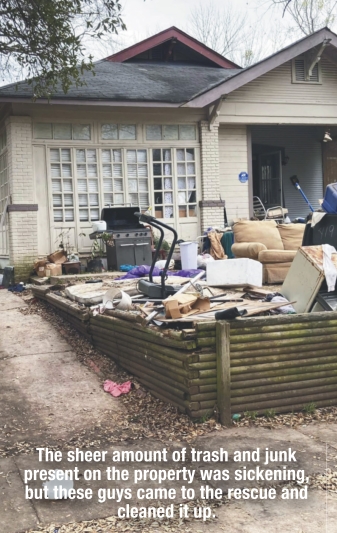
What began as a personal crusade in the Highland neighborhood escalated quickly into community activism and civic pride. In the end, neighbors, volunteers and local officials proved the adage about teamwork: together, everyone accomplishes more.
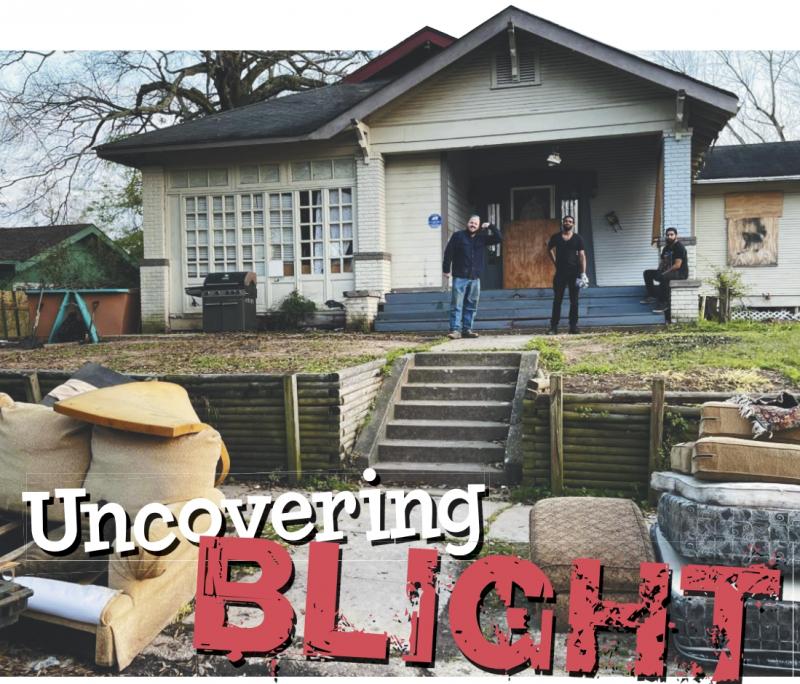
Turaeza Lopez lives in the Highland neighborhood, near the corner of Gilbert and Dalzell. For a couple of years, she watched as a house on that corner fell further and further into disrepair. Frustrated, she took to Facebook to voice her concern.
“I wanted to get people’s attention, like LeVette (Fuller) and John-Paul (Young),” Lopez said. “They have tons to do. But it was my livelihood. I drive by it every day. I didn’t let up about it. I wanted people to understand it breaks my heart.”
Another neighbor across the street from the dilapidated property described what he saw develop there over time.
“There was everything from broken-down bicycles and lawnmowers to broken-down weight benches and home furnishings,” the neighbor said. “There were several large rugs left out for weeks on end. All of it was left out in the elements for weeks and months on end. Nothing was protected from rain. There was no care shown for the items.
“A
U-Haul showed up there during the snowstorm. We thought it was going to
get cleaned up. But they were actually adding to the accumulation. They
were making it worse, not better.”
Lopez
posted photos of the dilapidated property on the Highland Neighborhood
Facebook page. The post, and the comments that ensued, caught the eye of
page administrator James Carstensen, and he started investigating.
James
Carstensen also lives in the Highland neighborhood and knew the
property had been an eyesore for almost two years. He said he discovered
that Giglio Plumbing bought the property about a year ago and inherited
a situation with squatters living in the house. But the new owners
faced legal challenges to removing the squatters during the COVID-19
pandemic because of a moratorium on evictions, he said.
Carstensen closely monitored the post and the comments associated with it. That’s when the dominoes started to fall.
“Jamar
Montgomery said we should get a dumpster and clean it up,” Carstensen
said. “I talked to some attorney friends. They said if you get
authorization from the property owners and there are no tenants, then
it’s just picking up garbage and junk. I met with the neighbors and
discovered the squatters had abandoned the property. Tess (Lopez) called
the Giglios and got authorization to clean it up. Then I called and
made plans for a dumpster.”
A
host of volunteers from the neighborhood, property standards and others
joined together to clean up the property. When it was all said and
done, more than three dumpsters full of trash were removed, as well as
furniture and other bulk items.
Caddo
Commissioner John-Paul Young lives two blocks from the property and
drives by it every day. He said he had watched the situation
deteriorate.
“It was
bad over the last year or so,” Young said. “There was a bunch of stuff
added to the yard. Property standards did a sweep and got it cleaned up.
But it seemed like minutes later, it was filling up again. I am friends
with the couple who live across the street from there. They have such a
pretty spot, and we would look at the junkyard that was developing next
door.”
Young volunteered to pick up some of the trash that city sanitation workers could not haul away.
“City
services are more expensive than we pay for,” he said. “Expecting more
without paying more just doesn’t work. Instead of taking the long route,
private citizens just went over and did some cleaning."
“Looks
like a completely different house this afternoon,” Carstensen posted on
Facebook on March 22, along with photos of the cleanup efforts.
“Got
property standards to pick up last of bulk items, and I had one more
dumpster hauled off from the driveway! House is still full, but I
secured it with plywood and four-inch deck screws ... nonetheless, it's
got a completely different curb appeal now!” Another post on the
Highland Neighborhood Facebook page asked about the status of a
burned-out, dilapidated property at the corner of Gilbert and
Rutherford. Soon after that post, Fuller posted a Facebook Live video declaring that property standards was on the way to that location to clear the rubble.
Fuller
said that while these specific issues of blight in the Highland area
have drawn attention through social media, blight is not as big an issue
there as it is in other Shreveport neighborhoods.
“The
concentrations of blight in Highland are not nearly as intense as in
other areas,” she said. “Part of that might be the capacity for
community. People who are intrigued by and curious about being in the
Highland area have been there trying to fight to hold onto it.”
More at Risk
The issue of blight is broader than property standards and values, too.
“It’s
also a mental health and crime issue,” Fuller said. “There are studies
that show that mitigating blight can decrease crime and show also that
mental health issues improve when you remove the same blight. You can
look at the crime map and see over time where blight is removed, things
calm down. You can also go through and survey those neighbors and find
that they feel better.”
Fuller said blight also influences economic development when businesses come to scout Shreveport as a possible location.
“The
biggest issue is the way we take care of people that are vulnerable in
this community,” she said. “It says a lot about a community when the
people who have the least are treated poorly. That’s not a government
thing. That’s a community thing.”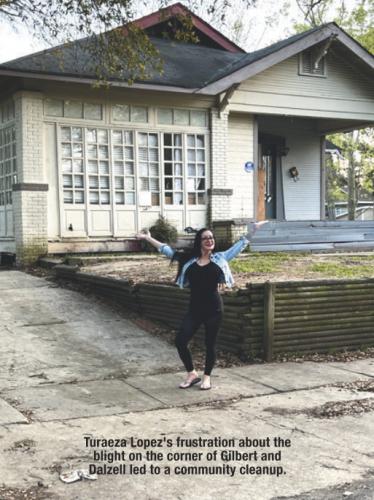
It also is a community health issue. Researchers at Louisiana State University, including Rebecca de Jesus Crespo, studied
two
adjacent but socio-economically diverse neighborhoods in Baton Rouge.
Their study found that the lower-income neighborhood had higher
incidence of the Asian tiger mosquito (a carrier of Zika and dengue)
than the higher-income neighborhood.
The
researchers examined the prevalence of two container-breeding species
of mosquitoes known to spread disease, the Asian tiger mosquito and the
southern house mosquito (a carrier of West Nile virus). They inspected
potential larvae habitats — discarded tires, discarded Styrofoam cups
and snack bags, plant pots and water baths —
in publicly accessible locations and calculated the percentage of those
that contained larvae. Additionally, they placed adult mosquito traps
around the perimeter of some private homes with permission from the
homeowner and in an abandoned house and an empty lot with trash
accumulation in the higher-income neighborhood.
They
found that the adult population of the southern house mosquito was
fairly diffuse. The lower-income neighborhood had significantly higher
numbers of Asian tiger mosquito (adults and larvae) and higher numbers
of total mosquito larvae. This shows that the presence of discarded
container habitats due to neglect provides more breeding grounds for
disease-carrying mosquitoes, disproportionately affecting lowincome
groups.
“I think
everybody can agree that urban blight is a problem we need to solve,” de
Jesus Crespo said. “Mosquito risk is one of those factors that could
impact human health, and that adds another level of importance with
that.”
Walking it Out Together
The
Highland Restoration Association hosted a meeting on March 25 at
Columbia Park to update residents on the data behind these issues and
ways to strengthen the neighborhoods. And Fuller said more volunteer
efforts are being organized to clean up Shreveport’s blighted
neighborhoods.
Private citizens acting on their civic pride is part of solving the problem.
“I
think citizens cleaning up their neighborhood doesn’t have to be a
process and a procedure,” Young said. “Government bodies are doing other
stuff. Getting the government to change track is a lot harder than
going and cleaning up a mess.”
The neighbor said that when the squatter abandoned the property, Castensen and the neighbors rallied.
“Once
he abandoned ship, we were left with a pile of garbage,” the neighbor
said. “At least it was quiet garbage. Now we have a perfectly quiet
corner. (Carstensen) did the Lord’s work on this deal.”
Carstensen said social media played a positive role in the cleanup efforts in his neighborhood.
“In
this situation, it certainly got a lot of exposure after the fact,” he
said of Facebook. “It played a role in pulling together people who
already knew each other. I have a reputation for getting things done. I
saw the post and linked people up to get the job done.”
Lopez said she believes that motivating the citizenry to act is key.
“People
need to get out there,” she said. “They need to have a voice and say we
aren’t going to stand for this anymore. John-Paul and LeVette can’t fix
everything, but we as a community can.
“I
want a safe community. I want a pretty community. Any town that has a
historic district is beautiful, except ours. We need the city’s help. I
do appreciate the community support and the support of our councilwoman
and our commissioner. As a community we are stronger."
Moving Forward
Fuller
and the Reform Shreveport organization are working on mapping the
city’s blighted properties, many in the Queensborough and Caddo Heights
neighborhoods. Fuller said teams of volunteers drove the area, plotted
specific locations on a map and uploaded photos and descriptions of the
issues.
When that data
was collected and analyzed, Fuller said it revealed a trend about
blight in several neighborhoods and Shreveport’s growth.
“The
city has actively disinvested in Queensborough and Caddo Heights for
longer,” she said. “Even if you do hold onto Highland, that doesn’t mean
you can get these back without some work.
“Every
time we have annexed on, that’s more infrastructure to take care of
without reinvesting here. If we reinvested here, we might be living
within our means right now. What’s reinvestment? Better infrastructure.
No one’s going to buy property here and invest in fixing it up, if you
still have open ditches where other areas have sidewalks.”


