A mistake does not have to define who you are
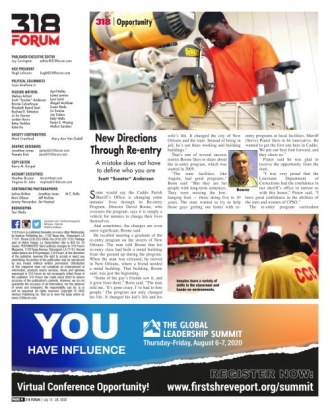
Some would say the Caddo Parish Sheriff’s Office is changing some inmates’ lives through its Re-entry Program. Director David Boone, who oversees the program, says it is simply a vehicle for inmates to change their lives themselves.
And sometimes, the changes are even more significant, Boone said.
 He recalled meeting a graduate of the re-entry program on the streets of New Orleans. The man told Boone that his re-entry class had built a metal building from the ground up during the program. When the man was released, he moved to New Orleans, where a friend needed a metal building. That building, Boone said, was just the beginning.
“Some of the guy’s friends saw it, and it grew from there,” Boon said. “The man told me, ‘It’s gone crazy. I’ve had to hire people.’ The program not only changed his life. It changed his kid’s life and his wife’s life. It changed the city of New Orleans and the state. Instead of being in jail, he’s out there working and building buildings.”
That’s one of several success stories Boone likes to share about the re-entry program, which was started in 2009.
“The state facilities, like Angola, had good programs,” Boon said. “But they are for people with long-term sentences. They were missing the lowhanging fruit — those doing five to 10 years. The state wanted to try to help those guys getting out faster with re entry programs at local facilities. Sheriff (Steve) Prator likes to be innovative. He wanted to get the first one here in Caddo. We put our best foot forward, and they chose us.”
Prator said he was glad to receive the opportunity from the state.
 “I was very proud that the Louisiana Department of Corrections had the confidence in our sheriff’s office to entrust us with this honor,” Prator said. “I have great confidence in the abilities of the men and women of CPSO.”
The re-entry program curriculum includes
education and training in victim awareness, substance abuse, reentry
support, communication, health and wellness, and counseling. Boone said
the program benefits from a wealth of volunteers who come in to teach
the various components of the curriculum.
Boone
said it is vital to get community volunteers because they are
professionals and experts in their given fields. Also, graduates are
more apt to use their services after meeting them in the program.
“Nobody
wants me to teach them money management,” he said. “What I thought was
better was to ask banks if they would teach the money management part of
it. If they come in and teach that class, the students have a face and a
name. So if they want to work on money management, get an account or
establish credit, they can go to that bank and ask for that person.”
The
crux of the program is employment skills training and job placement
assistance. Louisiana Technical College (LTC) sponsors the program.
Students learn carpentry skills in the classroom and hands-on
environments. When they complete the program, they receive a certificate
from LTC.
Students
get much of their hands-on training by working on projects with local
non-profit organizations, including the YMCA, the Fuller Center, Heart
of Hope and the Family Justice Center.
“We could do the whole class here, but when we go out on-site, they are learning how to work,” Boone said.
 Another
element offers fathers in the program a chance to connect with their
children. Sci-Port Discovery Center comes to the re-entry program and
teaches science to the fathers in the group.
Another
element offers fathers in the program a chance to connect with their
children. Sci-Port Discovery Center comes to the re-entry program and
teaches science to the fathers in the group.
“They
teach them science projects, like rockets and electrical stuff,” Boone
said. “The following week, a caregiver can bring the children in, and
the fathers teach their kids.”
Boone said the COVID-19 pandemic has changed the program.
Students
are not able to take the carpentry classes right now, and all other
classes are being taught by correspondence instead of in person.
The
program has averaged 600 graduates a year, Boone said. Once they finish
the program, graduates are eligible for 120 days of good-time credit on
their sentence. That early release saves the state $1.6 million a year
not having to house the inmates. And it gives the graduates an earlier
start on a second chance.
“I
saw a man in Lowe’s, and he just wanted to shake hands and said, ‘Man,
your program changed my life.’ I was quick to tell him that did not
happen. We offer it to over 600 a year, and it does not change all their
lives. There are those who are changed, but the program did not change
their lives. They did.”
Prator said the program is a reflection of his office’s commitment to those in its care.
“The
re-entry effort changes some inmates so they are able to reach their
potential,” Prator said. “They realize a mistake doesn’t define who you
are. This program and the effort it takes clearly show the CPSO cares
for inmates and doesn’t just ‘house’ them.”