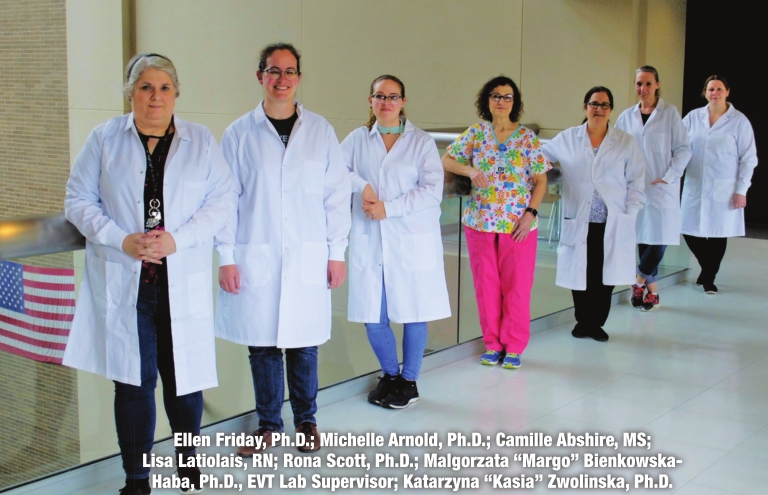
Not all heroes wear capes. Some wear lab coats.
The Emerging
Viral Threat (EVT) Lab at LSU Health Shreveport was set up and fully
functioning in less than two weeks to address the need for faster
detection and increased testing for SARS-CoV-2, the virus that causes
COVID-19. While it was, and continues to be, a real team effort of many
people from a variety of specialties to accomplish this undertaking, an
essential group of this team are the female researchers.
“Our
unique team of women made this vision a reality. They are the true
beating heart of the lab,” said Andrew Yurochko, Ph.D. “Without them,
there is no way this would be possible. Their effort has been so
incredible. As a group, they have worked the longest and hardest hours.
They are really the superheroes.”
These 21st century “Rosie the Researchers” are the boots on
the ground in the EVT Lab, and their superpowers include building a
diagnostic lab in 14 days, expanding testing in Louisiana, and making
sure SARS-CoV-2 tests are processed quickly and accurately.
Rona
Scott, Ph.D., associate professor and Mingyu Ding Endowed Professor of
Microbiology and Immunology at LSU Health Shreveport, has taken on a new
role as supervisor of the EVT Lab and is part of a team of 14 people.
She is a genomics expert and the “glue” that holds the lab together. “We
came together in a time of need and used our skills to fight the spread
of the virus in Louisiana. This team of women provided the critical
expertise and were essential in getting the EVT lab up and running. Dr.
Ellen Friday, director of the Feist-Weiller Precision Medicine Lab,
guided us through the validation and regulatory components of diagnostic
testing. Dr. Michelle Arnold, assistant professor of microbiology,
established lab protocols. Camille Abshire, genomic research specialist,
set up the molecular assay and instrumentation. Lisa Latiolais,
registered nurse, was on the front lines with her team of nurses getting
samples for testing. Drs. Margo Bienkowska-Haba, research specialist,
and Kasia Zwolinska, post-doctoral fellow, contributed their prior
clinical expertise and were instrumental in the lab design, assay
development and workflow. In a short two months, we have processed over
5,000 samples and will continue testing so that our community stays
healthy and gets back to work,” said Dr. Scott.
When a specimen comes to the lab, the samples go first into the pre-processing room, where the patient
information is entered. Then, the samples move into the “hot” room,
where all samples, some with potentially live virus, are manipulated for
analyses. Here, samples are loaded into the robot, which they
affectionately named “Wall-E.” This is a labor-intensive step that puts
the team in contact with possible live virus. Everyone is in full
personal protective gear, and have to work carefully and diligently
handling hundreds of patient samples with help from the robot in the
extraction of RNA. The now-isolated samples are collected from Wall-E
and brought to the PCR lab, where the qRT-PCR assays provide the result
as to whether the patient’s nasal swab is positive or negative for the
virus.
While this team of wonder women is extremely
well-trained, moving from their usual research lab environment to
establishing diagnostic testing in such a short time frame was a
challenge. “The fact that they were able to meet this challenge and
adjust so quickly speaks volumes about their character and their skills.
LSU Health Shreveport is lucky to have this type of dedicated faculty
and staff on campus,” said Dr. Yurochko. “Because of their commitment
and attention to every detail, our lab can make sure every report is
accurate.”
Like
we see in the movies, these superheroes answered the call to help in a
critical time of need, but instead of wearing special uniforms and
capes, these women wear white lab coats.


