
New studies examine how conversation and longevity are impacted
A pair of new studies takes a look at Alzheimer’s disease and dementia.
One has good news for caregivers, particularly spouses and other family members, who often can struggle to communicate with a loved one who’s been diagnosed with Alzheimer’s or dementia. The study examined how caregivers can improve their communication skills when taking care of a family members suffering from the disease. The other study looked at how the disease affects life expectancy.
Alzheimer’s disease and dementia affected 35.6 million people in 2010, and the number is expected to grow considerably as longevity increases.
As dementia progresses, patients have increasing difficulty communicating their needs and emotions, as well as interacting with those around them.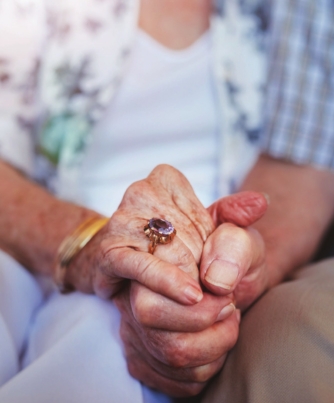
Communication problems lead to misunderstandings or misinterpretations, and can add stress to family members already experiencing the strain of caring for a sick loved one.
But a new study shows there can be hope. Researchers at Florida Atlantic University found that certain techniques can help. The study, published in Issues in Mental Health Nursing, also includes a tool that couples can use to measure their communication.
“There has been very little focus on the patient with dementia’s role in maintaining spousal relationships through conversation,” says Christine L. Williams, a professor at Florida Atlantic University and principal investigator of the study. “Maybe it’s because researchers assume that the patient can’t have a positive influence on communication because of dementia. We wanted to explore this issue further, especially for couples with a history of special memories shared over decades of marriage.”
Researchers examined conversations between patients
and caregivers to see what effect the 10-week communicationenhancement
course had on their communication levels. Communication techniques for
caregivers included clear, succinct and respectful communication that
avoids testing memory or arguing. Spouses with dementia were also given a
chance to practice communication with researchers who were trained in
communication deficits. Then couples tried conversing on a topic for 10
minutes using their new skills.
“There
are very few studies that have looked at actual communication between
couples in these circumstances and tried to analyze it,” Williams says.
“For instance, I’ve seen studies where they have taught communication
strategies to caregivers, but then what they measure is the caregiver’s
knowledge about communication, which doesn’t tell you anything about
whether or not they were able to communicate.”
One
thing Williams’ team considered that isn’t often looked at is nonverbal
behaviors used in communication. While many people might consider words
to be the largest component, nonverbal behaviors actually make up more
than 70 percent of communication. Some nonverbal behaviors – like
aloofness or staring into space – can impede communication, while others
– like looking at the other person or being affectionate – can enhance a
conversation.
Social
behaviors like responding to questions and using a partner’s name or
nickname can also enhance communication. Shouting, cursing or
communicating in an unintelligible way can negatively affect
communication.
Another
recent study, this time from the Mayo Clinic study, aims to answer the
question that many patients ask when faced with a serious disease – how
long will I have to live?
Published in JAMA Neurology, the
study took a look at how Lewy body dementia (the second most common
degenerative brain disease after Alzheimer’s) affected life expectancy.
“As
doctors, we want to be able to counsel our patients appropriately when
they ask, ‘What will happen to me?’” says Dr. Rodolfo Savica, Ph.D.,
lead author and a neurologist at Mayo Clinic. “Understanding long-term
outcomes can help clinicians better inform patients and their caregivers
about what to expect.”
By
taking a look at data from 1991 through 2010, doctors were able to
determine that patients with dementia tended to die about four years
earlier than the general population.


