
green and healthy all season long
Ahealthy lawn is your best defense against lawn diseases and other problems. But when the weather favors the disease more than your lawn, problems can occur.
Reduce the risk of disease by keeping your lawn healthy. Mow high to encourage deeply rooted grass that is more drought-tolerant and resistant to disease problems. Water early in the day so the grass leaves, blades, dry quickly and less water is lost to evaporation.
Apply the right type and amount of fertilizer at the proper time to limit the risk of disease. Regular fertilization, three to four times per year, encourages better results since most soils do not contain the essential nutrients for optimum growth.
Avoid high-nitrogen, quick-release fertilizers that promote lush, succulent growth that is more susceptible to disease. Instead, use a low-nitrogen, slow-release fertilizer like Milorganite (milorganite.com) that promotes steady growth that’s more drought tolerant and resistant to disease.
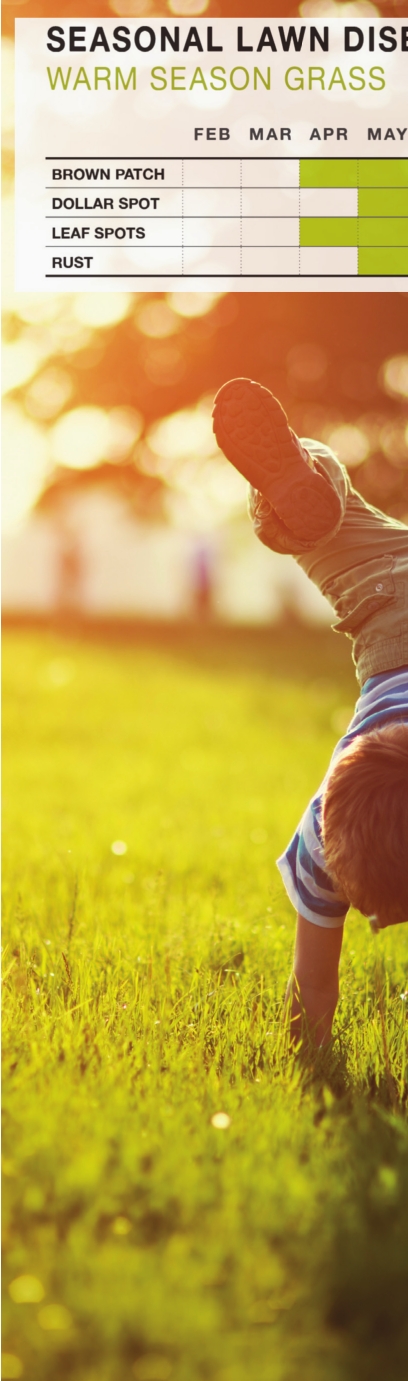
Monitor lawns for Brown Patch when temperatures and humidity rise and grass remains wet for long periods of time. Infected lawns will have somewhat circular patches of thin, light-brown grass. Look for white, cottony strands of fungal mycelium early in the morning on dew-covered lawns. Check grass blades for small, irregular tan spots with darkbrown borders on the individual grass blades. Avoid heavy fertilization with fast-release fertilizer in early spring and summer.
Look for dollar-size to six-inch diameter spots of bleached or light tan grass if you
suspect Dollar Spot. Infected leaves have white lesions with reddishtan
margins that often resemble an hourglass. Over- and under-fertilization,
drought, water on the grass blades for extended time and mowing too
low, all increase the risk of this disease.
Closely
examine lawns with a reddish hue to confirm the presence of rust
disease. Rust-infected lawns are covered with an orange or yellowish
powder, the fungal spores, that can leave an orange residue on your
shoes. Newly seeded and lawns weakened by inadequate fertilization and
drought are most susceptible.
Stay alert for leaf spot diseases that can attack lawns. Avoid excess fertilization and watering late afternoon and evenings.
Once
you discover a disease, visit Milorganite.com for more detailed
information and photos to help with diagnosis. Correct your lawn care
practices to speed recovery and avoid problems in the future. Proper
care and reseeding dead areas with diseaseresistant grass varieties is
usually enough to manage the disease. Be sure you need a fungicide
before applying. These chemicals are costly, the results can be
disappointing, and when used improperly, they can be harmful to
pollinators and the environment.
Further
speed recovery with a change in mowing habits. Continue to mow high but
cut the healthy portions of your lawn first. Then cut the grass in the
diseased areas. Once done, use a disinfectant to clean the mower blades,
then rinse with clear water. This, along with collecting and disposing
of clippings from the diseased areas of the lawn, reduces the risk of
spreading the disease next time you mow.
Provide
proper care and monitor your lawn throughout the growing season.
Discovering problems early means better results with less effort on your
part.
Melinda Myers
has written over 20 books, including “Small Space Gardening” and the
“Perfect Lawn” series. She hosts The Great Courses’ “How to Grow
Anything” DVD series and the nationally syndicated “Melinda’s Garden
Moment” TV & radio segments. Myers is a columnist and contributing
editor for Birds & Blooms magazine and was commissioned by
Milorganite for her expertise to write this article. Myers’ web site is www.melindamyers.com.