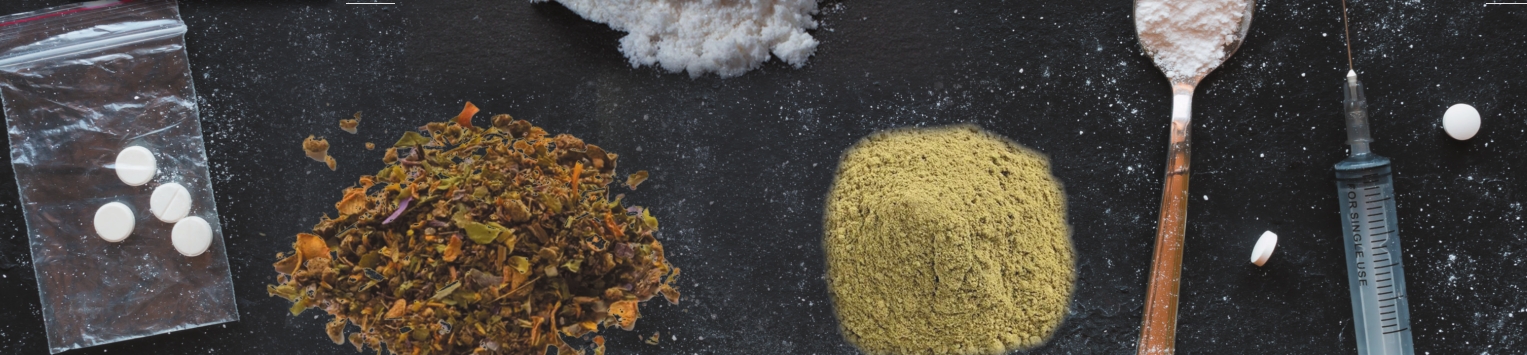
A “ROGUE’S GALLERY” OF DESIGNER DRUGS
It is said that “any drug that has the power to do good has the power to do harm.” Some current designer dugs were originally synthesized for study purposes, but they’ve escaped onto the street.
Synthetic cannabinoids (a.k.a. mojo, spice, K-2) 
Designed for pharmaceutical research in pain management, synthetic cannabinoids (marijuana-like drugs) are used for recreational drug use. They are easy to get through convenience stores, tobacco shops or head shops. A typical drug test won’t pick them up. There’s no way to describe general effects among all the different chemicals because they’re all different. Each version will have different effects at different dosages. It is impossible to know exactly what chemicals the drugs contain or how much a user is taking.
Synthetic cannabinoids can cause intoxication and death. Many of these drugs have been banned in this country, but dealers have found ways to keep variants on the market.
No studies have been conducted on their effects on humans. Compared to marijuana, adverse effects are often more severe: fast heartbeat, high blood pressure, blurry vision, nausea and hallucinations, epileptic seizures and psychosis.
Doctors are becoming careful to try and detect possible
use of these synthetics in their patients with presenting psychosis,
especially when the reason for the psychosis isn’t clear. Episodes can
continue to occur for a few months after the patient has stopped using.
Kratom (Mitragyna speciosa, a.k.a. ketum)
The
leaves of the kratom tree are used for pain relief. Kratom is a
stimulant at lower doses; at higher concentrations, it’s a sedative. It
can create episodes of psychosis, and it can be addictive. Kratom
targets the brain’s opioid receptors. Some researchers have noted that
kratom doesn’t produce respiratory depression as do other opioids, and
there’s work in progress to study it further to see if some of the
compounds made from it can have medical benefits.
Flakka (a.k.a., gravel)
So-called
“bath salts,” banned in 2012, are making something of a disguised
comeback in flakka (Spanish slang for a beautiful woman, “la flaca”),
which produces a cocaine-like high. Flakka can be smoked, snorted or
injected, and it has the potential to be much more dangerous than
cocaine. Even a small overdose can produce methamphetaminelike symptoms:
delirious excitement, violent behavior, spikes in temperature and
paranoia; however, it is most famous – even notorious – for evoking
PCP-like super-strength.
Flakka works in
ways similar to cocaine and methamphetamine, although its effects last
far longer. There is great concern that the damaging effects of the drug
may be permanent. Another possibly permanent result: People who survive
a flakka overdose may have to be on dialysis for the rest of their
lives.
Although
the FDA has placed a temporary ban on flakka, one way to circumvent the
ban is to label the substance “not for human consumption.” Nonetheless,
a ban might at least serve to discourage potential users.
2C group (so-named due to their chemical structure)
When
MDMA (Ecstasy) was banned in the U.S. in 1985, 2C drugs became a quick
replacement. In 1994 the main derivatives were declared illegal, leaving
the possibility open to sell variants legally. In clinical studies,
psychotherapy using MDMA itself has shown promise as a possible
treatment for disorders like post-traumatic stress disorder and anxiety.
Desomorphine (a.k.a. krokodil)
Krokodil
first appeared in 1932. It is a synthetic opioid with powerful,
fast-acting effects, such as sedation and analgesia. While more
effective than morphine for rapid relief of severe pain, its side
effects appear to outweigh any advantages. It is easily bootlegged, and
the process often introduces contaminants, making it even more
unpredictable and dangerous.
Krokodil has been
dubbed the “flesheating drug” because of tissue damage among addicts.
Even in small doses, there is a high potential for addiction.
25I-NBOMe (2C-I-NBOMe, cimbi-5 (a.k.a. n-bomb, smiles)
N-bomb
appeared as a common recreational drug in 2010. It is a psychedelic
used recreationally and in biochemistry research for brain mapping.
25I-NBOMe
has effects that are similar to those of LSD. Apparent overdoses have
occurred when it is taken by mouth, under the tongue, between the gums
and cheek, on blotter paper, and through the nose.
U-47700 (a.k.a. U4, pink)
A
research chemical known as U-47700, or pink, has been cited as the
cause of dozens of deaths across the U.S., including the 2016 overdose
death of Prince, caused by combining fentanyl and U-47700.
U-47700
was intended to treat severe pain, but it was never tested on humans.
It ended up being relegated solely to research. Pink and fentanyl have
been combined and sold on the street as a kind of bootleg Norco. It
causes a sense of relaxation and sedation. The downsides are its
tendency to create marked respiratory depression and drug dependence.
Kent Dean, PhD, LAC,
has been active in behavioral health counseling since 1975. He is CADA’s
(the Council on Alcoholism & Drug Abuse) director of Clinical
Development.


