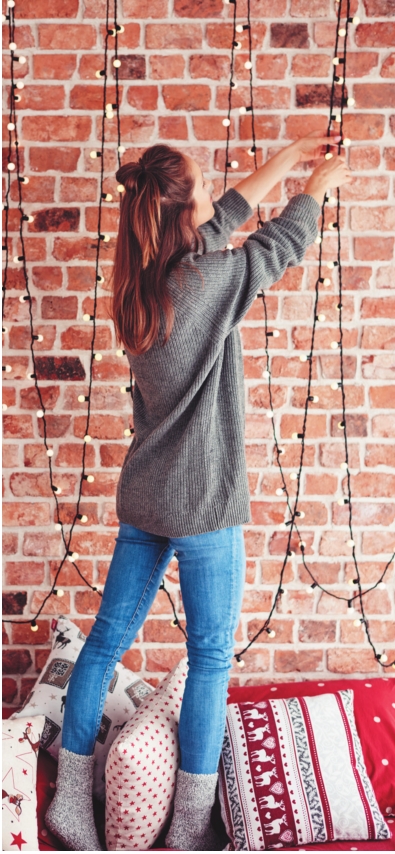
Be careful with electricity
The holiday season brings a subtle feeling of urgency among us all. Whether it’s shopping, finding the perfect dress for the seemingly bajillion parties, cleaning up the house to host friends and family, or realizing it’s Dec. 15 and you’re still without a Christmas tree, there’s a lot going on before the joy Christmas Day brings.
“You
can’t rush and be focused,” said SWEPCO’s Safety and Health Manager
Tony Rash. “This is a time when we are pulled in so many different
directions; we don’t want to turn somebody down for a holiday activity
or party. Yet we also have to take time for our own family.”
This means keeping a focus on safety during the haste of the season. “When we rush, we tend to make mistakes,” added Rash.
Of
course, safety is always key – and it’s a broad term at that. Let’s
focus on electrical safety at your home, because while electricity is
part of our daily lives, it is especially so during this time of year.
Keep in mind these safety recommendations for you and your home this holiday season:
Check for fraying.
When
you remove your holiday lights from storage, check the cords to make
sure they are not frayed or otherwise damaged. Hanging lights with
damaged cords can lead to an electrical short. This can damage your
other lights and holiday decorations, as well as potentially lead to a
fire. If you discover damaged strings of lights, throw them away.
Make the switch to LED.
If
you throw away damaged strings, LED (light-emitting diode) string
lighting uses about 90 percent less energy than standard incandescent
string lights, which means the cost to light a typical tree with LEDs is
about $1 per season. One hundred LED holiday lights will run you about
20 bucks and will pay for themselves with the first year’s energy
savings. LED lights generate much less heat, are cool to the touch and
can last more than 10 years.
Verify proper rating.
Bargain lights aren't a good deal if they pose a fire hazard. Only use lights that have
been tested and rated by Underwriter's Laboratory (UL) or Intertek (ETL
Semko). Strings of lights that have a safety rating are clearly marked,
both on the packaging and with labels attached to the electrical cords.
Speaking
of extension cords, “folks are buying the green extension cords for
their yards because you can’t see them,” said Rash. “But that’s the
problem: You can’t see them. Be sure your extension cords do not create
tripping hazards in the yard for family and friends.”
Use as directed.
There
is a big difference between indoor holiday lights and outdoor holiday
lights. Select lights appropriately and never use indoor lights outside
because they are not designed to be waterproof and could short circuit.
Outdoor lights, on the other hand, are usually hotter than indoor and
could pose a hazard if placed on a tree.
Also,
follow the manufacturer’s instructions for using tree lights. All
lights should be fastened securely to the tree, but never with
conductive wire. Bulbs should not come into direct contact with needles
or branches on natural trees. Though they don’t emit much heat, it could
eventually be enough to dry out the tree limbs.
Choose locations carefully.
Avoid
hanging holiday lights near any item that poses a potential fire
hazard, such as candles, space heaters, fireplaces, etc. Make sure bulbs
aren't too close to loose paper or any other flammable materials that
present a safety hazard.
Flip the switch.
When
you leave the house or go to bed, be sure all lights are turned off.
Disconnect lights by pulling the plug, not by yanking on the cord.
Always: Remind children never to touch lights or outlets.
For additional electrical safety tips, visit the National Safety Council’s website at NSC.org.