Community
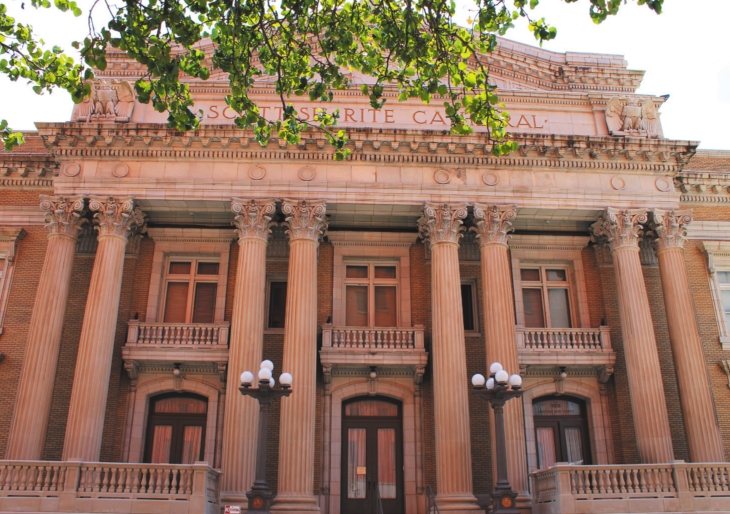
Driving south on Common Street out of downtown Shreveport affords motorists with the most expansive view of the Scottish Rite Cathedral. Located at the corner of Common and Cotton, it was completed in July 1917.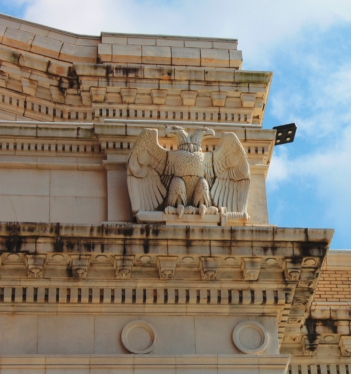
The impressive structure sits in a footprint of 133 by 110 feet. It stands as a sort of gateway to the Common Street Viaduct and the on-ramps to I-20 and the suburbs beyond. In 1917 dollars, the final cost of construction was $186,477.28. Many of the building’s original furnishings are still in use, as well as many original fixtures. There has been some modernization. Air conditioning and an elevator have been added over the years. Last year, the front entrance was updated to make it more accessible for visitors.
Renowned architect Edward F. Neild, a member, was commissioned to design the edifice. His design includes a three-level auditorium capable of seating 500, a wardrobe room, a marble lobby, a pair of matching marble staircases, a kitchen, a banquet hall, a masonic library, a parlor, as well as offices and classrooms.
 Other buildings Neild designed include A.C. Steere School; the Shreveport Municipal building;
Robinson Hall at Louisiana Tech; the Maricopa County Courthouse in
Phoenix, Ariz.; Bossier High School, Fair Park High School and C.E. Byrd
High School. Neild is also credited with the design of the Shreveport’s
Shriners’ Hospital for Crippled Children, the first Shriners’ hospital
in North America.
Other buildings Neild designed include A.C. Steere School; the Shreveport Municipal building;
Robinson Hall at Louisiana Tech; the Maricopa County Courthouse in
Phoenix, Ariz.; Bossier High School, Fair Park High School and C.E. Byrd
High School. Neild is also credited with the design of the Shreveport’s
Shriners’ Hospital for Crippled Children, the first Shriners’ hospital
in North America.
As
interesting as the overall architecture is for historians, the
intricacies of the detail provide far more insight into the Scottish
Rite. In the details of the woodwork are symbols that have great meaning
to the Masons who meet there. The interior boasts paint and moldings
that continue the themes inherent in the Masonic tradition.
The
symbolism is carried down to the smallest details. The number of
sconces in each room has an historic significance, according to Troy
Jones, an official with the local chapter. Careful examination of the
medallions in the extensive molding reveals other symbols. Robert
Langdon, the movie symbolist/hero, would be right at home in these
ornate corridors.
The
lobby boasts portraits of the local members and state and national
officials. The portraits each depict a member who is still alive. On
other floors, members who are deceased are displayed. This leads to the
very Masonic rejoinder of “I’m still in the lobby,” when asked how they
are doing.
The
Scottish Rite of Freemasonry is one of two divisions of Masonic
membership. It has been defined as a secret order whose object is mutual
assistance and the promotion of brotherly love among its members.
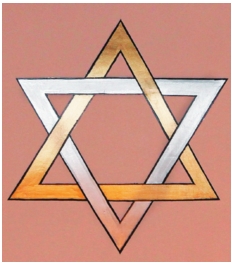
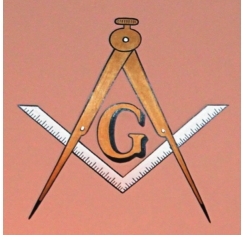
Some notable historic figures who were Freemasons include George Washington and Benjamin Franklin.
According
to Jones, “People say we’re a secret society, but, I mean, we’re in the
phonebook. We have a society that is like a board. Board meetings are
not open to the public. We have meetings where things are passed down
from mouth to ear.”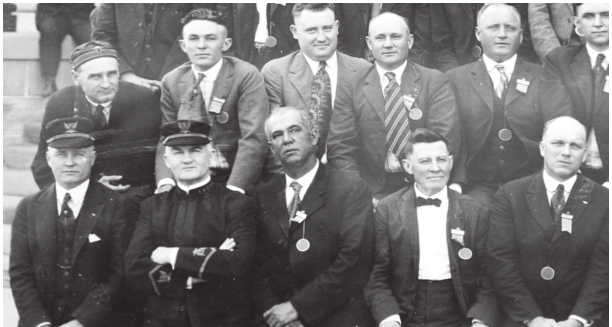
Probably
to most of the people who walk or drive past the building every day,
the day-to-day activities inside the Cathedral are as mysterious as the
“secret” rituals of Freemasonry. Children in need of speech therapy from
across Louisiana are assisted by the Masons. The Cathedral is used as a
speech and language center for those children. Other speech and
language centers are located in Shreveport, Monroe, Baton Rouge, Hammond
and Lafayette but are all headquartered out of the building in
Shreveport. All of this therapy is provided free of cost to the
children.
Jones
said local membership is over 600 men, and is 1.6 million in the United
States. He said the basic tenets, the socalled landmarks, of
Freemasonry have not changed since the order was formalized in 1717 in
England. The Ancient and Accepted Scottish Rite of Freemasonry is
commonly known as the Scottish Rite. It is one of several groups that
are part of the worldwide fraternity known as Freemasonry. Scottish Rite
is the largest and most widely practiced Masonic Rite in the world.
To
mark the centennial anniversary, the Cathedral held a dinner on
Thursday, Sept. 21, with a program entitled “Who We Are, What We’ve
Done, and What We Represent.” It included recognition of dignitaries, a
time capsule dedication, presentations and reception of guests.
Tours
of the Cathedral are not only conducted, but encouraged, said Jones.
Anyone wanting to visit can inquire about a tour by calling
(318)221-9713. The Cathedral maintains a website with history and
additional information at http://shreveportscottishrite.com.
According
to Jones, “We believe in the fatherhood of God and the brotherhood of
man,” and by walking the halls of the Cathedral, it becomes obvious they
also believe in intricate architecture, high symbolism and preservation
of America’s historic treasure.


