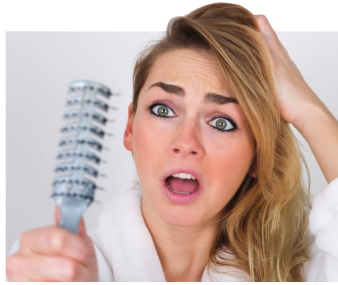
“My hair is thinning. What do I do?”
I often hear this question from patients, and that’s not surprising. Hair loss is a common problem among men and women, and it can be very distressing. Millions of people suffer from this problem.
People normally lose around 50-100 hairs per day. However, if you note increased shedding, bald patches or a rash in the scalp, you should consult a dermatologist immediately. We have treatments for many types of hair loss, but early intervention is important.
By far the most common type of hair loss in the United States is androgenetic alopecia, or “male- or female-pattern baldness.” Men have a receding hairline or thinning of the hair over the top of the scalp. Women commonly note a gradual widening of the middle part line. This form of hair loss may be hereditary or seen in conditions that involve hormonal imbalances, such as polycystic ovarian syndrome.
People taking anabolic steroids may also experience this form of hair loss.
Fortunately, we have treatments for this condition,
which we, ideally, begin in the early stage of the hair loss process.
Minoxidil 5% foam or solution is a safe FDA-approved treatment for hair
loss in both men and women. It is applied daily to the scalp to
stimulate hair growth. I caution patients not to expect results
overnight. It takes four to six months of use to achieve significant
benefit from this medication.
An
oral medication treatment, finasteride, has been FDA-approved for men.
It helps to slow hair loss and even stimulates hair regrowth in a
significant percentage of users. It works by stopping the production of
the male hormone DHT. For femalepattern hair loss, a medication called
spironolactone is often prescribed, but the FDA has not yet approved it
for this purpose. Other treatments for androgenetic alopecia include
laser combs/light devices, hair transplantation and platelet-rich plasma
injections.
Another
very common form of hair loss is telogen effluvium. This condition
occurs when a larger-than-normal number of follicles convert to the
shedding phase or telogen phase. Patients find themselves with this
condition after childbirth, when they stop or change hormonal
contraceptives, or after stressful events such as surgery, illness or
emotional distress. We also must rule out underlying conditions such as
thyroid disease or iron deficiency anemia. People with eating disorders
or diets low in protein may also experience hair loss. Certain
medications such as birth control pills, vitamin A derivatives or blood
pressure medications may contribute to hair shedding. The good news is
that, once the stress has been eliminated or the nutritional or hormonal
problem has been corrected, the hair loss should improve.
One
type of hair loss that we see most often in African-American female
patients at our clinic is central centrifugal scarring alopecia. It
appears as a smooth patch on the top of the scalp that radiates outward.
Patients may also note tenderness, burning or tingling.
Sometimes
hair loss is caused by an autoimmune condition. This is known as
alopecia areata. Patients develop circular bald spots throughout the
scalp. Skin conditions such as psoriasis or dandruff may cause hair
shedding, and infections such as ringworm may also cause hair loss. All
of these require medical treatment and should be addressed with a
dermatologist.
Hair
care is important as certain practices may damage the hair shaft or
cause actual hair loss. Bleaching or use of permanents may be damaging
to the hair, so limiting the frequency of these is important. When
possible, avoid the blow dryer or flat iron and allow your hair to air
dry. Tight braids or sew in styles can pull the hair and cause traction
alopecia.
Hair
is one of those things that can contribute to our self-confidence, but
hair loss is very common and has many different causes. If you note any
unusual hair loss, don’t delay treatment. A visit to a dermatologist
will allow you know the cause and then initiate treatment at the
earliest stage. As with most medical problems, the earlier we catch hair
loss, the better the treatment outcome.
Sarah
Baker is a partner at Ark-La-Tex Dermatology with offices in Bossier
City and Shreveport and is part of the Willis-Knighton Physician
Network.


