Fais Do-do with Robert Trudeau
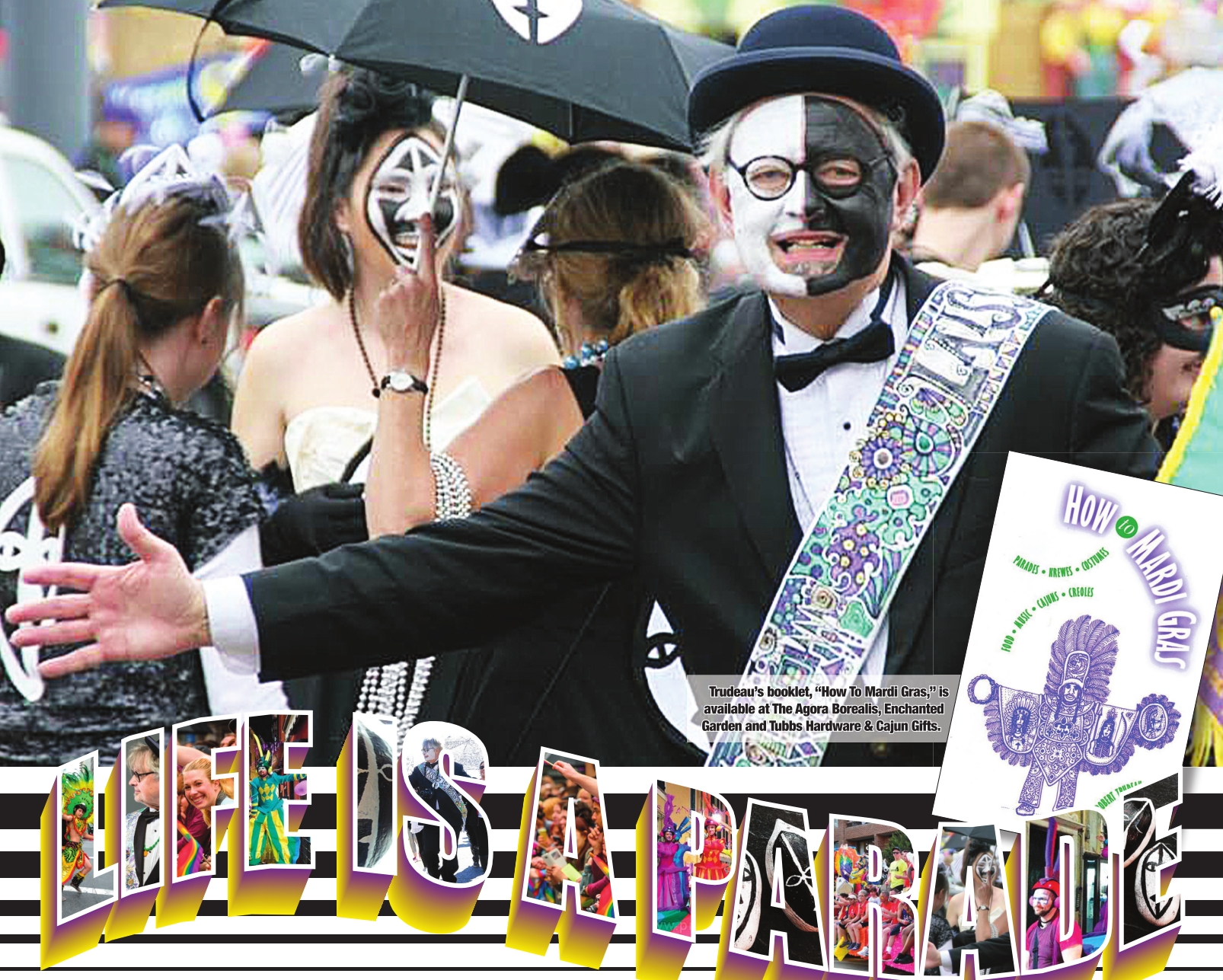
MARDI GRAS SEASON 2017 is already in full swing, yet this year seems to bring a bit more reflection as one of its most loved celebrants is transitioning to a new stage in life. Krewe of Highland member Robert Trudeau recently retired from his 35-year gig as a Caddo Magnet High School teacher, but no one really sees him slowing down much.
As an artist, Trudeau is an author, illustrator and musician, having actively purused his love of sketching, such as an album cover and T-shirt for the rock band Romulus Remus. He has won awards for video and music production from the Shreveport Regional Arts Council and projects funded by the National Endowment of the Arts. He received a PRIDE Award from the Shreveport Bossier Convention & Tourism Bureau in 2012 for communication through his Blog Aficionado. He has a long list of juried awards as well. His book “Illustrations for How to Mardi Gras” has sold 5,000 copies.
Perhaps Trudeau’s most iconic identity, however, is his place at the head of the deliciously interpretive Blanc et Noir Marching Society, the group in black -and-white dress carrying umbrellas in an authentic Second Line. The idea of Blanc et Noir was conceived by Trudeau and his friends Jerry and Tarama Davenport. In fact, one of Trudeau’s most successful videos has been “How To Second Line,” which can be viewed at www.youtube. com/watch?v=bpwlPh0k40U.
“Blanc et Noir is the product of watching the late Pete Fountain and his Half-Fast Marching Club ramble downtown on Fat Tuesday, and the Garden District Carnival Club on St. Charles Avenue, too,” Trudeau explained. “We hire a brass band, have a brunch at Marion Marks’ lovely house, and lead the Krewe of Highland parade. It’s a four-mile second line, and it is not easy to keep strutting at mile three. But the band and onlookers provide the necessary energy.”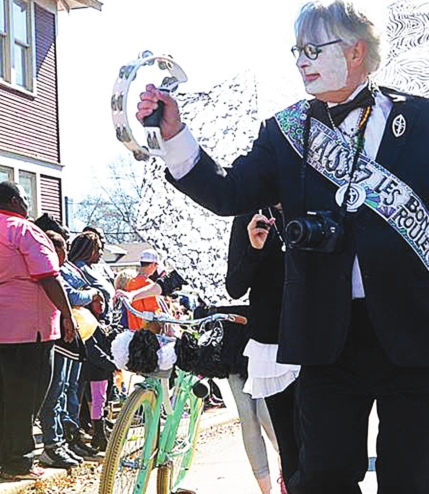
Blanc et Noir is set to unveil a new signature throw this year. Each painted pecan is an individual hand-held work of art and sure to become the most coveted throw in the Krewe of Highland Parade. “The painted pecan was introduced by member JoLinda Redling,” Trudeau added, “who created a super-cute, twotoned pecan with googly eyes. Somehow that design morphed into the easier-tomake painted pecan that you see today.
Marion Marks has put pounds of pecans through a wash of white acrylic paint and distributed them to members for the finishing touches. The ones in my photos were decorated by Talbot Hopkins and Madeline Trudeau Kawanaka. But many additional society members have taken markers and made their own. They are not meant to be hurled to the crowd, but handed out individually – like a painted coconut in the Zulu parade.”
Trudeau’s
passion for Carnival theatrics began when he was a boy living in New
Orleans. “Growing up with an uncle, my parrain (godfather), who was a
member of Rex and other krewes, I absorbed New Orleans Carnival from an
early age. He lived on the corner of Milan and Baronne, so the family
watched parades on St. Charles at Milan Street, about two blocks from
Fat Harry’s.”
 “Part
of the fantasy of viewing, dancing and leaping to the parades as a kid
was in knowing that someday I would participate by doing much more than
catching beads,” Trudeau added. “Knowing that one day I would be making
the parade music that made me shiver because it was so beautiful and
energizing.”
“Part
of the fantasy of viewing, dancing and leaping to the parades as a kid
was in knowing that someday I would participate by doing much more than
catching beads,” Trudeau added. “Knowing that one day I would be making
the parade music that made me shiver because it was so beautiful and
energizing.”
“The
Benedictine monks who taught me in high school at St. Joseph Seminary
enhanced my love for the academic and writing life,” Trudeau said. “For
me, life in NOLA was like being free to ramble while backstage
at the circus. In truth, the Crescent City was costumes, drumming,
architecture, red beans and rice, beer, freedom to be an artist … it was
and is a romance.”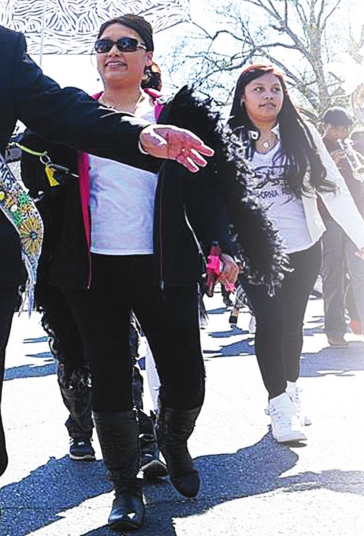
That
cultural and educational gumbo that Trudeau experienced growing up led
to one of his favorite pastimes. “Sketching people and objects around me
has always been a way of reaching out to people,” he said. “Students
always loved my sketches. Girls and friends and family, too. Sketching
has also been a defense, a way to protect myself against painful forms
of anxiety.”
It
was without a doubt Shreveport’s gain when Trudeau accepted a teaching
position here at Herndon High School after graduating from University of
New Orleans. “Soon, I was teaching social studies at Bethune High
School in the Mooretown neighborhood of west Shreveport,” he said. “My
lanky locks and granny glasses earned me the nickname ‘Steppenwolf.’
Life-long friendships were begun in ‘Mo’town,’ partly because my
after-school student jam session led to a rock band that played talent
shows at Booker T. Washington, Southern University and Bethune.”
When
Huntington High School opened, Trudeau joined the faculty there, where
he also sponsored another rock band and gathered students who remain
life-long friends. “During that time, I free-lanced as a writer for the Shreveport Journal as
well as almost every alternative news rag that appeared, such as the
‘Real Paper.’” Of course, not the least of his contri- butions to our
area is, as Trudeau refers to it, “the ability to teach English or
social stud- ies.” “I was chosen for the first faculty at Caddo Mag-net
High School. I stayed involved at Magnet for the next 35 years. The
school’s s philosophy was pian. Students were trusted utoand given
freedom of movement and flexibility in regards to classes and
off-curriculum activities. Teachers were held in esteem. Campus life was
enlivened not by pep rallies but by an abundance of dance, music and
drama performances.”
 “Perhaps
the biggest change that I noticed over the decades was in the attitude
of the faculty and administration,” Trudeau said. “Once, Magnet was a
school where the attention was on the subject matter. Today, Magnet is a
school dedicated to teaching individual students, regardless of their
academic status. To this day, a visit to Caddo Magnet High School feels
like a visit to a college campus. The tone is scholarly, student
groupings remain mixed and
flexible, and teachers are actively respected. The cafeteria is orderly
and joyous, the campus is not littered, and students do their best to
make each class on time.”
“Perhaps
the biggest change that I noticed over the decades was in the attitude
of the faculty and administration,” Trudeau said. “Once, Magnet was a
school where the attention was on the subject matter. Today, Magnet is a
school dedicated to teaching individual students, regardless of their
academic status. To this day, a visit to Caddo Magnet High School feels
like a visit to a college campus. The tone is scholarly, student
groupings remain mixed and
flexible, and teachers are actively respected. The cafeteria is orderly
and joyous, the campus is not littered, and students do their best to
make each class on time.”
Trudeau
has an endless legacy at Caddo Magnet High School, but some of his
highlights include a project with fellow teacher Ken Lerchie to promote
campus investment by firstyear students. “Once a year, I led the
freshman class in raising money and gathering shovels for tree
planting,” Trudeau said. “As a result, the campus on the Stoner Avenue
side is lined with colorful crepe myrtle trees, all planted by
14-year-olds.”
The
north end of the Coates Bluff Trail adjacent to Magnet called out to
Trudeau to enrich the art and education curriculum with a healthy dose
of outside. “With the support of parents and principals, hundreds of
students have accompanied me on scores of hikes along this forest
classroom,” he said. “They learn to identify sycamore, cypress and
cottonwood trees. They are watching the changes that occur in the Bayou
Pierre slough as new housing is built in the Riverscape development.”
And then last year, Trudeau’s youngest son, Jett, a
student at Tulane University, told him that Friday mornings at Tulane
included donuts and jazz in the quad before classes. Jett said, “You
should do that at Magnet.”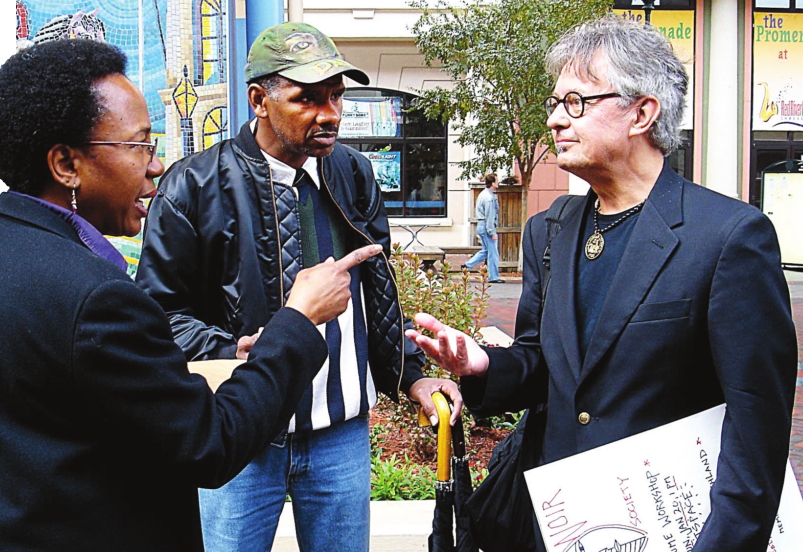
“With
the aid of teachers Bill Knox and Ken Lerchie, the Friday morning
series of informal performances enlivened Friday mornings at Magnet all
last year,” Trudeau said, beaming. “Soon, they will resume on a new
outdoor stage built by principal Michael Ilgenfritz with such talent
development in mind.”
While
building a full and wonderful life and guiding others to do the same,
Trudeau has remained absolutely smitten with Mardi Gras. His 36-page
booklet called “How To Mardi Gras” is a perennial seller. “I think the
reason it has held up well is because of the research. I spent some 10
years collecting articles from New Orleans magazines and papers and the New York Times and
in collecting books on Carnival. It remains in circulation because I
publish it. It’s for kids, and it’s for teachers – a classroom set makes
a great couple of days of learning – and for oldsters and for
visitors.”
Trudeau also spreads the carnival cheer with his interactive lectures on Mardi Gras, called “Fais Do-do with Robert Trudeau,”
and a New Orleans-style marching band. “Weddings, meetings and such
events are given the Louisiana street jazz touch when people hire the
Shreveport Second Line Brass Band.”
“For
me, Mardi Gras is a treasure chest discovered on a sandy beach,”
Trudeau explained. “Exploding from the trunk are dance and music,
historic foods and rituals, costumery and mystery. It represents a
blending of African, indigenous, Cajun, Creole and Anglo cultures. It is
silly and even absurd. But it is also a long stream of laughter. People
pushing ratty lawnmowers as floats, people strolling under a decorated
umbrella doing nothing but smiling. No beads, no frenzy … just
strolling.”


