Mounted officers help control crowds, cut down on crime during Mardi Gras
“A mounted officer, in a crowd, can do the work of 10 officers on foot,” said Cpl. Ryan Owen. “The size and strength of the animal, along with the coordination between the mounted officers, make up a force that cannot be matched by a crowd.”
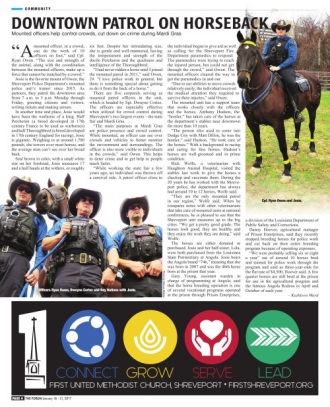
Josie is the favorite mount of Owen, the Shreveport Police Department’s mounted police unit’s trainer since 2015. As partners, they patrol the downtown area from 7 a.m. to 3 p.m. Monday through Friday, greeting citizens and visitors, writing tickets and making arrests.
In another time and place, Josie would have been the warhorse of a king. Half Percheron (a breed developed in 17th century France to be used as warhorses) and half Thoroughbred (a breed developed in 17th century England for racing), Josie is gigantic. Weighing in at around 1,700 pounds, she towers over most horses, and the average man can’t see over her broad back.
Seal brown in color, with a small white star on her forehead, Josie measures 17 and a half hands at the withers, or roughly
six feet. Despite her intimidating size, she is gentle and well-mannered, having the temperament and strength of the docile Percheron and the quickness and intelligence of the Thoroughbred.
“I had never ridden a horse until I joined the mounted patrol in 2011,” said Owen, 29. “I love police work in general, but there is something special about getting to do it from the back of a horse.”
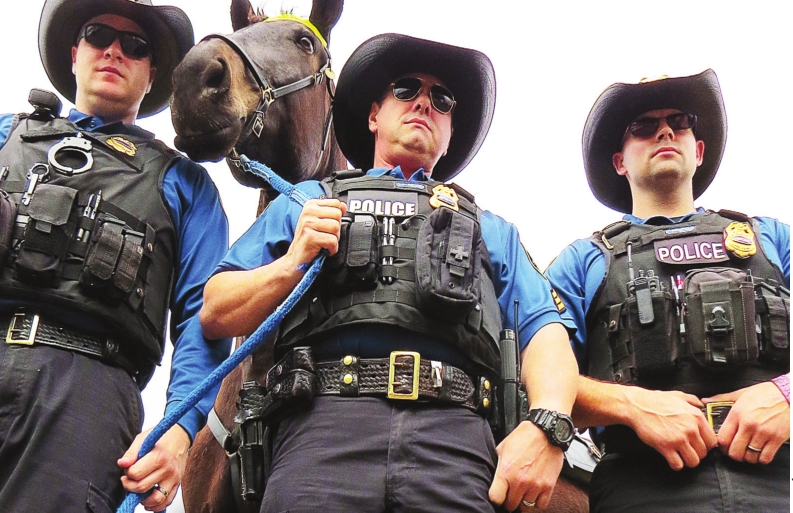
There are five corporals serving as mounted patrol officers in the unit, which is headed by Sgt. Dwayne Cortez. The officers are especially effective when utilized for crowd control during Shreveport’s two largest events – the state fair and Mardi Gras.
“The main purposes at Mardi Gras are police presence and crowd control. While mounted, an officer can see over crowds and vehicles to better monitor the environment and surroundings. The officer is also more visible to individuals in the crowds,” said Owen. This helps to deter crime and to get help to people much faster.
“While working the state fair a few years ago, an individual was thrown off a carnival ride. A patrol officer close to as calling for
the Shreveport Fire Department paramedics to respond. The paramedics
were trying to reach the injured person, but could not get through the
crowd,” said Owen. The mounted officers cleared the way to get the
paramedics in and out.
“Due
to our abilities to move crowds relatively easily, the individual
received the medical attention they required to survive their injuries,”
said Owen.
The
mounted unit has a support team that works closely with the officers
and the horses. Anthony Hudson, the “hostler,” has taken care of the
horses at the department’s stables near downtown for more than 10 years.
“The
person who used to come into Dodge City with Matt Dillon, he was the
hostler,” said Hudson. “He took care of the horses.” With a background
in racing and caring for fine horses, Hudson’s horses are well-groomed
and in prime condition.
Rick
Wolfe, a veterinarian with Haughton Animal Hospital, visited the
stables last week to give the horses a checkup and vaccinate them.
During the 20 years he has worked with the Shreveport police, the
department has always had around 10 to 12 horses, Wolfe said.
“They
are the only mounted patrol in our region,” Wolfe said. When he
compares notes with other veterinarians that take care of mounted units
at national conferences, he is pleased to see that the Shreveport unit
measures up to the big cities. “We get a pretty good grade. The horses
look good, they are healthy and they enjoy the work they are doing,”
said Wolfe.
The
horses are either donated or purchased. Josie and her half-sister,
Lola, were both purchased from the Louisiana State Penitentiary at
Angola. Josie bears the Angola brand “746,” meaning that she was born in
2007 and was the 46th horse born at the prison that year.
Gary
Young, assistant warden in charge of programming at Angola, said that
the horse breeding operation is one of several vocational programs
operated at the prison through Prison Enterprises, a division of the
Louisiana Department of Public Safety and Corrections.
Danny
Hoover, agricultural manager of Prison Enterprises, said they recently
stopped breeding horses for police work and cut back on their entire
breeding program because of operating expenses.
“We
were probably selling six or eight a year” out of around 10 horses bred
and trained for police work through the program and sold as
three-year-olds for the flat rate of $4,500, Hoover said. A few quarter
horses are still bred at the prison for use in the agricultural program
and the famous Angola Rodeos in April and October of each year.
– Kathleen Ward