Activity provides therapeutic experience
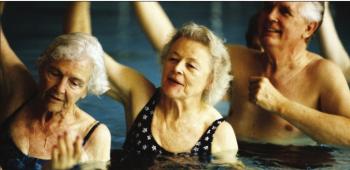
As summer begins to come to a close, everyone can certainly relate to how great it feels to get in the water whether it is in a lake, river or pool. Water can be relaxing and even therapeutic.
Dr. Robin Steed is an associate professor in the master of occupational therapy program at LSU Health Science Center School of Allied Professionals. She teaches research methods and the psychosocial components of the program. One of her areas of particular interest is water exercise.
“Warm water exercise is appropriate for almost everyone whether the goal is tness, weight loss or pain management. Even people who do not swim will experience water exercise to be safe and stress-free,” Steed said.
However, warm water exercise may be contraindicated for people suffering from multiple sclerosis or with uncontrolled hyper tension.
Steed said, “Water exercise has several advantages over land exercise, the most obvious being the lack of jarring impact on joints such as the knees, which can be particularly susceptible to other types of exercise. Many patients mistakenly believe water exercise is not effective for osteoporosis. The pull of tendon insertions on the bone while exercising is enough to strengthen bones.”
“A second bene t if the gentle resistance to movement that water offers. The faster the movement, the greater the resistance, which means greater control and less injury. This leads to another in-water advantage:
Muscles are strengthened in all degrees of joint range. Exercises on land tend to strengthen in one plane only, up and down or side to side for example. In water, the body moves freely in all directions for the full exercise session,” Steed said.
“The natural properties of water make exercise, less painful than land based exercise which proves to be an important feature for many of my clients,” Steed said.
Angie Collins, administrative assistant 3 at LSUHSC Of ce of Occupational Therapy, has bene tted by attending Steed’s warm water therapy classes.
“I was going for therapeutic reasons. I have a pool at home, but at the time I was attending Steed’s clinic, it was too cold to use my home pool. Arthritis, bromyalgia and other problems need the warm water to be effective using weights, noodles and other tools to gain more exibility,” Collins said.
“While anyone in the community is welcome, people with arthritis, bromyalgia or chronic pain will especially bene t from these classes,” Steed said.
“The warm water just feels so much better.
The water is warm enough to relax the muscles but not warm enough to overheat the body. The warmth helps block the pain signals. This is particularly important for patients with central nervous system disorders like bromyalgia,” Steed said.
In bromyalgia, pain signals can overstimulate centers of the brain which process pain causing even more pain. Warm water calms down the brain and soothes the body.
The warmth is also bene cial for people with in ammatory conditions such as arthritis.
“Normally, when joints become in amed from an injury, the surrounding muscles tend to spasm in order to hold the joint in place to heal. This works well when the injury is temporary but poorly in chronic conditions,” Steed said.
“The warm water loosens tight muscles so the joints can move freely without pain, reducing in ammation. Water supports the spinal column adequately so the nerves coming out of the cord have suf cient room to relax the surrounding musculature decreasing chances for injury,” Steed said.
In order to provide individually tailored exercise plans, Steed meets with each patient before attendance to determine tness levels and needs. A doctor’s release is required to participate but not a prescription. The fee is $50 a month and is not covered through insurance plans.
For more information, call 813-2970.
– Karl Hasten
WANT TO ATTEND?
Classes are held from 4:30-5:15 p.m. Tuesdays and Thursdays in the School of Allied Professions Rehabilitation Clinic at 1450 Claiborne Ave.
Convenient parking is available.