
Now is a good time to pick up real English antiques
Trends come and go, even in the world of antiques, but English antiques continue to hold their own as icons of good design.
They are also dependable workhorses in modern homes. As John Veuleman of The London Gallery in Shreveport said, “Good design is good design.”
Veuleman first opened the shop back in 1993 with the late Harrel Mulkey.
“He and his father, Harrel Sr., both had a weakness for English, and they sort of dictated good taste in Shreveport for decades,” he said.
English design was already firmly established in southern homes when the 1990s design world saw a resurgence of all things British, somewhat in part due to Merchant Ivory British Empire-era films and publications such as Victorian magazine that demonstrated the art and ritual of living with fine silver tea sets, bone-handled flatware, mahogany cane chairs and campaign tables. The antiques Veuleman hunts down and sells, however, often go back to much earlier periods.
“English design influenced world design,” Veuleman said. “They were the empire for a reason.”
Now is a good time to pick up real English antiques. “Some of these pieces are 250-years old and have survived 250 years of abuse from children and pets because they are solid wood and because they are handcrafted,” Veuleman said. “Harrel Mulkey, at the birth of his first granddaughter, gave her an early George III bureau bookcase. It had a hidden drawer inside, and his plan was to leave a note in there for her to discover. But the idea that you can buy a child a piece that’s already an antique and that they will be able to grow up with it, doing their homework on it and then later in life paying their bills at it, then as they retire writing letters to old friends at the same desk, and then passing it on to their child. How can you not fall in love with a piece like that?” “You’re starting to see pieces show up from continental Europe that you didn’t see before,” Veuleman said. “That’s primarily because of availability. A good example of this is in tea caddies and boxes. Forever they were the staples of English dealers. Almost overnight, the prices quadrupled. At some point, they run out, and then you have to wait long enough for the secondary market to rebuild itself. All those boxes that have been bought are now turning up at estate sales and auctions and are becoming available again, so everything is cyclical.”
Perhaps, the most iconic place to practice good English design is in the dining room. “This is going to sound strange because people are building houses without dining rooms,” Veuleman said. “But dining room furniture for my clients has always been and still is the hot ticket. When your child gets engaged and she has an announcement party and you start entertaining like an adult, you need a dining room. Whether the dining room is part of the same room as the kitchen or not, you still need a big table and a sideboard.”
When the dining table is not set for a formal meal, it can function as a library table, a desk or a work surface, which coincides well with 21st century multiuse rooms.
“It’s ironic because that was always the case 18th century England,” Veuleman said. “When the dining room wasn’t being used as a dining room, the furniture broke down. That’s why the tables came apart, the ends tipped up, and they went against the wall. The center section was often a gateleg table. It would serve as a desk. I have a sideboard in the shop right now that is Regency, about 1820. You pull out the middle drawer and it falls open to reveal a hidden desk drawer, because the sideboard served double duty at the time.”
Veuleman’s shop is filled with fabulous old pieces, both big and small, both regal and even a bit quirky. He pointed out a George III breakfront bookcase. “I priced one in London 20 years ago, and even at a dealer export price was going to cost me 60,000 pounds. Now granted, that was on High street, but they have always been
prohibitively expensive. I bought one here in the States that is as pure
and original from the ground up as I have ever seen, and it is a
fraction of that.”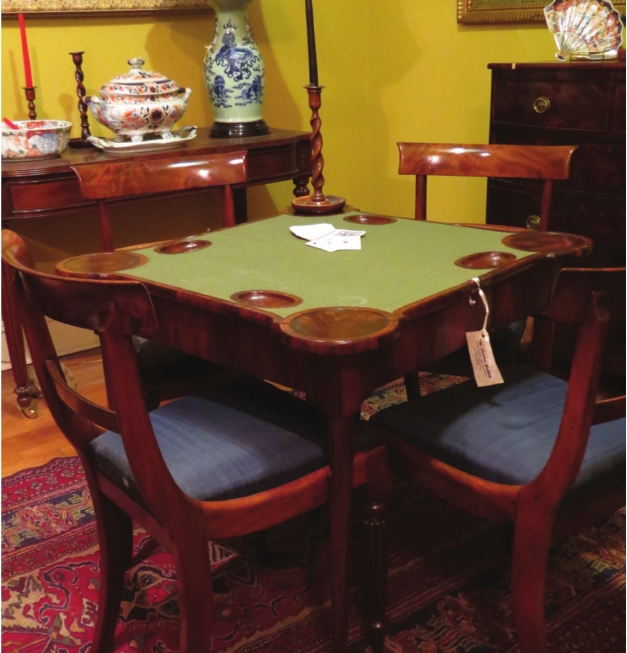
“Here
is a Queen Anne period 1710 walnut game table. What makes it special is
the way that it opens. It’s one of those pieces that, when it wasn’t
being used, it folded up and went against the wall. This one’s rare and
is what they called a concertina action, which in a Queen Anne piece is a
huge deal for antique geeks like me.”
“Personally,
I’m crazy about Japanese Imari, the reds, the blues, the pieces that
match the Oriental rugs,” Veuleman said. “They’ve always been an
accessory to English antiques for as long as either have been around.
The trend recently has been away from Imari and more toward Rose
Medallion with the pinks and the greens, and I have plenty of that here.
But if your house is neutral and you bring in a piece of Imari, it
becomes the standout statement piece.”
Veuleman
also pulled out a couple of large, rare, very old books, including a
leather-bound original 1616 first edition of the collected works of King
James. “There’s everything from an apology for the ‘Oath of Allegiance’
to a treatise on the evils of tobacco,” he said. “It’s a fun read.”
The
other volume was a book of British aristocracy printed in 1809. “It was
already a problem with people pretending to have titles, so this was a
who’s who of British aristocracy,” Veuleman said. “You open up the first
volume, and there is a fold-out colorcoded chart of British titles. The
first chapter explains Coats of Arms, which is what really attracted me
because I always have a piece of silver with one on it. They can be
tricky, even down to where a line is located on the shield, or in what
quadrant. Whether the feather has a curl that leans to the left or leans
to the right can mean entirely different things.”
“In
the English market pretty much anything is a good buy now,” Veuleman
said. “I’m selling pieces now for less than what I was having to pay for
them when I first opened. Any good highquality English antique is going
to be a bargain right now.”
You can see some of the fine English pieces The London Gallery has to offer at www.londongallery-antiques.com. The shop is located at 5908 Fairfield Avenue. For more information, call 868-3691.
– Susan Reeks


