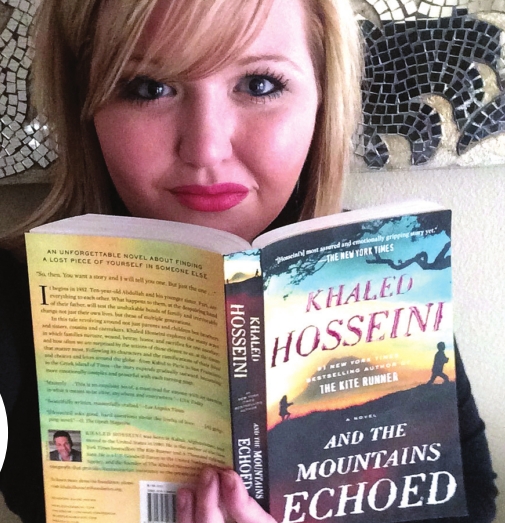
How one generation affects many
Rachel Lawton
“And the Mountains Echoed”
by Khaled Hosseini
I read Khaled Hosseini’s “The Kite Runner” when I first began teaching in a multicultural school and found it an insightful look into the psyche of a young Afghan child. Hosseini’s “And the Mountains Echoed” provides similar insights but across multiple generations and countries.
Plot: The story begins with a narrator (Saboor) telling a fable to his two children (Pari and Abdullah) while sitting around a fire in Afghanistan. The genius of Hosseini’s writing is that he speaks directly to the reader as if you are the child listening to a scary story around a campfire. Saboor tells a despondent fable about a div (supernatural creature in Afghan folklore) who comes to families’ homes and offers a choice, either choose one child to give to the div, or he takes them all. Saboor says a div came to one Afghan home and gave the father one hour to decide which child he would sacrifice. The father could not decide, so he finally drew names, selecting his tiniest and favorite son; he then deposited his son outside the home and locked the door. The child realized what was happening and began crying and banging on the door until the family heard nothing but silence. The father was lost for years until he decided there was nothing left for him, so he made the long journey to the div’s cave. Once there, the div told him he had made the right choice to sacrifice one “finger for the hand.” The div then showed him his youngest son, playing in a plush, green garden with other children his age, explaining that it was a test of sacrifice and showed the man how his son is happier here.
This fable is the impetus for the entire novel. The next chapter switches perspective to the two children – Pari and Abdullah, very close-knit siblings. Abdullah is a 10-year-old protective, older brother to his young, 4-year-old sister Pari. The two are crossing the desert with their father to go to the city and find work. Abdullah sneaked along against his father’s wishes and must endure the punishment, but Pari sticks by his side the whole way. Once in Kabul, Abdullah and Pari are taken to a rich home where they assume their father will be working, but they are ripped apart – Pari taken by the owner of the house and Abdullah taken by his father back home. Once home, Abdullah is heartbroken over the loss of his sister and the knowledge that his father would sell her.
The next few chapters are told in different perspectives from new characters affected by this tragic experience and spanning many decades. Through the different perspectives, you see the ripples this event caused both families for generations. You also see Afghanistan change from the more liberal ruling Shahs (kings), to the invasion of the Soviets, to the influx of the Taliban, and the U.S.’s invasion to expel the Taliban, even depicting more recent reconstruction efforts.
As the book ends and many decades pass, you are left wondering if Pari and Abdullah will ever reunite. But this is a Khaled Hosseini novel. There is no Disney ending. There are no birds whistling or baby deer frolicking in the background. The ending is true to life – with two people who have lived completely different lives, in different countries with different cultures. Their reunion poses the ultimate question: Did Saboor do what was best for Pari?
Why you would recommend this book: This book is a heart-wrenching story that I suggest reading with a tissue in hand. It’s also enlightening to the current and past experiences of Afghanistan. Hosseini highlights the war-torn areas of Afghanistan, but he also shows how families migrated to camps in Pakistan with little to take care of themselves, returning years, sometimes decades, later to find everything they once had stolen and gone. This book is a definite read for anyone looking for something thought provoking. It is a challenging read merely because the perspective changes from chapter to chapter along with the setting, time period and format (Hosseini plays with structure and sometimes you read the story through an interview, a letter, etc.), but the overall message is worth it.
That moment you were on the edge of your seat: This book isn’t a mystery where you’re on the edge of your seat the whole time. It’s a poignant read that makes you question the actions people choose. There are small moments in each chapter that always connect to Pari and Abdullah’s possible reunion which leaves the reader wanting more information. The last chapter is particularly gut wrenching as you anticipate the siblings’ reunion: If it will happen? Will they remember one another? Will it bring them the peace they’ve always hoped for?
What are you reading next? “The Orphan Train” by Christina Baker Kline
Rachel Lawton teaches AP English at Airline High School.
Read on: Each month CityLife will feature a book review from a local voice in the community.
If you would like to share a favorite book, email [email protected].


