A west-side business story
By GRANT PICK
Grant Pick had a knack for the unusual. During his time as a Reader contributor, he documented residents of a north-side hotel as they fought against displacement, interviewed a local hypnotist who once loaned his services to Saddam Hussein’s eldest son, and profiled a stranger clad with dozens of keys (“the keys to my broken heart”) who stopped to fix his collar. I first read Pick’s work in The People Are The News, a collection of his writings compiled and published posthumously by his son. A fellow journalist suggested the book to me a few months into my tenure with the Reader. I scribbled down the title, checked it out from the library, and quickly understood why.
Pick had a way of capturing the city through the eyes of the people he wrote about. His subjects were authentic and unfiltered (and not always in a pleasant way). He documented all the mess and excitement of life in a Chicago that in some ways has long since died—and in some ways is still very much alive. Revisiting this piece three decades after it first ran on June 10, 1993, I’m reminded how lucky I am to work at a newspaper willing to publish 6,500 words about a laundromat. I’m also reminded why these stories must continue to be told.
—Shawn Mulcahy, news editor
Content note: This story discusses sexual and domestic abuse.
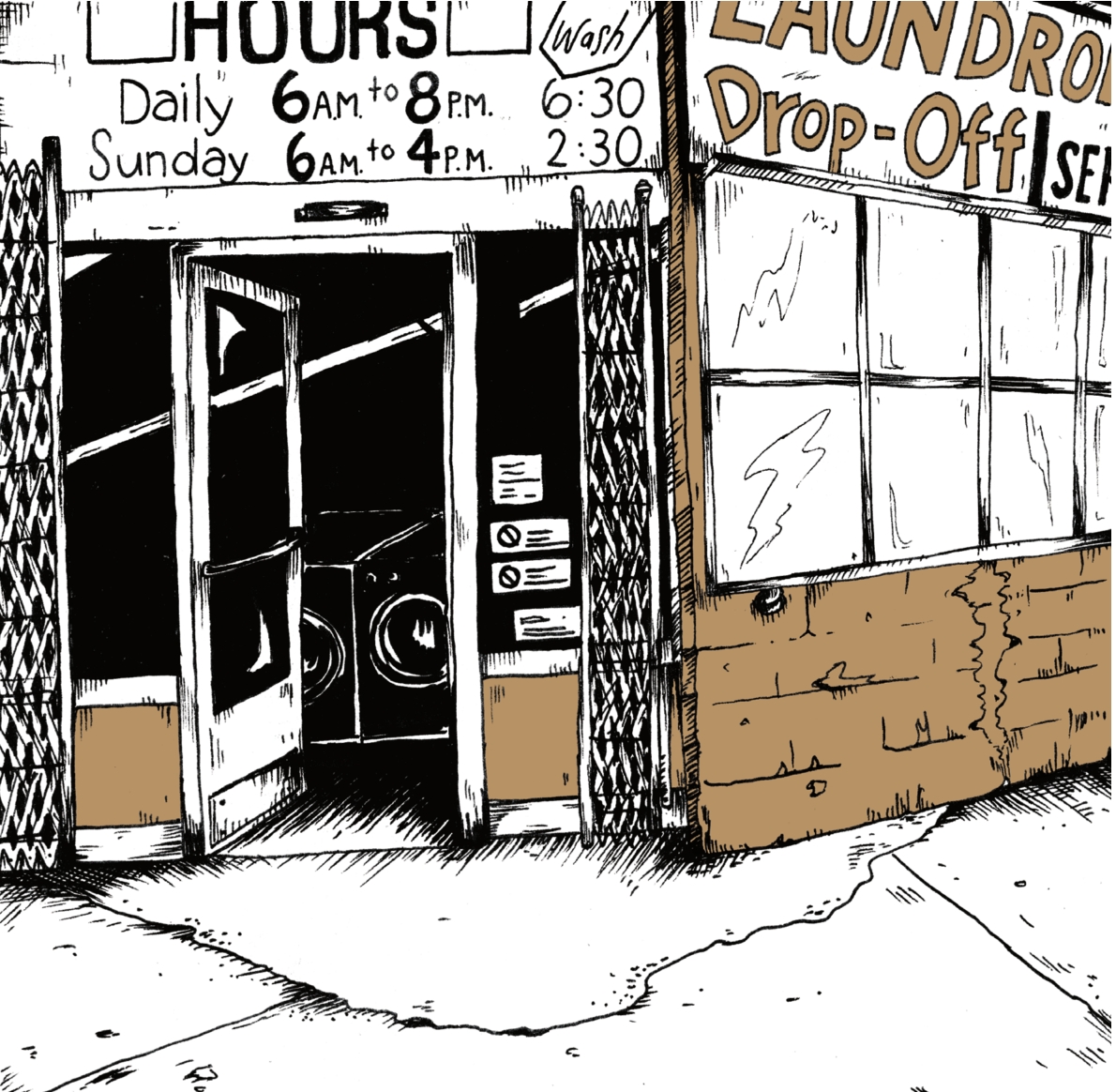
The first arrivals push through the door of the Davis Speed Wash on Roosevelt Road just past five o’clock on a frigid February morning. They walk to the rear counter, where owner Hughzell Davis is dispensing cups of thin coffee for 50 cents.
They settle comfortably into what seem to be their regular spots. Some sit on a row of colored plastic chairs, a couple slide onto folding tables, and others stand. They peer at the street through the windows’ black metal grille, talking quietly as the sky lightens.
“There’s
a depression goin’ on,” says George Gray, a middle-aged man in a
threadbare coat. “People think the new president has some kind of magic
wand over the economy, but he doesn’t. The Congress does. That’s my
thinking.”
Gray has
come out of the cold after walking the streets all night. He complains
that his welfare has been cut to the bone. Gray had surgery recently,
and while recuperating in a nursing home, he was arrested for theft.
“Supposedly I stole my roommate’s wallet, but they really planted it in
my drawer,” Gray tells Glenn Dupree, the muscular fellow standing next
to him.
“Lousy
coffee,” remarks Dupree, as he sips Hughzell Davis’s brew. Dupree
dropped his wife off at work and now he’s at the Speed Wash. There’s a
$5 bill tucked into his hatband in case he needs it. “I’m a hustler,” he
explains. If he’s lucky, he says, a friend will pick him up soon to do
some jobs. “If the guy stands me up, I’ll go home to my son. He’s eight,
and his teeth should get brushed before he leaves for school.”
Gray begins a rambling account of playing basketball in high school.
“All
that basketball was a waste ’cause you never got no piece of paper,”
Dupree says. “A diploma counts for a lot. You need one to make money,
and I’m about getting my GED and making money. All I need is a little
luck.”
“There ain’t much of that around here,” says Gray.
There
isn’t much in the way of a coffee shop either, which is why these men
gather at the Speed Wash. This stretch of Roosevelt Road, between Kedzie
and the city limits in Lawndale, was once the commercial heartbeat of
Jewish Chicago. But the road has been down on its luck for decades. The
strip is now distinguished by fast-food joints, liquor stores, churches,
vacant lots, and laundromats. There is no shopping in the grander
sense, only small operations fishing off the bottom.
The Davis Speed Wash is a small oasis, not only a laundromat but a notions store, coffeehouse, community
center, and economic success. The residents of Lawndale find friendship,
safe haven, and a measure of respect while drinking Speed Wash coffee
and watching their dirty clothes hit the spin cycle.
Every
day but Wednesday, John Franklin “Monk” Tucker, the morning clerk,
opens up the Speed Wash. More importantly, he puts up a full-bodied
coffee that the regulars much prefer to Hughzell Davis’s. “They come
from everywhere for my coffee, from Maywood and the south side,” boasts
Tucker. “They’re crazy about the stuff.”
Besides
the coffee, the Speed Wash offers four varieties of plastic-wrapped
Danish, which the clientele can heat up in the microwave. A television,
positioned high in a back corner, broadcasts the morning news shows,
which will give way to diversions like Joan Rivers and the soaps; in the
afternoon there’s Jeopardy.
The
morning conversations go off in the usual directions—politics, sports,
women. Many of the regulars have known each other for years without
establishing some of the basics. “I don’t know names,” says Frank Ware,
who rolls out of bed each morning and over to the Speed Wash. “That guy
over there is Rabbit. That fucker’s Doc. Willie over there I’ve known
for a long time. Don’t know his last name, and whether Willie’s his
first name I couldn’t say.”
As
the men talk, nibble pastry, and drink coffee, Tucker stands watch.
“You got to keep your eyes open,” he says. “I know who is who and what
is what. I don’t take no shit from nobody.” The smallest infraction
riles him. He will reprimand someone for sitting on the folding tables.
Wash your hands in the sink in the back that’s only for washing and
drying clothes and you’re likely to be confronted by Tucker, talking
tough and brandishing a small billy club.
Tucker
acts from experience. “It’s rough around here,” he says. “I’ve seen 12
or 13 people killed, most shot but some stabbed. Drugs are on all the
streets—on Grenshaw, Fillmore, Independence, and Roosevelt. If it’s
midnight and you don’t have a gun, you better not be out walking.”
By
the time Hughzell Davis arrives at 8:30 the men are drifting outside.
Some walk east, past a shuttered store and onto a vacant lot where they
will loiter away the day. Others buy a bottle of wine and a paper at
Sunshine Food and Liquor, the Arab-owned grocery across the street.
Shortly George’s Music Room, a full-service record store
and local bright spot, will open. Owner George Daniels puts speakers
outside and blasts gospel music. “Gospel sets the morning mood on the
block,” says Daniels. “In the afternoon, anything goes.”
The
area’s women enter the Speed Wash as soon as their kids leave for
school. “They all have their schedules,” says Davis. “We have Monday
washers, Tuesday washers, and Sunday washers. Wednesday is usually slow
for some reason. When the mailman brings the welfare checks the business
just flows in.”
Most
women are carting dirty clothes and sheets, though a few who have
washers in their buildings show up with articles dripping wet. “Folks
also sometimes do their clothes in the bathtub,” says Davis. No one has
dryers, at least renters don’t, since to run one requires an extra gas
line or a 220-volt electrical line strung into a building, a cost
Lawndale landlords won’t bear.
The
Speed Wash has 22 washers and 18 dryers. “Bedspreads, blankets,
comforters come cleaner here,” claims a sign. Over the folding tables in
front is a fish-eye security mirror.
Davis,
a sweet-faced man of 52, invariably wears the camouflage cap that came
to him from a son who was in the army. His principal venue is the back
counter, where he sells laundry soap, pantyhose, barrettes, candy, pork
rinds, aspirin, laundry bags, and pop, not to mention coffee. There is a
bottle of hot sauce on the counter for those who like it on their
potato chips.
Doing
their wash, the women scuffle across the worn tile floor, heft wet
clothes into carts, and make chitchat with one another and with Tucker
and his attendants. These are Delores Ruffin, Joe Greer, a self-styled
“goodwill ambassador” who helps out voluntarily, and the laundromat’s
tart-tongued fixture, Rose Coffee. “Honey, I been here 22 years,” says
Coffee.
“I know everyone and everyone knows me. They can tease me and I don’t get upset, and if they want help I give it to ’em.”
The
camaraderie is one of the reasons many of the women are here. “This
place is nice and homey,” says Carolyn Jones, a young mother of two on
welfare. “I always get to jabbering with the other people.” Patrice
Henry, a young mother, processes five loads of wash every Saturday.
“When you come up in here, you be having fun,” says Henry, “getting
together to do laundry, talk, and laugh. You catch up on what your
girlfriends are doing.”
Other
customers use the Speed Wash more reluctantly. Robin Johnson, an office
manager who has lived two blocks away since she was a girl, comes on Saturday
to do wash for her husband, O-Jay, their five-year-old son, and her
niece. “I’m always praying the place is empty,” says Johnson. “I put my
stuff in the washer and come back later to put it all in the dryer.
There are all these guys I don’t like hanging out around. O-Jay used to
tell me not to go, but Davis’s place is so close to home. Besides, Monk
is on the lookout, Rose has known me practically my whole life, and the
coffee’s good.” Adrienne Smith, an assistant gas station manager, would
rather patronize “the biggest, cleanest place I can find, but sometimes
it’s hard to get a ride. I use this [the Speed Wash] as a last ditch.”
Davis
tries to make his establishment comfortable. He addresses each customer
as “mister” or “young lady,” and as a rule they call him “Mr. Davis.”
He’s a softie about making change to catch the bus. “I also take
messages for people,” says Davis. “Someone will have a mother living
down south and the mother’ll call here and I’ll pass on the message.
We’ve got several customers in their 80s who we pick up and bring over.”
Young drug traffickers frequently spill in from the street, to buy candy and coffee with sugar. “If they can’t get
drugs they need sweet stuff,” says Davis. “It pacifies them.”
Increasingly, unfortunates hawking one product or another—screwdrivers
or hand cream—come inside to find buyers. The homeless slip inside to
rest, and though Davis normally doesn’t allow them to sit for long, or
sleep, “if it’s cold or raining I relax my ways,” he says. He is most
permissive early in the morning, with the men.
But
it aggravates Davis to see someone arrive with food. “They leave their
wrappings, or they want free napkins from me,” he says. “Why should I
have to clean up after them? I’m making no profit off them.” When
someone slams a washer in anger or is seen swilling a bottle of beer,
Davis has a quiet word. “I never swear or holler,” he says, “but I make
clear that sort of behavior is out of line. I’ve had some fights, but
whenever I see something I tell the people to settle their dispute
outside.”

Outside,
Davis often finds drug dealers standing around. “They use my doorstep as
a lookout point for police or for actual sales,” he says. He politely
shoos them away, and doesn’t call the police. The dealers don’t go far. A
lookout is normally posted across the street, at the entrance of
Sunshine Food and Liquor. The proprietors of Sunshine are more tolerant
than Davis and refuse to trouble the lookouts. “You don’t stick your
nose in anything,” says a Sunshine clerk. Actual sales occur behind the
grocery.
The Speed
Wash weathers its share of crime, such as the May break-in when an
intruder stole the color television. But there have been no holdups or
major brawls. “I’ve been fortunate,” Davis reflects. “I haven’t a clue
about why, except that if I’d been a real snob or a bastard who knows
what would have happened. I treat people as I’d like to be treated.”
In
the afternoon schoolkids come in with their mothers, and there’s a
particular feeling of community. One day this winter a girl from
Marshall High was showing off her grades, first to Rose Coffee and then
to Davis. There was one D on the report card, in math; Coffee and Davis
praised the girl for her good marks yet encouraged her to pick up the D.
A four-year-old girl who had graduated from preschool came in with her
mother one afternoon in May and accepted congratulations all around.
Davis
stocks penny candy for younger children. “You’d be surprised how many
kids come in here with a dollar’s worth of change in their pockets,”
says Davis. For teenagers he lays out fruit drinks and chips.
By 6:30 the last loads go into the washers, and an hour and a half later the Speed Wash closes
for the day. “If people aren’t done, I don’t put them out,” says Davis.
By eight o’clock, when Davis finally padlocks the door for the night,
the Speed Wash will have brewed some 175 cups of coffee.
Millard
and Deeker, a real estate firm, gave Lawndale its name in 1870 and
began developing the area, which reaches west through mid-Chicago
roughly from Western to the city limits. Lawndale first drew Dutch,
Irish, and German families, then Bohemians. In the early 1900s came the
Jews, most of Russian and Eastern European origin, who occupied the
two-flats that were erected in profusion during the period.
By
1930 the overwhelming majority of the population was Jewish and
Lawndale was known as “Chicago Jerusalem.” It supported 60 synagogues
and other quasi-religious institutions, notably the Jewish People’s
Institute, a large community center. Novelist Meyer Levin, who grew up
in Lawndale, set his novel The Old Bunch (1937) there. Lawyer
Elmer Gertz was reared in a Lawndale orphanage. As a young woman, Golda
Meir, the future prime minister of Israel, was a local librarian. The
24th Ward Democratic machine became a legendary force in city affairs;
in time Cook County party chairman Jacob Arvey, a former alderperson,
would launch the national political careers of Adlai Stevenson II and
Paul Douglas.
Roosevelt Road was the shopping mecca.
“A
dense shopping area, the street was lined with every kind of store
imaginable,” native Beatrice Michaels Shapiro would recall in a
monograph. “You name it, they had it. You wanted a sign painter, there
was Primack; you wanted floor covering, there was Kramer; you wanted
wine, there was Wexler’s; you wanted high-fashion women’s clothes,
Milton Sacks and B. Nathan filled the bill. You could have a party or a
wedding at Cafe Royale or the Blue Inn or a number of other places.
There were ice cream parlors and eateries, jewelry, furniture, and men’s
furnishings stores galore, and on and on.”
Lawndale
supported three banks and six movie theaters, which featured current
films plus the top stage performers of the day— Sophie Tucker, Benny
Goodman, the Marx Brothers. The great delicatessens included
Silverstein’s at Saint Louis and Roosevelt, a locale favored for wedding
showers. “A shower always attracted passers-by, who could observe the
doings from a window on the Saint Louis Avenue side of
the building,” wrote Shapiro. “As kids, we’d peer through the window and
watch wide-eyed as the bride-to-be would open her beautifully wrapped
gifts, and voila!, from one of the boxes would sometimes emerge a pair
of nylon stockings—a precious gift indeed during the war years.”
As
a Jewish commercial strip, Roosevelt Road had no equal. “Oh, there was
Lawrence Avenue in Albany Park,” says Irving Cutler, a retired geography
professor and Lawndale historian, “and there were nice Jewish shopping
strips in Humboldt Park and in South Shore. But there was nothing like
Roosevelt Road.” Many businesses that still grace Chicago—from Fluky’s
hot dogs to the Piser Weinstein and Weinstein Brothers mortuaries—have
their roots on the street.
By
1950 Black Chicagoans had started to move in and the Jewish residents
out, to the north side and the suburbs. In 1960 Lawndale was 91 percent
Black. Roosevelt Road went into decline, though a number of white
merchants hung on into the 60s. Then came the Martin Luther King riots
in 1968. “The stores were torn up bad,” remembers Monk Tucker. “There
wasn’t too much left afterwards.” Few merchants returned. “Either their
businesses were destroyed and they got out, or else they were afraid and
saw no future and got out,” says Irving Cutler.
But
Black businessmen, ironically, now had access to Roosevelt Road. “The
riots opened things up for us,” says Ralph Moore, who at the time owned a
laundromat on 13th Street. “SBA [Small Business Administration] loans
were readily available, and the old owners were moving out from fear and
intimidation.”
A man
named Leo Golsher had operated a laundromat at 3860 W. Roosevelt since
1951. But in 1969, after the riots, he sold out to Ralph Moore, who
wanted to move to a main drag. For a time Moore ran both the laundromat
and a dry cleaners across the road, but eventually he combined these
operations in the laundromat.
Moore
says the vicinity still supported many businesses. A tavern, a beauty
shop, a furniture repair shop, a hardware store, and a five-and-dime
were within easy reach, and also John’s restaurant,
where you could linger over a full meal or a cup of coffee. Another
restaurant, known for its peach cobbler and banana pudding, stood where
Sunshine Food and Liquor is today.
The Davis Speed Wash
is a small oasis, not only a laundromat but a notions store,
coffeehouse, community center, and economic success.
But
off Roosevelt Road, the housing was in decay. Every winter fires set by
space heaters would gut a few more apartment buildings. “If the Blacks
owned the buildings, they couldn’t afford to rebuild,” says Moore. “If
other nationalities owned them, they didn’t want to.”
From
1960 to 1990, Lawndale would lose 48 percent of its housing units,
according to the city’s housing department; its population shrank from
125,000 to less than 50,000.
Worse
yet, the area’s large employers— General Foods, Coca-Cola, Western
Electric, Sunbeam, Aldens—gradually took their leave. The largest
employer was Sears, Roebuck and Company, whose national headquarters,
bank, and retail store stood on a 55-acre site at Homan and Arthington;
but even Sears began to pull out in 1973. By 1987 the Sears site offered
“some warehousing and very, very little else,” according to a Sears
spokesman.
Moore says
many Black shop owners on Roosevelt Road had a hard time of it. “They
really didn’t know how to manage a business. Many had trouble buying
wholesale and setting prices. Others would make money fine, but then
they’d blow it on cars or at the racetrack.”
But
Moore’s laundromat on Roosevelt Road thrived. So did two new
laundromats Moore opened across the Eisenhower Expressway on Madison
Street, and “it all become kind of taxing for me. Then my wife, who used
to help me out, got arthritis.” In 1984 he put his place on Roosevelt
Road up for sale, and Hughzell Davis offered to buy it.
Davis
had grown up in the Mississippi Delta, the fourth of a farmer’s ten
children. After high school he briefly worked in a factory that made
backing for carpets, then migrated north to Chicago. For five years he
was a warehouse clerk at the Spiegel catalog house. “It was a job, but
it didn’t pay well enough,” Davis says. He trained in computer
accounting at a Loop trade school and soon began an 18-year stint in
computer operations at the American National Bank, where he rose to
shift manager.
In 1984 the First Chicago
Corporation acquired American National and a new supervisor fired Davis.
“It was tough and I was disappointed,” he says, “but they made the
right move. I was burned out by the rat race and the politics that you
have to play. I was tired of going to school to keep up.” A friend
interested him in buying a laundromat, and even though he knew nothing
about the business (“I could turn on the machine, is all”), he made
Ralph Moore an offer. They settled on a price of $49,000 for the
building and the business; Davis put $10,000 down and has been paying
Moore off since.
“When
I first came over here I was concerned a lot,” Davis says, “but I had
kept all Moore’s employees, and they knew people.” Moore’s washers and
dryers were shot, so Davis installed new equipment. He put up new
paneling and redid the ceiling. In went video games (which were
discontinued after burglars stole the money out of them). Davis passed
out key rings and calendars and for a couple of years, revenues were
respectable.
But in
1986 Mark Holstein opened a spanking new place at Roosevelt and Keeler.
“My idea was to revitalize the neighborhood,” says Holstein, a former
paint salesman whose half-million-dollar facility, called the Clean
Scene, offered double the Speed Wash’s washers and dryers. (The Clean
Scene is still the largest noninstitutional construction project in the
24th Ward since the riots.)
“When
I found out about Holstein opening down the street, my heart almost
popped,” says Davis. Yet Davis was determined not to be hostile. “He
wasn’t the enemy, and why should he be?” Davis says. He made it a point
to have a sandwich with Holstein. “He and I sat down and shot the shit
and got along fine,” says Holstein.
Nonetheless,
Davis found his sales dipping 20 percent, and he began to offer coffee,
hair accessories, candy, and other items as a sideline. There had
always been a Pepsi machine in the front of the store, but now Davis
laid in five more kinds of pop in a back-office cooler.
Customers
are encouraged to carry discount cards. Twenty visits to the Speed Wash
and you have the option of taking a $5 premium or continuing to log
benefits; two punched-out cards win you a laundry cart. “It keeps ’em
coming back,” says Davis. Not everything succeeds. During the past year
Davis entered into a deal to sell beepers for a wholesaler, “but the guy
went sour on me,” says Davis, and he’s abandoned the idea.
Sales have rebounded some. Today [in 1993]
the Speed Wash grosses $160,000 a year. The average laundromat in the
U.S. takes in $96,000 annually, says Richard Torp, spokesman for the
Chicagoland Coin Laundry Association. Torp says about Davis, “He’s doing
good business for a small store. It’s commendable. Evidently he’s
pleasing his customers.”
Glenn
Dupree happens by the Speed Wash for coffee at about six o’clock almost
every morning. Afterward, he’s usually at his leisure. He used to
assist his friend Ike, who specializes in hauling and gutting, “but
Ike’s a cheap motherfucker and that’s why I stopped working for him,”
says Dupree. He says he runs a crew of his own, but mostly on weekends.
Dupree
didn’t finish his senior year at Crane High School. “This woman got
pregnant with me,” he says, “and, shit, I dropped out.” Since 1979 he
has lived on Fillmore two blocks from the Speed Wash, in a three-bedroom
house owned first by his mother and since her death by himself. Early
on he held a series of jobs, including six years as a short-order cook.
“Wherever there was money to be made, there was Glenn,” he says. But he
wound up on general assistance (GA). Because GA is designed for single,
employable adults and he was married, he was, he admits, not entitled to
it.
Last July new
budget cuts eliminated Dupree and thousands of others from general
assistance. Now all he receives is $111 a month in food stamps. Dupree
passed up the new EarnFare Program, which offers a welfare check in
return for part-time employment. “I have a heart murmur, and my right
leg is crippled,” he explains. “I get sick. It takes me a half-hour to
get out of bed in the morning.” At the moment he is angling for Social
Security disability benefits. Meanwhile, his wife has taken a factory
job, packing cologne into boxes.
Dupree
passes the days alongside an oil drum behind a three-flat near the
laundromat. The surroundings are sparse—no grass, two dead trees, a
shopping cart, and several cars being worked on by Frank Ware, Dupree’s
friend from the Speed Wash and the street. Ware was ticketed once by the
city for keeping a fire going in the oil drum, but the ticket failed to
douse the flames. During the winter people come to warm their hands
over the fire, and in every season the drum serves Dupree as an outdoor
stove.
“People’ll be
out here working on their cars, and they can’t wait to finish so they
can eat my food,” he says one spring morning that finds him resplendent
in a black Bulls hat, deep purple sweatshirt, and bright blue jeans.
There’s a diamond stud in one ear. “I make pork or ribs, fish, and
wieners.”
Wieners and
pork in a can are today’s specialties. The oil drum, stuffed with
burning timbers, has been turned on its side, and Dupree is preparing to
be the chef. He slices some onion and sprinkles the bits on a half
dozen hot dogs positioned on tinfoil. Opening a can of processed pork,
he sprinkles the contents with onion, pepper, and seasoned salt. “Don’t
forget to put in some Spanish fly,” yells Ware from underneath the car
he’s tuning up. Dupree laughs. He places the pork can on the piping hot
surface of the oil drum; the wieners also go atop the drum on a rusty
grill.
“I’m Mr.
Rogers,” shouts Dupree to his audience, which includes Ware, a woman
named Gayle, and several other men with time on their hands. “Soon you
all are gonna have some real good food.”
“Hey,
Glenn, you got your pimp clothes on today,” jokes Gayle. Humorously,
Dupree doffs his Bulls hat in Gayle’s direction, revealing a scalp he
has shaved clean. “Bald I don’t have to worry about no brush or no
comb,” he says. One of the men announces he’s off to Maywood to look for
work. “I’m going to buy a lottery ticket,” says another fellow, an
announcement overwhelmed by the wail of a souped-up car driving by.
Dupree knows the driver. “Hey, motherfucker, can you smell prime nigga
cooking?” he yells.
When the food seems done,
Dupree unwraps a loaf of Wonder bread. He deposits a hot dog on each
piece of bread, then slops on some pork. Everyone grabs a sandwich and
eats heartily, washing down lunch with beer. Ware, the exception, is
drinking vodka and water. It’s 10:45.
Soon
Ware slips away. “He knows he’s drunk, so he’s going into his house,”
remarks Dupree. Ware, 48, is the father of four children by various
women. One daughter was raped and murdered at the age of 14, according
to Ware, and he says he hasn’t been the same since.
He
carries the marks of a hard life. “I been shot five or six times,” he
says. “I take the bullets out myself or do nothin’, so there you go.”
To
prove his point, he displays a maimed part of his left hand where a
knuckle used to be, and shows off a scar near his left eye. “Some guy
shot at me,” he explains, “but I didn’t go to the doctor because I
couldn’t find my medical card.” Cross Ware at your peril. In May he
concluded a girlfriend had stolen a saw and $60 in cash from him. “I
plugged her up the side of the head with some of my tools,” he says. He
was charged with battery and hauled off to jail.
Ware
lost his driver’s license after a series of drunk-driving arrests,
though he continues to drive a 1974 Oldsmobile. He’s held “so many jobs I
can’t recall them all.” He receives $155 a month in Illinois assistance
that comes to persons presumed eligible—but not yet approved—for Social
Security disability payments. He gets food stamps and makes some money
repairing cars.
“Here’s home,” says Ware as
he welcomes a visitor to the basement apartment he occupies in the
three-flat; he lives for free in exchange for watching over the
building, which was bought recently by someone in Maywood. The top three
floors are empty and being renovated. “I go upstairs and check on
things,” Ware says. “I listen. I’ve run a few people out, and I hit one
guy with an iron pipe.”
Ware’s
apartment consists of four rooms, but only one is usable. He cooks
fried chicken and pinto beans and ham hocks on a hot plate, sleeps on a
box spring mattress, and sits in a reclining chair afternoons and
evenings watching Gunsmoke, Bonanza, and karate movies on a small
television. There is no phone or water in the building. To use the
toilet, Ware must fetch water from a nearby fire hydrant. When he wants
to take a shower, he goes to his brother’s house across the street.
From
the oil drum Dupree can eye the drug dealers hanging at the corner of
Grenshaw and Springfield. “Those little rodents,” he remarks. “They’re
pathetic, out on the corner selling rock [crack cocaine] or blow
[heroin]. They come out after the kids go to school, and they’re out
again in the afternoon once the kids get back. They’ll walk through a
crowd of kids giving out fucking candy.” (The dealers on Grenshaw do
more than that, says a neighbor: they throw a kids’ block party during
the summer and give away hams at Christmas.)
A
cop car glides east along Roosevelt Road past Springfield. “Ready on
the road,” yells a lookout at Sunshine Food and Liquor, meaning the cops
are driving by. Once the police car is out of sight, the lookout gives a
second signal—“He’s straight.” A dozen persons suddenly materialize in a
line behind the Sunshine grocery building, and a dealer makes his sales
at high noon.
“Look at that shit,” says Dupree disapprovingly. “I don’t have anything to do with that shit.”
Glenn
Dupree doesn’t drink coffee at the Speed Wash because he needs to. “I
can make coffee my own damn self,” he says. “The thing is, I like to
have coffee and a roll and shoot the shit with the other fuckers who are
hanging around. Plus, it’s best to leave some money circulating in the
neighborhood, and not with the drug dealers.”
The
neighborhood can use the help. Only a few employers remain. One of them
is the Roscoe Company, an industrial laundry that’s been a Lawndale
fixture since 1927 and intends to stay. “People that work for us live in
and around this area,” says president Jim Buik. “We have a ready supply
of labor.” Not every employer feels so comfortable. “We had a sign on
the building but we had to take it off because we don’t want anyone to
know we’re here,” says one small manufacturer. “It’s not safe.”
The
mean annual household income in Lawndale is $18,336, according to the
U.S. Census Bureau, about half the city average. About 40 percent of the
neighborhood gets public assistance. A 1991 study for Chicago’s
Department of Economic Development reported 121 businesses along
Roosevelt Road, but “there is a combined total of 49 vacant storefronts
and vacant lots along the commercial strip, and pedestrian traffic is
extremely shallow and widely dispersed. Apart from food and liquor
establishments, there appears to be very little support for other
businesses.”
Most
Speed Wash regulars leave the community for major purchases. Glenn
Dupree goes to an Aldi for his canned and frozen goods, to Moo &
Oink on the south side for meat, “or wherever there’s a sale.” He buys
rice at a church. “On Sunday we go to [the Maxwell Street shopping
district], where we buy jumbo eggs with double yolks plus fruit,” he
says. North Riverside mall is his destination for most clothing, though
he purchases neckties and jeans from a Goodwill store and other thrift
shops.
Frank Ware
drives his Oldsmobile beyond Lawndale for nearly all his needs. He
favors a flea market at 26th and Pulaski for clothes. “’Cepting suits,”
he remarks. “A woman I just dropped bought me some suits in Detroit.
Nice ones. Basically, though, I don’t need ’em, because I don’t go to
church and it’s best to avoid funerals.”
Robin
Johnson, who lives a block from Dupree, shops for groceries at the Omni
or the Aldi in Cicero, or at the Super Giant supermarket at Pulaski and
Harrison. For clothes she heads to the Brickyard or North Riverside
malls. Johnson frequents a Lawndale dry cleaner and Sunshine Food and
Liquor, “to play the lottery and for two-liter pop.”
“There’s
nothing to buy around here, except for gas, a clothes wash, and a can
of pop,” says Hughzell Davis. Davis acquires supplies for the Speed Wash
from wholesalers and discount houses. He says he’d like to open an
account at the Community Bank of Lawndale, owned by the
neighborhood-based Pyramidwest Development Corporation, but he’s heard
negative comments about the small institution so he banks on the south
side.
Laundry turns out to be a
major contributor to the economic health of Lawndale. Johnson’s biggest
local outlay is the $10 to $15 she spends each Saturday at the Speed
Wash. Ware takes his wash once or twice a week to the Speed Wash,
jamming it all in one washer to limit his expenses. Dupree and his wife
own a washer and dryer, but he sometimes does his laundry at the Speed
Wash anyway “just to get out of the house.”
The
1991 study for the Department of Economic Development found that the
average Lawndale resident spends $54 a year along Roosevelt Road on
clothing, $29 to dine out, $2.67 on furniture, and $2 on auto care. The
largest outlay is for groceries—$698. The study didn’t give a dollar
figure, but it reported that after groceries residents spent more of
their money on laundry than on anything else.
In
recent years Lawndale has been the subject of several attempts to spur
retailing. In 1988, 24th Ward alderperson William Henry helped start a
chamber of commerce, which limped along for several years and finally
died. Henry also tried to godfather a pact between Arab merchants and
Black community members, which came to naught after Henry was indicted
on charges of extortion and mail fraud and was defeated for reelection.
He died in May of ’92.
Plans
by Wallace E. “Mickey” Johnson, a former Chicago Bull, to build a
shopping center near Roosevelt and Homan have gone nowhere. And though
Lawndale did participate in the Commercial Area Revitalization Effort
(or CARE), a city program meant to spur retail development in declining
neighborhoods, the principal benefits have been trash receptacles and
street banners along Roosevelt.
A
CARE banner flies from a pole outside the Speed Wash, and a trash
receptacle is nearby. Recently the city installed a bicycle rack in
front of Sunshine Food and Liquor, but no one can recall seeing a bike
locked up there.
“You
talk about all these programs that are supposed to revitalize this area,
and nothing really works,” says Hughzell Davis, who joined the Chamber
of Commerce and participated in CARE. “What I see out here depresses me.
All I see are Black folks going no place. They’re just in a rut. All my
waking hours I spend in an environment where it’s easy to get bad
feelings, to think that what I see around here is life.”
Davis
has the most sympathy for his female customers on welfare. “The ladies
are in a bad situation because, sure, they should work, but they have
the responsibility for their kids.
“The
men, though, they’re looking for a handout. Nobody’s going to give them
anything to get them up the ladder, but that’s what they expect. Each
situation is different, I know that, but why don’t they go home and
figure out what to do, instead of just standing around on the street?
They think if they stand out there long enough something’s going to
happen.
“They have
only themselves to blame. I could be in the same place they are but I’m
not. Even if they don’t use drugs, they are addicted to standing on the
corner with their buddies. They refuse to give up 24 hours a day of
doing nothing, afraid that if they get a job they won’t be able to stand
out there anymore, that they’ll miss something.
“Clinton
gets blamed over the economy, like he could change things in Lawndale
in the city of Chicago. Clinton’s only going to do what Congress allows
him to do, and Congress seems to be fighting him. If the whole economy
improves maybe then things will change, but not before.
“My
best advice to the men would be to move away. Go clean, with new
friends and a new neighborhood. That’s the only way to break the cycle.”
Davis
is seldom approached for advice, although he is free with it. A few do
consider him a role model. “I talked to him several times about getting
into my own business, and he encouraged me,” recalls Ann Marie Parker, a
laboratory assistant at Malcolm X who’s a Speed Wash customer and wants
to run her own pharmacy one day. “To find a Black businessman like him
around here is a rarity.”
The idea of being considered an example perplexes Davis. “I can’t say what I am,” he says. “You’d have to ask somebody else.”
He
continues to draw satisfaction from the Speed Wash. Last year Davis and
his brother-in-law opened a laundromat on Clybourn on the north side,
but Davis is content to let his brother-in-law handle the other place.
“I never say to myself that I don’t want to go to work,” he says. “I
come every day and look forward to coming here because it’s mine. The
boss is me. I don’t go on vacation really, three or four days at most
but nothing more. I’m not ready to get out yet. Maybe in ten or 12
years, but if my health holds up and I don’t burn out I’ll probably stay
around.”
[email protected]