EDITOR’S NOTE
The people are still the news
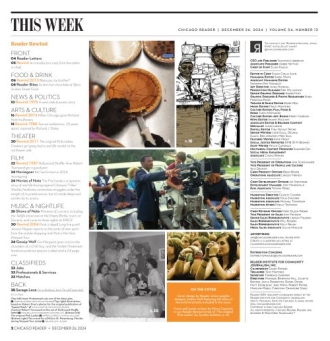
Notes on this issue; a look back at stories we love
By SALEM COLLO-JULIN
Every day of work at the Reader brings new discoveries and challenges but we don’t do this work alone. We have the joy of our readership: those of you who seek out our paper, send friends to our website, and talk online about our stories.
We’re also doing this work while trying to keep our balance as we’re perched upon the Reader’s legacy. Many of us feel the presence of all the people who worked here in decades past as we write, edit, design, and talk about the Reader, and some of those people still pop up in our pages on a regular basis.
Living with a legacy of community-based journalism is an intimidating but lovely thing. If you ever find yourself at the Reader headquarters, you’ll see that the presence of our full print archive quietly looms in the southwest corner of the office. This means we’re only a bookshelf away from diving into more than 50 years of history at any moment.
So for our final issue of 2024, we’ve decided to share some of our favorite gems from those cherished archives. Some of the writers responsible for this work are still active in journalism and check in with us from time to time, some have moved on and are using their talents in other trades, and one, unfortunately, has passed on.
Writer Grant Pick died suddenly in 2005 of a heart attack. By that time, Pick had written for the paper for more than 20 years. As former Reader editor and columnist Michael Miner wrote in a tribute a few years later, “In many ways, Grant was the writer who best defined this paper. As he liked telling journalism students who read his pieces and asked where the news pegs were, ‘There is no news peg. The people are the news.’”
The Grant Pick–penned article from 1993 that our current news editor Shawn Mulcahy chose to reprint for this issue (Speed Wash, see page ten) embodies that sentiment. It’s a longform look at a laundromat on Roosevelt Road, and the subheading tells you everything and nothing at once: “A west-side business story.” Pick used the business as a home base for the reader, a place to center ourselves as we travel alongside his words in a journey through the changing of the tide in that west-side neighborhood. We hear voices of residents, laughter, and life’s challenges. The people are the news. Their words are now our windows into what this time and place was like.
One of the Rewind articles you’ll find in this issue was written by one of our longest-serving staff members, senior writer Mike Sula. Though “Bean pie, my brother?” (originally published in 2013 and on page six for this issue) is categorized in our Food & Drink section, it’s also (like so much of Sula’s work for the Reader) a capsule of cultural understanding.
For the piece, Sula traveled through the south side and brought our readers to the origins of the singular and delicious bean pie, to the Nation of Islam and its Chicago presence, and to Chicagoan Imani Muhammad. Muhammad’s business, Imani’s Originals, is still active and, as we found when reaching out to her to get new photos, she still sells the original bean pies as Sula describes in his story. She’s also added Groovy Granola to her offerings, but, then again, many things have changed since 2013.
If you dive into the Rewind stories this week, you might find some light updates. Mainly, our standards of language have changed slightly over the years (as has that of many Chicagoans). Some examples: we default to using the abbreviation LGBTQ+ when writing about the community as a whole; we capitalize the words Black, Brown, and Indigenous when referring to people. We integrated standards like this into our style guide at the Reader because we center people’s experiences. We are scribes for the city of Chicago, and hope to faithfully continue to capture the unique stories of our fellow residents in coming years so that someone 50 years from now can read and say, “This is what it must have been like to be a Chicagoan in 2024.”
[email protected]