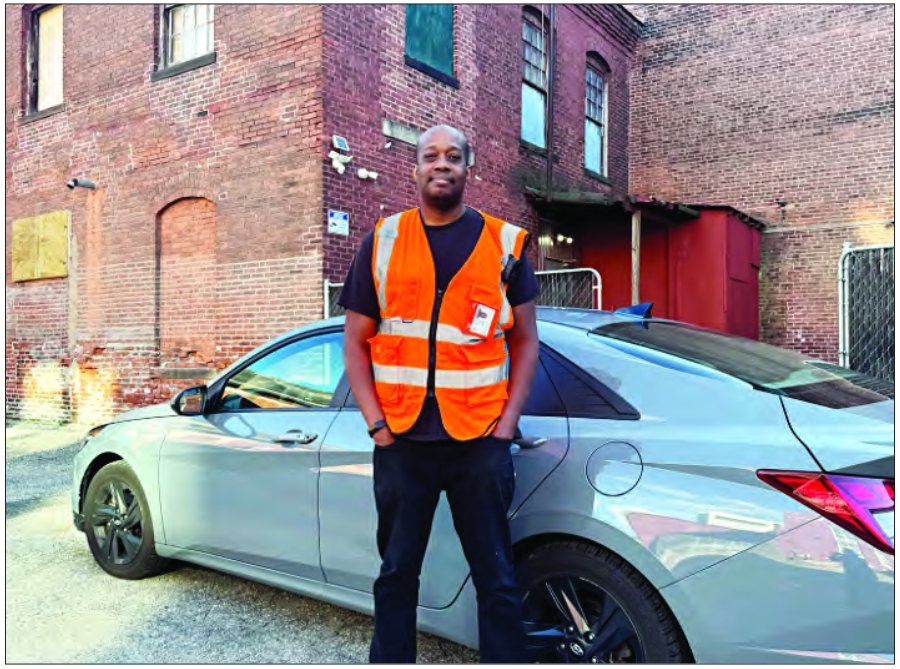
Duane Harden, owner of BlazeXpress in Holyoke, says he’s not sure his business will still be around next year.
GBH NEWS
When Duane Harden opened up his cannabis delivery business three years ago, he was hopeful that the new venture would be a success — fueled by the legalization of recreational weed in Massachusetts in 2016.
But three years later, the 55-year old Haverhill resident says he’s hardly turned a profit from his company, BlazeXpress, an Amazon-type business that purchases marijuana products and delivers them to customers in a handful of cities in and around Springfield.
“I’m just feeling defeated,” Harden told GBH News recently. “Will BlazeXpress be around next year? I’m not sure.”
Harden was supposed to benefit from the state’s Social Equity Program, which was created by the Cannabis Control Commission to address historical inequities in marijuana enforcement after the legalization of recreational marijuana 10 years ago.
About 10% of all marijuana businesses are part of the Social Equity Program, meant to empower people who had been negatively affected by the war on drugs. That includes both those convicted of marijuana charges, and people like Harden, who live in areas targeted by strict drug enforcement in recent decades.
But experts and operators told GBH News that the results have been murky at best, and in many ways are failing to live up to that promise. People of color are still struggling to make it work in an industry that remains majority white and male Currently, just 11.2% of workers are Hispanic or Latino, and only 7.2% are Black, according to data from the Cannabis Control Commission.
A key example of the challenge is the delivery license, the type that Harden procured. Such licenses have been reserved solely for people in the Social Equity Program in an attempt to give budding entrepreneurs a foot in the door without requiring too many upfront costs. It includes the largest percentage of people of color in the state’s marijuana industry — just over half, according to a 2025 report by the UMass Donahue Institute.
But he and other people of color find themselves operating a business that’s among the most difficult types to turn a profit. The delivery business — which total 33, according to state data — represents about a third of the entire Social Equity Program licenses.
Lucy Xiaolu Wang, assistant professor of resource economics at the University of Massachusetts, Amherst, said the surge of cannabis businesses has created intense competition that has driven prices down.
“It turned out that passing the law was a relatively easy part, but the implementation and getting the funding into the hands of people who need them are relatively hard,” she said.
The Cannabis Control Commission says it is committed to supporting social equity moving forward. “Our equity mandate will always be a work in progress as we continue to strive for the goal of full participation, and it is work we are proud to do,” Commissioner Xiomara Albán De- Lobato said in a statement to GBH News.
But Harden is running out of time.
“I
don’t want to sound ungrateful, because I thank God for the opportunity
to participate in the legal cannabis industry through social equity,”
he said. “But on the flip side, the regulations made it almost
impossible. It’s like they set us up for failure, you know?”
Trying to crack the code
Delivery
license holders like Harden are able to deliver directly to the
consumer, with no brick and mortar store needed. But tight industry
regulations are particularly challenging for them, according to Jeff
Moyer, a public policy lecturer at Northeastern University.
“Whether
you’re delivering cannabis or delivering pizzas, you’re probably
operating on the margins, right?” he said. “And even if you make a
profit, that’s a really small margin. And so these businesses are really
sensitive to anything that’s going to increase that margin even
slightly.”
For Harden,
who previously owned restaurants and music businesses, delivery seemed
promising. He started the process in 2020 when people were stuck at home
during the pandemic. He was attracted by the business model because
some customers want a discreet option to buy cannabis, or need the
service because they are disabled and can’t leave their home.
Harden
chose Holyoke to base his business because the city was welcoming to
new cannabis entrepreneurs and has a significant amount of empty
warehouse space. But finding a workspace was just the beginning. “I
literally almost went bankrupt before I opened,” he said
Delivery
is free, but there’s a $50 minimum on each order. Harden delivers
products in an unmarked car, each order in a brown paper bag with a
receipt stapled to the outside.
He
says he works hard to set his business apart. He used to give out a
bottle of water, a lollipop and a bag of chips with each order, but got
written up for violating his license because he can only deliver
cannabis. Now he gives out
cards with inspirational messages and affirmations, like “you’re
crushing it” and “make your dreams happen.”
On
a recent drive around Holyoke, Harden pointed to three dispensaries
within a five-minute walk of his own warehouse. In an oversaturated
market, he says some businesses with access to out-of-state money can
price their products low to entice customers.
“There’s
what I call ‘race to the bottom’ dispensaries. I can’t compete,” he
said. “Within the 10 towns that I deliver in, there’s over 40
dispensaries.”
To just
break even, he says needs to make at least $1,500 dollars in sales each
day. On a recent September afternoon, he had brought in a little less
than $500 dollars. The day before he sold around $700 in product.
Even
without a physical store, the bills add up: car insurance, gas, rent,
electric bill. And Harden says some regulations — like expensive,
mandatory body camera systems — put a strain on a small business.
“Inflation has hit everything else, but not weed,” he said. “None of us in Western Mass. have been able to crack the code.”
Some need more than one license to survive
Damaris Aponte is owner of Blossom Flower, another marijuana delivery business in Holyoke.
A
Puerto Rico native who used to sell drugs illegally, Aponte said she
realized early on that she couldn’t survive with only one path to a
profit. She now has four marijuana licenses — including delivery,
manufacturing and cultivation.
“I knew as [an] equity business, I knew one license by itself was not going to be enough out here in Western Mass.,” she said.
Aponte says work in the weed business is more than a job for her.
The
country’s war on drugs took a personal toll. She said she came to
Holyoke from Puerto Rico when she was 3. She started selling weed at 15.
“I
was on the block hanging out with the guys. They were selling heroin. I
was selling weed,’’ she said. “Everybody was just trying to make a
dollar.”
She said her brother, who also sold drugs, was murdered in 1997 shortly after leaving jail.
That’s why she was glad when Holyoke started welcoming marijuana businesses after legalization.
She also had previously worked as a medical assistant and office manager, where she saw the benefits of cannabis for patients.
She soon plans to open a location on Blue Hill
Avenue in Boston with a business partner where she hopes to “give
opportunities to people who’ve been affected by the drug war.”
Hope for the future
Many
new entrants into the cannabis business are still hopeful about the
future. Ruben Seyde, founder and CEO of Delivered Inc., based in
Clinton, about 16 miles from Worcester, says being in the Social Equity
Program is “like a rollercoaster.”
He
said he was optimistic at first, but then grew disappointed by promised
support, including business classes he said weren’t helpful. He says
it’s a struggle to operate in a crowded market.
“There
wasn’t really any funding or operational assistance to really make
those classes become lessons that we can actually implement,’’ he said.
“That was a bit discouraging.”
He
points to recent policies, including getting rid of a rule that had
required two agents in the car for each delivery, and extending the
delivery-only restriction for social equity businesses, as moving in a
positive direction. A recent social equity grant through the Executive
Office of Economic Development has been “life-changing” for Seyde’s
business, he said, and will open up new opportunities for marketing. He
re-launched his website recently and has already seen an uptick in new
customers.
He is looking forward to what’s next.
“The goal is to expand into brick-and-mortar in the future,” he said.
Ulysses
Youngblood, president of Major Bloom in Worcester, has a delivery
license, as well as manufacturing and retail licenses, which he says is
key to sustaining a business.
While
getting started was a challenge — he had to raise $1 million to just
get off the ground in 2017 — he’s “grateful for the opportunity now that
it’s here.”
Youngblood
says it also helps to operate in an area where he has roots. He came to
Worcester to attend Assumption College, but in his first year, he got
kicked out for a cannabis-related offense. He eventually finished
college and got his MBA, and was ready to jump on the opportunity when
legalization became a reality.