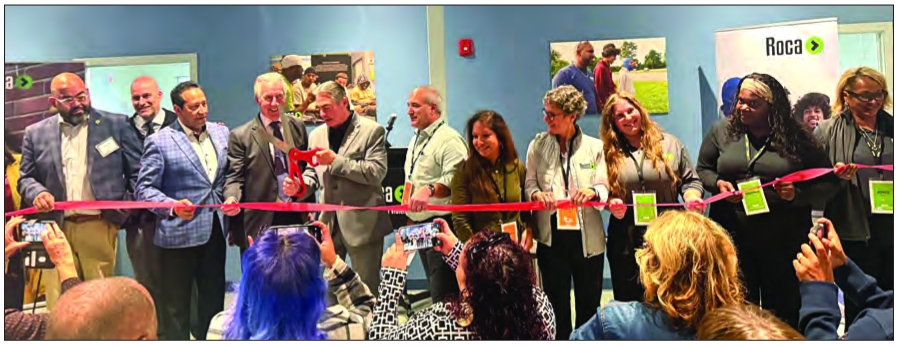
Elected
officials, Roca staff and community partners gather for a
ribbon-cutting ceremony during the grand reopening of Roca’s Springfield
facility on Nov. 4. 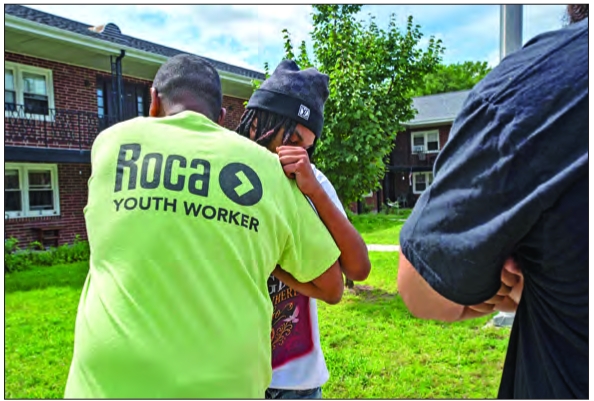
A Roca youth worker embraces a young participant outside the organization’s Springfield facility.
Roca, the Chelsea-based violence intervention and behavioral health nonprofit program for young people, celebrated a grand reopening of its Springfield location Nov. 4, unveiling three remodeled buildings designed to serve the community and its staff.
Roca works with people ages 16 to 24 who have experienced trauma and are at high risk of violence, including males, females and young parents. In Springfield, the program served 272 young people in 2026, according to the organization.
The renovation included the entire space, including the main building, home to the young men’s and women’s programming and staff offices; plus two smaller buildings: one with a playroom and mental health space for young parents and the other with a flexible classroom space. Roca gave all three the same color scheme and a new look.
“We feel like participants deserve that, and staff deserve that,” said Scott Scharffenberg, Roca’s executive vice president of New England.
In a press release issued before the event, Roca said feedback from young women in the program shaped the design around what they and their children need to feel safe.
The grand reopening brought together a variety of speakers at Roca’s School Street site, including U.S. Rep. Richard Neal, Hampden County District Attorney Anthony Gulluni, Mayor Domenic Sarno, state Sen. Adam Gómez and state Rep. Carlos González, alongside Roca leadership and program participants. The event included a ribbon-cutting and recognition of the partners who support Roca’s work.
The state representative
for the 10th Hampden District, González, who spoke at the reopening,
said he has watched the program change lives.
“I’ve
seen young parents get reconnected to their children and start
believing in themselves and fighting for what they want in their lives,”
he said.
Participants
in Roca take part in a four-year program built around Rewire CBT, a
cognitive behavioral therapy approach that Scharffenberg said teaches
participants “how to put a pause into making a decision that could have
bad outcomes for them.”
Roca operates in Springfield and other Massachusetts cities, as well as Baltimore and Connecticut.
Gulluni
said Roca’s work complements law enforcement by providing long-term
support that police departments are not equipped to offer.
“Roca
really augments law enforcement and public services by having the
resources and expertise to engage long-term with young people,” Gulluni
said.
The
organization works with participants on issues including mental health
and substance use while helping them pursue careers and avoid further
involvement with the criminal justice system, he said.
Roca
also partners with the Hampden County court system through the Emerging
Adult Court of Hope, a program serving young adults in the criminal
justice system. Gulluni said Roca provides much of the programming, job
training and support for participants through its partnership with the
trial court and the District Attorney’s Office.
Roca
reported about $35.8 million in revenue and $30.8 million in expenses
for the fiscal year ending June 2025, according to its most recent tax
filing. About 90% of that revenue came from contributions and grants.
For
Roca, the building itself is a part of its message. Board President
Lauren Gilbert said the board raised $2.5 million for the renovation
project because the “environment you’re in really sends a message about
how we care about them.”
The
old building was well loved, Gilbert said, “but it needed to actually
reflect how it is that we feel about young people and how dedicated we
are to them.”
She said Roca’s work interrupts the ripple effect violence has on families and communities.
“That ripple effect of change is also contagious,” Gilbert said.
González
said the renovation signals Roca’s commitment to the city. Investing in
the building, he said, means “better access to care, better access to
treatment [and] better access to educational programs.”
He
also argued for more prevention funding, saying the state should invest
in programs that combine education and sports rather than stepping in
after young people are already in trouble. Funding Roca, he said, “needs
to be looked at as an investment opposed to as an expense.”
The
state’s fiscal 2027 budget directs at least $1.25 million to Roca’s
program for young mothers experiencing acute trauma, an allocation
González cited as important.
State
funding for Roca predates the current allocation. The fiscal 2023
budget earmarked $750,000 for services in Boston, Lynn and Springfield,
while the fiscal 2025 budget allocated $500,000 for services in Lynn and
Springfield.
The renovation, Scharffenberg said, signals that Roca plans to stay.
“We’re not going anywhere; we’re committed,” Scharffenberg said.
At the reopening, Scharffenberg said, one priority was recognizing Roca’s staff.
“They don’t always get recognized,” he said. “But they’re what’s happening behind this new space.”