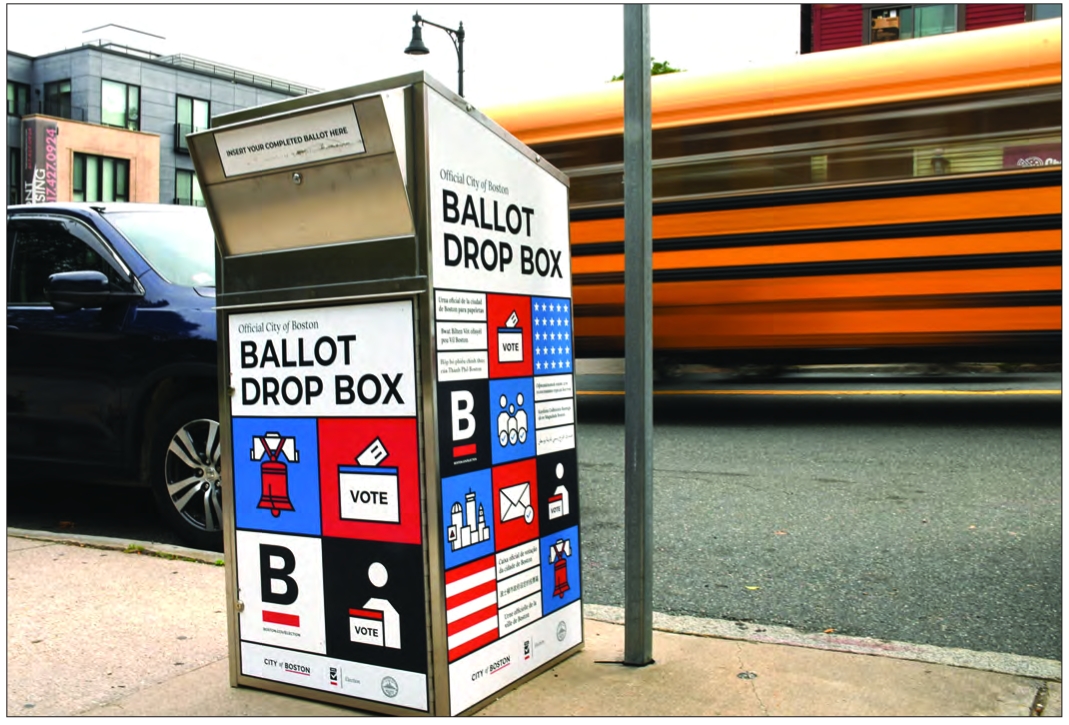
There were a record tying 9 ballot questions for Massachusetts voters to decide on this year.Gov. Maura Healey scored a decisive win in her bid for a second term in the Nov. 3 elections.
Election night also saw voters opt to preserve access to legal recreational cannabis and keep the state’s two-party primary voting system. Voters also rejected a bid to repeal a gun control law amid a slate of nine wide-ranging ballot questions.
“Tonight is a moment of hope and of action. That’s what [Lt. Gov] Kim Driscoll and I are all about and that’s what the next four years are going to be about,” Healey said.
The Massachusetts results came as voters nationwide voted a wave of Democratic senators, representatives and governors into office, flipping the U.S. House of Representatives and Senate to Democratic control in a historic election that was widely seen as a referendum on President Donald Trump and his second-term agenda.
Healey and Driscoll led the Massachusetts ballot, easily winning reelection by an about 27-percentage point margin, according to preliminary results from the Associated Press.
In her election night victory speech, delivered to a crowd in a ballroom at the Fairmont
Copley Plaza Hotel in Back Bay, Healey cast the results as an
opportunity to “meet this moment” amid a wider landscape of uncertainty.
“Here’s
what [this election] means to me: It means that I have an obligation, a
responsibility, to get up every day and drive change with urgency and
action,” Healey said. “I may not get it right every time, you may
disagree with some of the decisions I make — and you should — but I
promise you this, I’m going to work my hardest, every single day, for
the things that matter in your lives.”
Healey
has promised to work on lowering living costs, pointing to existing
efforts by her office to build more housing, lower energy costs by
bringing in new sources and lower health care costs while increasing
access and fostering a stronger economy with new jobs.
Driscoll,
in her speech, called this a “critical moment for our country” and
touted the administration’s investments in housing, infrastructure and
transportation while promising to “keep at it.”
“We’re
going to make government work and we’re going to make life a little
easier for the families who call this state home,” she said.
And in an election season that saw high partisan divides, Healey and Driscoll offered a message of unity.
“At
a moment when fear and division are being weaponized across the
country, Massachusetts must stand for decency, inclusion and hope.”
Driscoll said.
Healey
beat Republican challenger Mike Minogue, securing more than 60% of the
vote. Independent candidate Andrea James came in third place, with about
3% of the vote.
In
his concession speech, Minogue said the results were not what his
campaign hoped or worked for, but that they would continue to push to
improve Massachusetts.
“An
election determines who holds the office, it does not determine what we
believe in, what we stand for and how much we care about the
commonwealth,” he said.
The
midterm election also saw the reelection of Ed Markey, the longtime
senator who was first elected to his seat in 2013. He faced a challenge
from Republican candidate Jon Deaton, whom he beat by about 30 points,
as well as Socialist and Liberation Party candidate Joe Tache and
independent candidate Shiva Ayyadurai, who together scored a total of
just under 5% of the vote.
In his victory speech, Markey, too, offered a message of hope.
“A
new day is rising in America and it’s ours for the taking, if we have
the resolve to seize it. Together we will create a healthier, fairer,
more prosperous and hopefilled future for everyone,” Markey said.
The
remaining top elected state officials — Attorney General Andrea
Campbell, state Auditor Diana DiZoglio, Secretary of the Commonwealth
William Galvin, and Treasurer Deborah Goldberg —kept their seats in
their respective bids for reelection, winning their races by margins
that didn’t drop below 30 percentage points.
Ballot questions
When
Massachusetts voters went to the polls on Nov. 3, they also voted on
nine ballot questions — the largest number in the state’s history — with
topics ranging from the state’s recreational cannabis industry, to
changes to the public records law, to a controversial proposal to
jumpstart construction of new starter homes.
Among those races was an
effort from Virginia-based nonprofit Smart Approaches to Marijuana to
repeal the legalization of recreational cannabis in the state. Question 8
failed by a margin of about 50 percentage points, with voters widely
opting to preserve the state’s cannabis industry.
Nike
John, founder of the Charlestown dispensary the Heritage Club, said the
statewide “no” vote to repeal the law was a relief for her and her
staff.
“It’s a weight
off of like all of my team. … You want to let your employees know they
will have a job,” she said. “There’s so many jobs that were saved by
this not going through.” The state’s Cannabis Control Commission
estimates that nearly 15,000 employees work in the industry in
Massachusetts.
For
John, the vote — and the wide margins carried it — offers a sort of
mandate for the state to continue to support and grow its cannabis
industry. She said she expected the initiative to be rejected but
worried it would be by a smaller amount.
“I
think it actually means that if there’s things that we want to see
change, that there is public support for cannabis,” John said.
Question
3, which asked voters if they wanted to shift the state’s primary
system to an all-party primary, failed by a nearly 30-point margin. Had
it passed, that question would have put all candidates, regardless of
party affiliation, on a single primary ballot; the top two vote-getter
would move onto the general election.
Supporters
of the question said it would increase competitiveness in races by
getting more viable candidates to the general election, which tend to
have a higher turnout. Opponents argued it would give candidates with
the most money the best shot of winning, creating barriers for smaller,
grassroots candidates. In a statement published to its social media
platforms, the Vote Yes on 3 campaign, headed by the Coalition for a
Healthy Democracy, thanked supporters and said they “knew from the start
the race was against the status quo.”
“On this question and others, every voter in
Massachusetts got a real choice and a real contest,” the statement read.
“That’s how every election should feel. We’ll keep working until it
does.”
Another ballot
question that asked voters if they wanted to uphold a 2024 state law
creating new firearm regulations. That law included new restrictions on
assault-style firearms, the creation of a new electronic firearm
registration system, and prohibitions on ghost guns — those without
serial numbers. Voters opted to uphold that law, which is also facing a
legal challenge in the courts, with a twothirds majority.
Voters
also overwhelmingly opted to expand the state’s public records law to
the governor’s office and Legislature, both of which were previously
exempt. The state’s Committee for Public Counsel Services, which
provides representation to people who can’t afford a lawyer, can now
form a union. Voters changed state law to allow voters to register or
update their registration address on the day of an election and
supported the creation of a fund intended to support nature
conservation.
They
also narrowly rejected a proposed change to a state law governing the
cap on taxes that Massachusetts can raise each year. If it had passed,
residents would have been more likely to receive rebates if the cap was
exceeded. It also would have included tax revenue from the so-called
Fair Share Tax, which added a 4% surtax on taxable income exceeding
about $1 million toward the cap; previously, the Legislature
specifically excluded those funds. As of Thursday afternoon, an
initiative to create a statewide zoning rule that would allow
single-family homes on smaller parcels remained too close to call, with
vote tallies leaning toward rejecting the initiative.
In
Massachusetts, the array of Democratic victories was generally
expected. But nationwide, Democrats’ major wins in prominent state and
national elections have been framed by state and local officials as a
rebuke to the Trump administration’s policies and actions.
Notably, Democrats flipped
seven Senate seats, including in Texas, South Carolina and Kansas, which
voted for Trump in the 2024 presidential election. And the Democratic
Party scored wins in gubernatorial elections in 28 races, flipping seats
previously held by Republican governors in five states.
Also,
voters elected a handful of historic candidates, including in Georgia
and New Mexico, where respective, the country’s first Black woman and
first Native American woman will serve as governors. Florida, Wisconsin
and Nevada elected the first Black governors to serve in those states,
while Texas voters elected their first Latina governor. In the U.S.
Senate, the elections yielded the country’s first Muslim senator in
Michigan, the country’s first Native American woman elected senator in
Minnesota and the country’s first openly gay man to serve as senator in
New Hampshire.
Boston
Mayor Michelle Wu, speaking at the victory party for the statewide
Democratic candidates, called the country’s leftward shift “a long time
coming.”
“We’ve held
the line against Washington’s attacks, but with more Democrats in
office, we will do so much more than hold the line. We will move our
country forward, we’ll take on the big fights that matter, and we will
make sure that our communities are powering our future,” Wu said.
In
her own speech Tuesday night, U.S. Rep. Ayanna Pressley said “the
stakes could not be higher” but that the midterms proved what is
possible. Pressley won reelection to her House seat in the
Massachusetts’ 7th District for her fifth, two-year term in an
uncontested race.
With
new majorities in the U.S. House and Senate, Pressley called on
Democratic lawmakers: “Don’t tell me about a majority — show me a
majority.”
“From the
corner of Dorchester Avenue to the halls of Congress, this world does
not belong to small, violent men. It never has and it never will,” she
said. “This nation belongs to the people — the dreamers, the strivers,
the resisters, the persisters.”